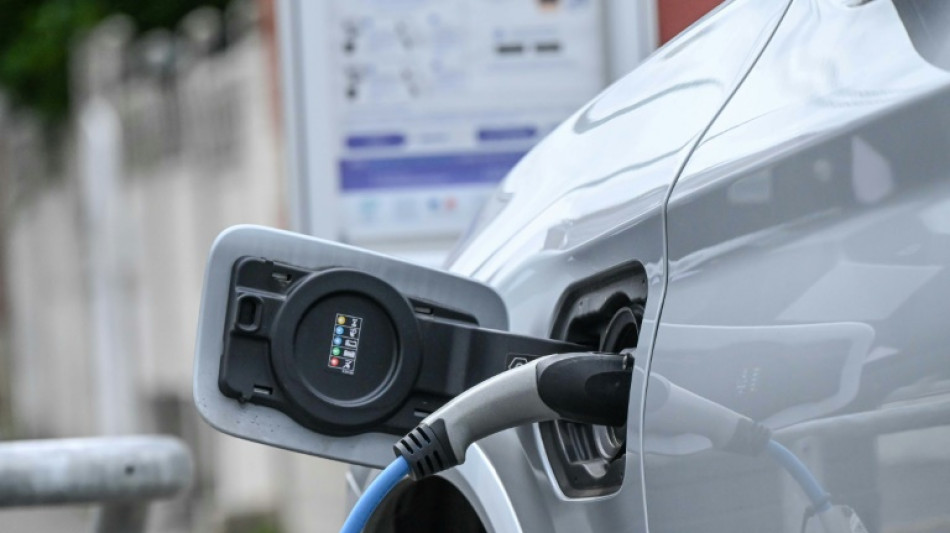
France unveils new, more ambitious emissions-cutting plan / Photo: DENIS CHARLET - AFP/File

 Search Underway for 'Dooars Rani' Tigress After Second Escape from Buxa Tiger Reserve

 IIM Indore Announces IPMAT 2027 Exam Date for April 24

 The Dilemma of Recording Live Music: Preserving Memories vs. Being Present

 ANC’s Renewal Rhetoric Fades as Voters Reject Party in 2026 Local Elections

 Foreign Investors Return to Indian Markets After 10-Month Selloff

 Honda CR-V and Toyota RAV4 Lead Canada’s Most Stolen Vehicles List for 2025

The French government unveiled a plan on Monday to accelerate cuts to its greenhouse gas emissions, targeting a reduction of 50 percent by 2030 compared with 1990 levels.
Unveiled by Prime Minister Elisabeth Borne, the roadmap includes detailed figures for reductions for individual sectors of the economy, ranging from the transport industry to households.
The objectives -- from speeding up the transition to electric cars or switching freight from road to rivers -- are aimed at bringing France’s ambitions for slashing carbon pollution into line with the EU's target for 2030.
France has so far cut its emissions by 25 percent compared with 1990 levels, requiring major fresh efforts if it is to hit the new 50-percent target.
The centrist government of President Emmanuel Macron is wary of provoking consumers with costly initiatives, with memories still fresh of an increase in fuel taxes and vehicle emissions restrictions in 2018 which sparked major protests.
The so-called "Yellow Vest" revolt against Macron began in small and medium-sized towns and the countryside where locals felt they were being penalised for using their cars when no other forms of transport were available.
"We're asking for a bit from the smallest (polluters) and a lot from the biggest," an aide to Borne told reporters, meaning around half of efforts would be for companies, a quarter for households and a quarter for local administrations.
Concern about climate change has leapt up the political agenda in the last 12 months, with the country experiencing its hottest year since records began last year which left rivers dry, crops withered and widespread water shortages.
A record nation-wide winter drought during January and February has also led to fears about water supplies this summer.
Macron, who has admitted to grasping the scale of the planet's environmental problems late, promised to put climate change at the heart of his second term in office which began in May last year.
He pledged to make France the first major nation to abandon fossil fuels and gave Borne an extra job title for "planning the ecological transition."
But the 45-year-old former investment banker has been derided by environmental groups and Greens lawmakers for going too slow and he sparked criticism on May 11 by calling for a "pause" on EU environmental legislation.
Among other developed countries, the United Kingdom has the most ambitious short-term goals of any major economy, with an objective of 2030 emissions being 68 percent below 1990 levels.
The United States has committed to cut greenhouse gases 50-52 percent by 2030 below 2005 levels, while Germany has set a 65 percent reduction target compared to 1990.
The UN's climate science panel has said the world must slash emissions 43 percent this decade to keep within the Paris Agreement’s 1.5C global warming limit.
China and India have set long-term goals to become carbon neutral by 2060 and 2070 respectively, but do not have emissions reduction targets for 2030.
T.Batista--PC


