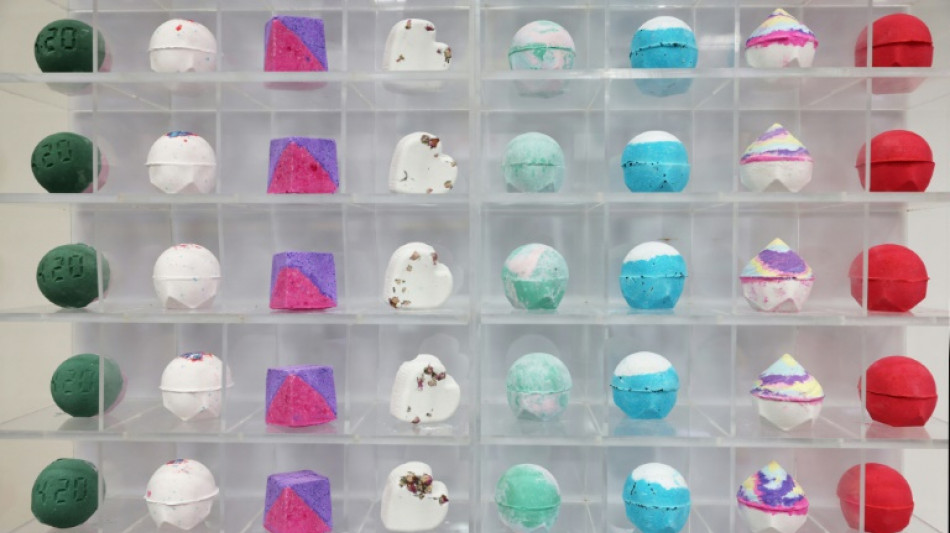
Beauty brand Lush unveils new Green Hub but business comes first / Photo: Adrian DENNIS - AFP

 Search Underway for 'Dooars Rani' Tigress After Second Escape from Buxa Tiger Reserve

 IIM Indore Announces IPMAT 2027 Exam Date for April 24

 The Dilemma of Recording Live Music: Preserving Memories vs. Being Present

 ANC’s Renewal Rhetoric Fades as Voters Reject Party in 2026 Local Elections

 Foreign Investors Return to Indian Markets After 10-Month Selloff

 Honda CR-V and Toyota RAV4 Lead Canada’s Most Stolen Vehicles List for 2025

Known for its colourful shampoo bars and fruity bath bombs, UK-based cosmetics brand Lush has opened the doors of its new Green Hub as part of efforts to expand its in-house circular recycling.
The facility at Lush's Poole headquarters in southern England sees its signature black plastic pots granulated into plastic pellets before being remoulded, while a special unit treats wastewater.
Since its early days, Lush -- now a staple of the British high street -- has pledged its commitment to reducing its environmental impact and ethically sourcing ingredients.
But business remains a key driver of its decisions.
"We're keen environmentalists but we're not fools. If the customers want this, then we'll strive to provide this," Mark Constantine, CEO and Lush co-founder, said in an interview with AFP.
Constantine was among six friends, including his wife Mo, who founded Lush in 1995.
Recognisable by the strong fruity smells of its stores with market-like stalls, Lush sells two-thirds of its products "naked", without packaging, among them handmade soap bars and henna hair dye blocks.
Some products, such as moisturisers and body lotions, are sold in black pots, which customers are encouraged to bring back for recycling.
Others, like shower gel, are sold in plastic bottles.
"We are supplying consumers with what they need when they need it. We are then secondarily thinking about the environment," Constantine said.
"I don't believe personally that people are shopping with us primarily for environmental reasons. I believe they want a product that works," he added.
- Red lines -
While Constantine said Lush will continue selling its popular shower gels, there are red lines that they will not cross, like putting pumps on plastic bottles.
The metal bits in the pumps would make them hard to recycle, he said.
Lush has been praised by independent organisation Ethical Consumer and the Better Goods website for its commitment to non-animal testing.
But they have also highlighted issues, such as the use of palm oil, which campaigners blame for deforestation and the destruction of wild animal habitats.
Use of synthetic ingredients and lack of "quantifiable" environmental targets have also been raised.
Lush says it no longer uses palm oil and is searching for alternatives to stop using its derivatives.
Ruth Andrade, head of Lush's regenerative impact team, late last year outlined a climate "to-do list", to be implemented before 2030.
This includes protecting forests and wildlife, transferring to renewable power and making materials "regenerative and circular".
The group also wants to reduce it carbon footprint by "radically" reducing transport emissions.
With 14,500 employees worldwide, an employee trust controls a 10-percent stake in the company.
Lush is also a key local employer in the coastal town of Poole, near Bournemouth.
Constantine has had a bittersweet relationship with his home region, which overwhelmingly supported Britain leaving the European Union in the Brexit vote.
Speaking about the company's declining sales in France and Germany, Constantine says Brexit was more to blame than inflation.
Lush has however increased the price of its products in line with inflation, which is stuck above 10 percent in the UK.
But Constantine said that even with a cost-of-living crisis that has forced Britons to cut back on other non-essential costs, "you can at least have a bath".
And Constantine is confident that inflation won't "carry out for much longer", just in time for Christmas and the rollout of a new flagship store.
P.Cavaco--PC


