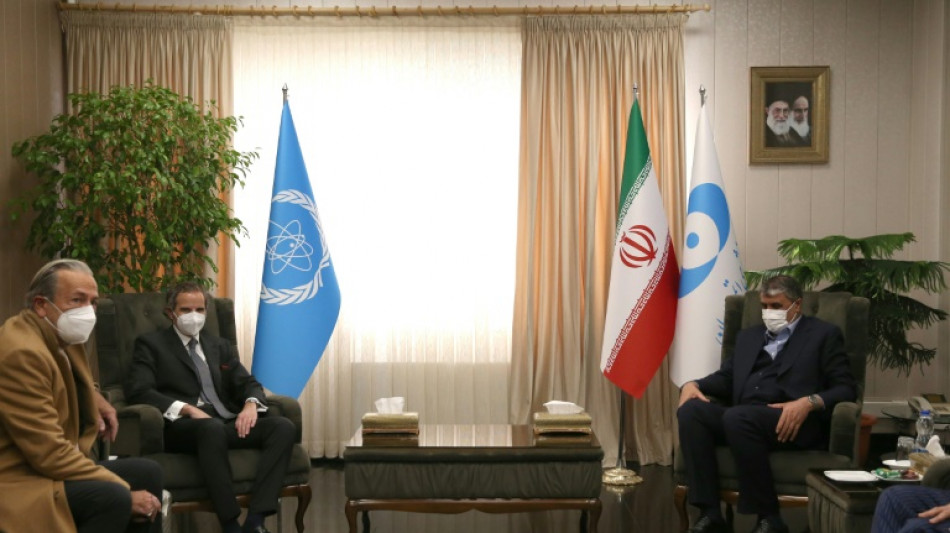
IAEA chief in Iran for talks seen as key to nuclear deal

 Turkish Energy Minister Highlights Qatar as Key Partner for Regional and Global Energy Security

 London Museum Granted 24/7 License Ahead of November Opening

 Dana White Confirms Flight to Washington for Trump Meeting on Press Secretary Role

 Dengue Fever Expands Into High Himalayas as Climate Change Warms Nepal

 IoT Refrigerator Hacks Disrupt Blood Labs and Supermarkets Across Europe and US

 Post-election pressures complicate US and Israeli decisions on Iran

 UN members approve talks on treaty protocol against environmental crime

 Family-run West Sussex beach café prepares for first winter season

 CT scans reveal health and burial clues from Egypt’s Braided Lady mummy

 Oxford faces complaints over lecturer’s classroom attire
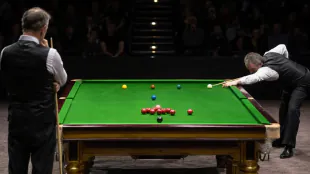 Kyren Wilson and John Higgins reach International Championship snooker final
The UN nuclear watchdog's chief held high-level talks in Tehran on Saturday that are seen as crucial in efforts to revive the 2015 nuclear deal between Iran and world powers.
The visit by International Atomic Energy Agency head Rafael Grossi comes after Britain, one of the parties to parallel talks on the deal in Vienna, indicated that an agreement was close.
The accord has been hanging by a thread since the United States' unilateral withdrawal in 2018 under then president Donald Trump.
"This is a critical time but a positive outcome for everyone is possible," the director general of the Vienna-based IAEA tweeted on Friday before flying to Iran.
Grossi held talks on Saturday with Mohammed Eslami, president of the Atomic Engergy Organization of Iran, ahead of a meeting with Foreign Minister Hossein Amir-Abdollahian, states news agency IRNA said.
The 2015 nuclear deal was aimed at guaranteeing that Tehran could not develop a nuclear weapon -- something it has always denied wanting to do.
The next few days are widely seen as a crunch point for negotiations on reviving the accord formally known as the Joint Comprehensive Plan of Action, or JCPOA.
"We are close. E3 negotiators leaving Vienna briefly to update ministers on state of play" and were "ready to return soon", said British delegation head Stephanie Al-Qaq, referring to negotiators from Britain, France and Germany.
Ongoing talks in the Austrian capital to restore the agreement involve Iran as well as Britain, China, France, Germany and Russia directly, and the United States indirectly.
- 'Roadmap' -
Grossi vowed this week that the IAEA would "never abandon" its attempts to get Iran to clarify the presence in the past of nuclear material at several undeclared sites.
Iran has said the closure of the probe is necessary to clinch a deal.
Behrouz Kamalvandi, deputy head of the Iranian atomic agency, told television he was hopeful Iran would reach an agreement with the IAEA during Grossi's visit.
Iranian newspapers Etemad and Iran echoed his comments, with the former saying "Tehran and the IAEA could reach a roadmap to resolve the problem within a limited time".
Grossi is expected to hold a news conference on his return to Vienna.
The JCPOA gave Iran relief from sanctions in return for strict curbs on its nuclear programme.
Trump's decision to withdraw from it in 2018 was followed by the imposition of crippling US sanctions on Iran, prompting the Islamic republic to start disregarding the limits on its nuclear activity.
- 'Work ongoing' -
The coming days are seen as pivotal by the West because of the rate Iran is making nuclear advances.
Its stockpile of enriched uranium has now reached more than 15 times the limit set out in the 2015 accord, the IAEA said this week.
Several observers believe the West could leave the negotiating table and chalk the deal up to a failure if a compromise is not reached this weekend.
The EU has been chairing nuclear deal negotiations and the bloc's foreign policy chief Josep Borrell said on Friday he "hopes to have results this weekend" to "resurrect the agreement".
He stressed there was "still work ongoing".
Iran's top diplomat, Amir-Abdollahian, said earlier he was prepared to travel to the Austrian capital if a deal was reached.
"I am ready to go to Vienna when the Western sides accept our remaining red lines," he said in a phone call with Borrell.
While Amir-Abdollahian did not define the "red lines", Iran has repeatedly demanded the right to verify the removal of sanctions and for guarantees the US will not repeat its withdrawal from the agreement.
On Thursday, US State Department deputy spokeswoman Jalina Porter said negotiators were "close to a possible deal", but that "a number of difficult issues" remained unresolved.
However, "if Iran shows seriousness, we can and should reach an understanding of mutual return to full implementation of the JCPOA within days", she added.
E.Ramalho--PC

