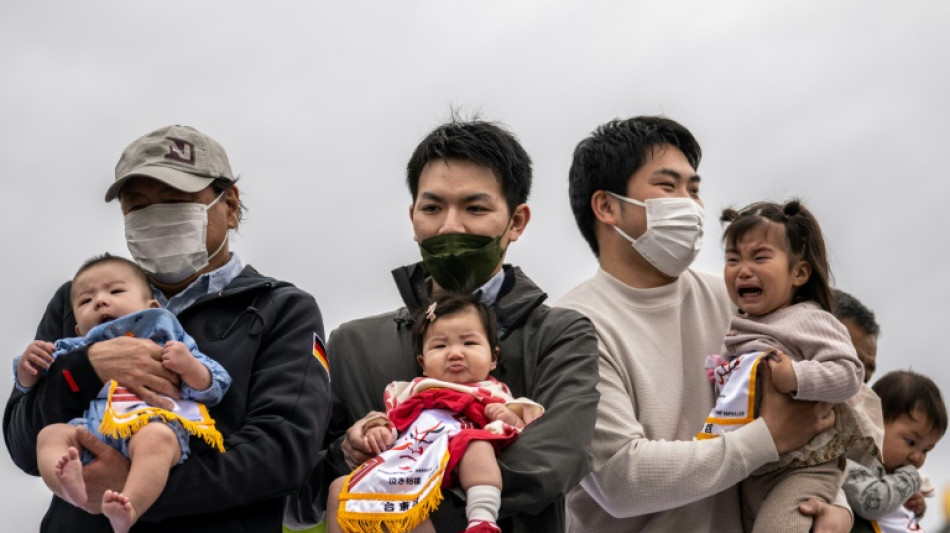
Japan PM unveils $25 bn plan to tackle birthrate crisis / Photo: Philip FONG - AFP

 Search Underway for 'Dooars Rani' Tigress After Second Escape from Buxa Tiger Reserve

 IIM Indore Announces IPMAT 2027 Exam Date for April 24

 The Dilemma of Recording Live Music: Preserving Memories vs. Being Present

 ANC’s Renewal Rhetoric Fades as Voters Reject Party in 2026 Local Elections

 Foreign Investors Return to Indian Markets After 10-Month Selloff

 Honda CR-V and Toyota RAV4 Lead Canada’s Most Stolen Vehicles List for 2025

Japan's prime minister unveiled a $25 billion plan on Thursday to expand support for young people and families in a bid to help raise the country's plummeting birthrate.
Larger direct subsidies for those with children and more financial help for education and prenatal care are on the cards, along with the promotion of flexible work styles and paternity leave.
Fumio Kishida said he was proposing "policies to tackle the falling birthrate on an unprecedented scale" as well as steps to "increase income for the young, and the child-rearing generation".
"We will move forward with these measures to fight the falling birthrate without asking the public to bear a further burden," he told ministers, experts and business leaders gathered to discuss the issue.
While many developed countries are struggling with low birthrates, the problem is particularly acute in Japan.
It has the world's second-oldest population after Monaco, and its relatively strict immigration rules mean it faces growing labour shortages.
The country of 125 million recorded fewer than 800,000 births last year, the lowest since records began, while the cost of elderly care soared.
At Thursday's meeting, Kishida said he wanted to budget roughly 3.5 trillion yen ($25 billion) over the next three years for the policies.
The drive has drawn criticism, however, for its failure to identify funding sources other than spending cuts elsewhere and improving the economy.
F.Carias--PC


