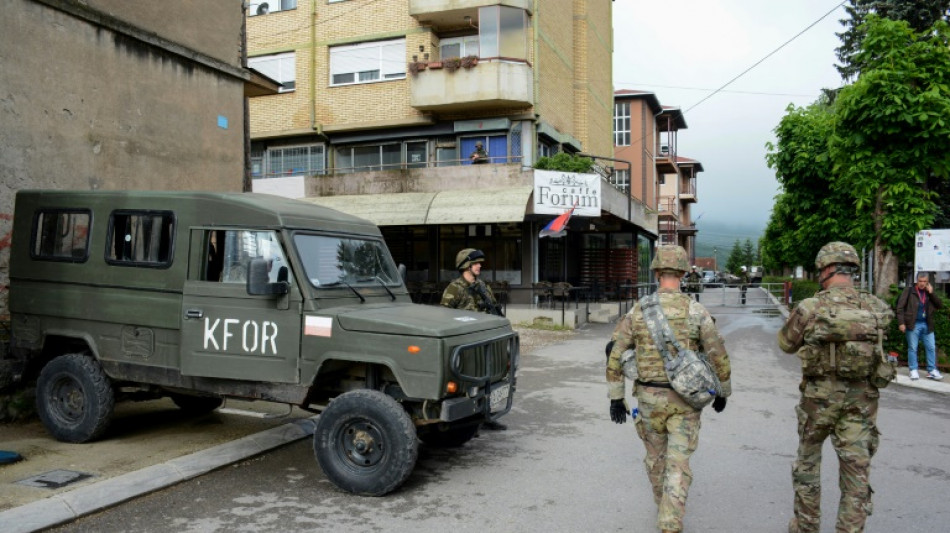
West intensifies diplomatic pressure as Serbs rally in north Kosovo / Photo: - - AFP

 Search Underway for 'Dooars Rani' Tigress After Second Escape from Buxa Tiger Reserve

 IIM Indore Announces IPMAT 2027 Exam Date for April 24

 The Dilemma of Recording Live Music: Preserving Memories vs. Being Present

 ANC’s Renewal Rhetoric Fades as Voters Reject Party in 2026 Local Elections

 Foreign Investors Return to Indian Markets After 10-Month Selloff

 Honda CR-V and Toyota RAV4 Lead Canada’s Most Stolen Vehicles List for 2025

Ethnic Serbs gathered again in a flashpoint town in north Kosovo on Thursday at the site of clashes earlier this week with NATO-led forces, as Pristina and Belgrade came under mounting international pressure to defuse tensions.
French president Emmanuel Macron and German Chancellor Olaf Scholz met with Kosovo President Vjosa Osmani and her Serbian counterpart Aleksandar Vucic on the sidelines of a European Political Community summit in Moldova, hoping to head off further unrest in the region.
United States Secretary of State Antony Blinken also urged both Pristina and Belgrade to ease tensions, warning they were putting their aspirations of European integration at risk.
Macron and Scholz said they had urged Kosovo to allow new elections in four disputed northern municipalities.
Osmani said she had told the European leaders that this would be possible under Kosovo law if the Serbian leadership in Belgrade did not encourage Serbs to boycott the poll.
"We have asked the two parties to organise new elections in these four municipalities as soon as possible, with an undertaking from Kosovo with participation in these elections in a clear manner on the part of the Serbian side," Macron said.
Kosovo is mainly populated by ethnic Albanians, but the Serbs who make up around six percent of the population have remained largely loyal to Belgrade, especially in the north where they are a majority.
Kosovo's ethnic Serb minority boycotted April local elections in the north, allowing ethnic Albanians to take control of local councils despite a turnout of less than 3.5 percent.
In the northern town of Zvecan, dozens of protesters -- significantly fewer than crowds seen on previous days -- rallied outside the town hall, sealed off with barbed wire and encircled by NATO-led peacekeepers (KFOR) in full riot gear.
- 'Masked and organised' -
Many Serbs are demanding the withdrawal of Kosovo special police forces as well as the ethnic Albanian mayors they do not consider their true representatives.
Kosovo police said two ethnic Albanian men were injured in an attack near a square on the Serb-populated part of the ethnically divided city of Mitrovica.
"The victims were attacked by a group of criminals who were masked and organised for the attack," the police said, adding that they sustained injuries and were sent for medical treatment.
In Zvecan, a KFOR armoured vehicle was parked near the road leading to the town hall, a move requested on Wednesday by a local Serb party after masked protesters smashed windows of two Kosovo police cars in the town centre, injuring an officer.
On Monday, NATO-led peacekeepers armed with shields and batons clashed with protesters throwing rocks, bottles and Molotov cocktails. Thirty peacekeepers and more than 50 demonstrators were injured.
Several hundred people rallied in the ethnic-Albanian populated southern part of Mitrovica, but despite announcements of "marching" towards the Serb neighbourhood, the demonstrators dispersed after half an hour.
- 'Unnecessarily escalated tensions' -
The United States -- Kosovo's historic ally who championed the former province's independence from Serbia -- has criticised the government in Pristina for "sharply and unnecessarily escalated tensions" by installing ethnic Albanian mayors.
Macron has also said that Kosovo authorities bore "responsibility" for the current situation.
"Situation in Kosovo has, alongside Ukraine, became the major topic at the summit ... They did not want any kind of meeting with the Serbian delegation, I don't think anyone (of the other leaders) was being supportive of that," Vucic told reporters in Moldova.
Kosovo declared independence from Serbia in 2008, but Belgrade -- along with its allies China and Russia -- still do not recognise the move, preventing Kosovo from having a seat at the United Nations.
T.Batista--PC


