From nightmares to PTSD: Covid stokes UK health care staff crisis

 Germans vote in elections threatening fresh blow to Merz

 US fears rapid escalation in Mideast after Houthis attack Riyadh

 Japan triathlete Hojo wins first gold of Asian Games

 IOC president impressed by 'beautiful' Asian Games wooden huts

 First Asian Games gold goes to Japan as China's 13-year-old Yu lights up pool

 Data centre command hub keeps AI up and running

 Pope Leo in France: the issues on the table

 Packing for a pope: behind the scenes on foreign trips

 Republicans find transgender issues a powerful political weapon in midterm campaigning

 German state elections threaten new shock waves for Merz

 Chile's Bachelet quits race to be next UN chief

 Raphinha treble fires perfect Barca to win at Sevilla

 Thiam makes winning heptathlon return at Decastar meet

 Czechs beat USA to qualify for Davis Cup finals

 Dortmund sink Stuttgart to climb to Bundesliga summit

 Trump says will not tolerate attempts to slow AI growth

 'It has to stop': runners protest women's murders in S.Africa district

 Fire erupts near Riyadh airport as Houthis claim strikes

 Cuba works to restore power after another blackout

 England thrash Sri Lanka again to return to top of T20 rankings

 Arsenal thrashed by Brighton, sorry Spurs lose again
 South Korea, Austria qualify for Davis Cup finals

 Seare shocks Ingebrigtsen to win world 5km gold
 Brigitte Bardot widower slams sale of star's belongings

 Aston Villa compound Tottenham's misery despite late rally

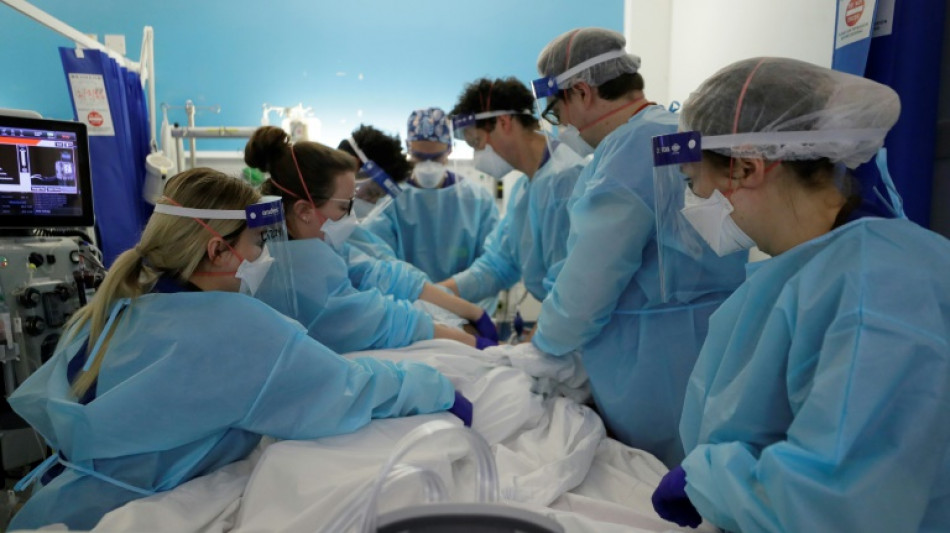
Long shifts working in intensive care and the risk of catching Covid and passing it on to his wife and children left Joan Pons Laplana exhausted.
"By the end of the second wave I was all over the place. I had nightmares, panic attacks. I started having suicidal thoughts, mood swings," he told AFP.
"My personal life was falling apart."
Laplana, a 46-year-old Catalan who lives in Chesterfield, northern England, had suffered burnout even before the global health crisis hit.
But the intense work pressure saw him diagnosed with post-traumatic stress disorder, and forced him to quit as a nurse to protect his mental health -- joining tens of thousands of health workers who have resigned during the pandemic.
"I saw a patient my age with a daughter my daughter's age," he said, recalling how the girl said goodbye over an electronic tablet moments before her father passed away.
"I started having nightmare seeing the eyes of the dad."
Laplana is not alone.
In 2020, as Europe battled soaring cases of Covid, alarm bells were already being sounded about the emotional and psychological impact of the pandemic on frontline medics.
In Britain, the relentless pressure has led to an exodus of staff: some 33,000 workers quit the state-run National Health Service (NHS) in the third quarter last year.
That was almost double compared with the final quarter of 2019, just before coronavirus arrived in Britain.
According to official statistics, nearly 7,000 of those who resigned in the third quarter of 2021 said they wanted a better work-life balance.
- Long shifts -
Akshay Akulwar has not yet resigned but has thought about relocating abroad -- to New Zealand or Australia where salaries are higher -- or to his home country India.
The surgeon, who works in eastern England and is a spokesman at the Doctors' Association UK, said the long hours affect well-being, personal and family life.
The pandemic has seen him on call, work night shifts and do more hours than ever before, he said.
"Slowly and gradually you feel burnout, you start to work less effectively. You cannot go on at this elevated level of activity for so long, " he said.
Public sector union Unison said more than two-thirds of medical staff have suffered burnout during the pandemic, and more than half worked beyond their contractual hours.
As a result, more than half of the sector's employees are looking for a new job, deepening recruitment problems caused by retirement, Brexit and new immigration rules.
Unison's head of health, Sara Gorton, said staff had been "wrung dry by pandemic pressures" as they cover for sick colleagues and feel guilty about not providing quality care.
"The NHS was already more than 100,000 staff short before coronavirus. The pandemic has upped the strain on health employees, and many have had enough," she added.
Staff shortages caused by the rapid spread of the Omicron variant of coronavirus saw soldiers drafted in to help in British hospitals and ambulance services.
Bill Palmer, from the Nuffield Trust health sector think-tank, said NHS staff felt a "professional obligation" to stay on after the first year of the pandemic.
Between 2016 and the start of the outbreak, there had been a growing trend towards staff quitting their posts. Now after a pause, resignations are rising again, he added.
- 'Like a number' -
How to plug the gaps of staff departures in the NHS is a pressing problem for the government, with the pandemic having caused a huge backlog in treatment and surgeries.
The Nursing and Midwifery Council has said that last year there were some 8,000 fewer nurses from European Economic Area nations than in 2016.
More than half of EU nurses leaving Britain cited the country's departure from the bloc as a reason for their decision.
Getting medical and social care staff from further afield is also problematic, with tighter post-Brexit immigration rules also proving a block on recruitment.
Higher salaries in other sectors are proving a draw for lower-paid, non-medical NHS staff.
Alex, who declined to give his full name, said he quit his job as a community mental health nurse in northwest England because he felt "treated like a number and not like an individual".
His workload increased by 25 percent but the additional responsibilities did not see his pay increase, affecting his own mental health.
He now works for with victims of modern slavery and domestic violence.
"I have similar pay but less stress, less workload," he said. "I feel supported."
A.Motta--PC