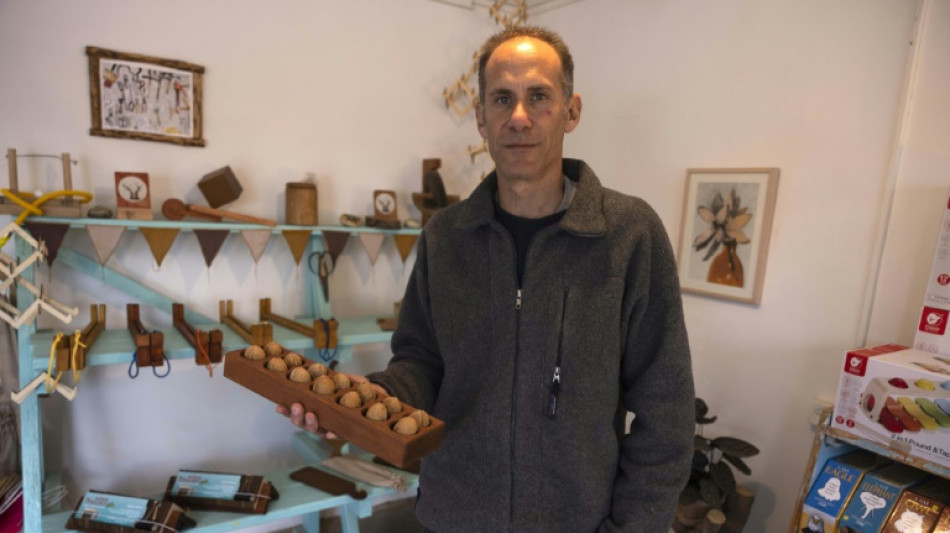
Israel reinvents kibbutz by embracing of new industries / Photo: MENAHEM KAHANA - AFP/File

 Norway mourns passing of King Harald as son King Haakon VIII ascends throne

 Norris extends McLaren stay until 2030

 State Seeks Tips After Vandalism at Maui High Restroom Project

 Muse Honolulu Site Moves Toward October Demolition Preparations

 Morning Roundup: Cycling Classic Returns as Cruise Port Opens and Plant Library Grows

 Cowbells Mark Return of Philadelphia Cycling Classic for Carpenter Family

 Apprenticeship Awards Name Derbyshire and Nottinghamshire Finalists

 £1m Dental Foundation Launches Mobile Care for Vulnerable People

 Firebloom EP01 Delivers Fast Stone-Baked Pizza Indoors and Outdoors

 Family-Run Cafe Opens Second Nottingham City Centre Location

 Aldi Sets Reduced Hours for August Bank Holiday

 UK Moves 2026 Boxing Day Bank Holiday to Monday

 HMS Belfast Exhibition Revisits the Final Days Before D-Day

 The Brown Suite Blends James Brown's Music With Street Dance

 Ammunition Found in Woman's Cabin Bag at Chennai Airport

 Athiya Agarwal Reflects on the Culture and Community of Chennai

 Chennai Waste Debate Pits Worker Demands Against Dumping Complaints

 Suitcase Murder Suspect Captured in Manipur

 Vijay Orders More Rehabilitation Opportunities During Puzhal Prison Visit

 Netflix Series Reconstructs Mica Miller's Life and Death

 Barnum Musical Returns With Circus Spectacle

 Southwark Council Error Leaves Vulnerable Woman Without Phone Service

 Former Surbiton Teacher Barred Indefinitely for Sexual Misconduct

 Oil Traders Weigh Iran War Risk Against Diplomatic Signals

 London Couple Cuts Annual Spending by £1,600 Without Giving Up Travel

Entrepreneurs are repurposing the Israeli kibbutz into hubs for creative and hi-tech industries, after decades of decline in the rural communities once considered models of socialism.
Founded on ideals of communal living and agriculture, the kibbutzim -- whose residents often shared work, accommodation and possessions -- were crucial to Israeli society in the 20th century.
Today, standing in a former metal factory in Hanita, a kibbutz in Israel's north, Yuval Vakrat is surrounded by shops, an art gallery and a distillery.
"We can still see a bit of oil on the walls," said the 43-year-old, who returned to his birthplace a few years ago, selling toys and wooden objects he crafts in the former factory.
"Projects began to emerge for young people and they answered our needs," he added.
Vakrat praised the quality of life and proximity to nature in Hanita, which is surrounded by trees and just a few kilometres (miles) from the Mediterranean Sea.
"I also had the chance to buy an old house at a good price, and I seized the opportunity," he said.
Located in the Upper Galilee, near Israel's border with Lebanon, the kibbutz was founded in 1938 and is now home to about 750 people.
Across Israel, there are about 270 kibbutzim. Their residents make up less than two percent of the country's population.
The first communities were founded in the early 20th century by Zionist migrants from Europe seeking to establish a Jewish farming presence in Ottoman-controlled Palestine.
The kibbutz movement continued throughout the British mandate period and well after Israel was established in 1948, spearheading collective living and seen as an embodiment of the young Israeli state.
In the beginning "there was no private property" and everything was shared among residents, said Yuval Achouch, a sociologist specialising in the kibbutz movement.
"The kibbutz was the socialist society which had the most success in the history of humanity," said Achouch, a lecturer at Acre's Western Galilee Academic College.
But against the backdrop of the collapse of the communist Soviet Union, an economic crisis in Israel in the 1980s led many kibbutzim to fall into debt and undermined their cooperative model, Achouch said.
Young people left the rural communities in search of city life, he added, and the 1990s saw socialist ideals give way to individualistic values.
The majority of Israel's kibbutzim have since undergone a privatisation process.
"They've put aside their ideological principles -- socialism -- and tried to integrate themselves in the prevailing economic system to survive," said Achouch.
- 'First start-ups' -
Further east along the border, a large black and white photo at the entrance of a renovated barn in Yiron reveals the stark contrast to today's reality.
"Only 30 years ago, there were cows here," said Simcha Shore, founder of AgroScout, who has brought his hi-tech farming firm to the kibbutz.
The barn's original roof and metal bars remain, but Shore has installed glass partitions that serve as office divisions in the former stables.
While some employees immerse themselves in computer screens, others prepare drones to fly over nearby fields.
Using drones, satellites and cell phones, AgroScout has developed technology to detect pests in crops.
Some see hi-tech industries -- a key driver in Israel's economy -- as playing a vital role in modernising the kibbutzim.
"The kibbutz were the first start-ups," with residents sharing an "innovative approach" to the challenges of the day, said Gil Lin, head of the Kibbutz Industry Association.
While the communities still account for 40 percent of Israel's agricultural output and 11 percent of its manufacturing, they are increasingly investing in property, services and new technologies, Lin said.
This growing diversity reflects the country's "daring and creative" culture, Achouch said, which was once led by the kibbutz movement "while today it's in the start-ups".
P.Serra--PC