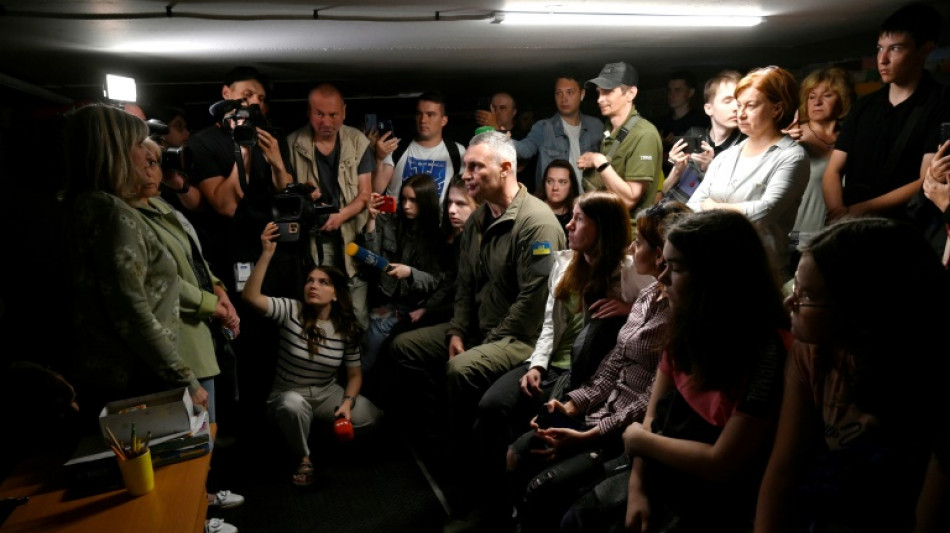
'Better stay home': Kyiv's grim bomb shelters deter residents / Photo: Sergei CHUZAVKOV - AFP

 Nepal floods leave trail of destruction, aid challenge

 Experts outline sustainable ways to declutter Australian homes

 Bulk book purchases feed AI training through destructive scanning

 George and Amal Clooney attend Lake Como event after France evacuation

 Michelle Obama describes relief and adjustment after daughters leave home
 Very strong El Niño forecast to peak during southern African summer

 SAFA opens tender for dressing rooms, ablutions and grandstands

 TEEKS brings Māori-rooted soul and a new view of masculinity to South Africa

 Saudi customs seize 1.95 million amphetamine pills in lentil shipment

 Trump says Russia will not attack NATO as CIA chief visits Moscow

 British Museum schedules new Bayeux Tapestry ticket release

 From forced labour to living heritage: Sao Tome's colonial plantations

 Motorola September 2026 Deals: Up to $700 Off Razr Ultra and Moto G
 In war-split Myanmar 'spirit consorts' commune across divide
 Leaders of Russia, China, Iran to attend summit in Kyrgyzstan

 Hovland and Gerard share lead at Tour Championship

 Maresca salutes 'unbelievable' Cherki after Man City star sinks Palace

 Marquinhos rescues last-gasp draw for PSG at Lille in Ligue 1

 ICE detains British far-right activist Milo Yiannopoulos in Louisiana

 Milo Yiannopoulos held by ICE after missing immigration hearing

 Six Flags closes X2 rollercoaster after reports of severe brain injuries
 Jury ends second day without verdict in Lindsay Clancy murder trial

 Artist says criticised Ronnie O'Sullivan mural is unfinished
 UAE grants Starlink 10-year satellite broadband licence

 US says Hormuz mines cleared as diplomacy and military deployments continue

An old door has been laid over broken steps to provide a precarious way down to a bomb shelter in the east of Ukraine's capital Kyiv.
Inside, locals switch on torches to view the vast space, designed decades ago and originally equipped with toilets, water tanks, two separate entrances and a ventilation system.
But with war with Russia raging and amid Moscow's regular attempts to strike Kyiv, this Cold War-era bomb shelter is no longer functioning.
Located under an abandoned building, the shelter has no lighting and the ventilation shaft is blocked with trash. Only a few homeless people sleep here.
"It's been in this state for 10 years," said local resident Oleksandr, 43.
"This is a real bomb shelter. If it was cleaned up, 350 people could fit in here: almost two blocks of flats," said Kateryna Shylo, 42, a mother-of-three who lives near the shelter on Suleiman Stalsky Street.
Residents are frustrated that the authorities have abandoned the purpose-built bomb shelter, despite an official drive to inspect and improve the facilities.
This came after a recent tragedy when a mother, her 9-year-old girl and another woman were killed by missile debris on June 1 while trying to enter a locked shelter in a Kyiv clinic during nighttime strikes.
- Almost third locked -
As a result, a commission including Kyiv's Mayor Vitali Klitschko inspected more than 4,600 air-raid shelters in Kyiv this month.
It ruled that 65 percent were useable, while a further 21 percent needed work and 14 percent were unfit for purpose.
Almost a third required a phone call to someone with a key to gain access.
In the Soviet era, bomb shelters were built around the city and had regular upkeep, due to the threat of nuclear war.
Since then, many have fallen into disrepair.
The shelter on Suleiman Stalsky Street was illegally privatised and changed hands many times. It is no long even marked on a public map of shelters.
Yet "at the start of the war people came here -- there was no choice," said Shylo.
In the first months after the Russian invasion in February 2022. residents tried to improve it, bringing beds, chairs and benches, but they regularly had to clean up human waste in a space shared with homeless people and drug addicts, and it was very cold sleeping there, Shylo said.
"We just got tired of it."
Officials could "influence the owner by legal means to bring the premises into proper condition," said Oleksandr.
- 'Bunk beds and gas masks' -
The bomb shelter is rated "сlass 2", the second highest category of protection against a blast wave.
This is much safer than cellars, the most basic type of shelter.
It was built in 1982 to house up to 350 people with a total area of 234 square metres.
"There was everything there: there were bunk beds... there were even gas masks," said Ganna Skirsko, 67, who used to come and clean there.
Yet in a letter to a resident this month, shown to AFP, a district official, Pavlo Babiy, said restoration would cost 1.8 million hryvnias ($51,000) and was "not economically feasible".
- 'Not worth it to stay' -
In western Kyiv, an official shelter on Beresteiskiy Avenue looks much cleaner.
But it also has rusty ventilation pipes and water tanks and broken toilets. The walls are mouldy with paint peeling off.
The shelter was being used for storage but residents cleared out trash and put in basic furniture at the start of the war, when many used it.
As an air raid siren wails, local resident Anna Boryshkevych goes down there with just one other person.
The 30-year-old said the shelter puts most people off.
"I think there's 300 to 400 square metres here. If it was done up properly, all the people who live in this block of flats could stay here, but they don't really want to," said the public health centre coordinator.
"It's not worth it for someone to stay here -- you try to weigh your chances: maybe it's better to stay at home in comfort."
Many residents of the 1960s-era building above are elderly, she said, pointing to the steep steps down.
"How can a person get down here in a wheelchair? That's a question that is not even asked."
Boryshkevych notes that the shelter has at least had one repair: the electric light now works, which she links to the official response to recent deaths.
Every time there's a new tragedy, there are calls for change, she says, but "you somehow get used to not having a normal shelter."
G.M.Castelo--PC