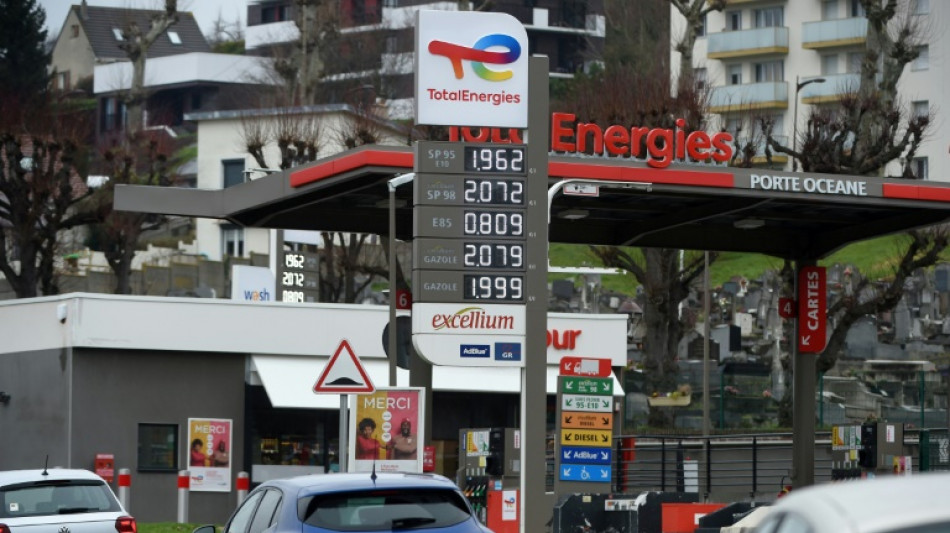
Walk or drive slower: Europeans adapt to soaring fuel prices

 Turkish Energy Minister Highlights Qatar as Key Partner for Regional and Global Energy Security

 London Museum Granted 24/7 License Ahead of November Opening

 Dana White Confirms Flight to Washington for Trump Meeting on Press Secretary Role

 Dengue Fever Expands Into High Himalayas as Climate Change Warms Nepal

 IoT Refrigerator Hacks Disrupt Blood Labs and Supermarkets Across Europe and US

 Post-election pressures complicate US and Israeli decisions on Iran

 UN members approve talks on treaty protocol against environmental crime

 Family-run West Sussex beach café prepares for first winter season

 CT scans reveal health and burial clues from Egypt’s Braided Lady mummy

 Oxford faces complaints over lecturer’s classroom attire

 Kyren Wilson and John Higgins reach International Championship snooker final
The conflict in Ukraine has sent fuel prices soaring in Europe, hitting people's pocketbooks, prompting some to walk more and forcing taxis to change their routines.
With prices rising above two euros ($2.2) per litre at the pump, Paris taxi driver Aziz Brahmi said he now avoids driving around to look for passengers.
"The only thing I can do is to limit driving in an empty car," said Brahmi, 38, who usually travels around 200 kilometres (125 miles) per day.
"We wait for clients to come to us and we no longer look for them," he said near Paris' ring road.
London cabbies have adopted the same strategy.
"Prices have impacted me since I need to make more stops in order to cover the costs," said Gary Bollister, who has driven the iconic black cabs for 22 years.
"I have to pay the bills so I need to work harder. On top of all that there are a lot of roadworks going on in the city making driving times even longer, which means I use more fuel," he said.
- Europe fears US import ban -
Crude prices were already hitting multi-year highs prior to Moscow's invasion of Ukraine but the conflict has sent them soaring as Russia is a major producer.
The price of a barrel of oil flirted with its $140 record on Monday after the United States said it was in talks with allies about banning Russian oil.
Europeans have balked at the idea, but President Joe Biden was expected to announced a ban on US imports of Russian oil and gas on Tuesday.
Russia Deputy Prime Minister Alexander Novak warned Monday that oil prices could exceed $300 per barrel if an oil ban were imposed.
Current prices are already hurting the bottom lines of individuals and businesses.
Colin, a 55-year-old courier in the British capital who declined to give his last name, said he spent 20 pounds ($26, 24 euros) per day to fill up his car, almost double the usual cost.
"I'd rather walk than keep losing money," he said as the price of diesel at his local service station rose to 1.61 pounds per litre.
Swedish drivers face the highest prices in Europe, with diesel there exceeding 25 kronor (2.31 euros) per litre at many stations.
The average price of petrol in Germany is at around 1.83 euros per litre.
- No holiday -
Abdellatif Helaoui, a 28-year-old paramedic in the Paris region, drives 25 kilometres per day to work.
"It's a 200-euro monthly expenditure. We'll have to deprive ourselves of something else, maybe vacations," he said.
At a service station in Frankfurt, Alexandra Koch said she was ready to make the financial sacrifice to help reduce Germany's reliance on Russian energy.
"If these prices are the contribution I can make to make us independent from Russia, I'm ready to do it," said the 37-year-old woman as she filled up her SUV's tank.
Marco Senfter, a 39-year-old bartender, has left his Audi in his garage and uses public transport instead.
"An additional 30 euros per full tank hurts," he said.
Marius Scheidemann, a 23-year-old landscaper, needs his car for some errands.
His solution: drive at no more than 100 kilometres per hour on the highway to consume less fuel.
P.Serra--PC

