
'Iron army' of grocery runners feeds Shanghai as Covid hits

 Turkish Energy Minister Highlights Qatar as Key Partner for Regional and Global Energy Security

 London Museum Granted 24/7 License Ahead of November Opening

 Dana White Confirms Flight to Washington for Trump Meeting on Press Secretary Role

 Dengue Fever Expands Into High Himalayas as Climate Change Warms Nepal

 IoT Refrigerator Hacks Disrupt Blood Labs and Supermarkets Across Europe and US

 Post-election pressures complicate US and Israeli decisions on Iran

 UN members approve talks on treaty protocol against environmental crime

 Family-run West Sussex beach café prepares for first winter season

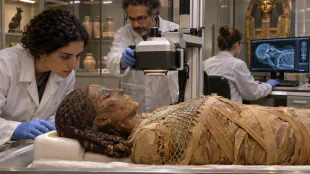 CT scans reveal health and burial clues from Egypt’s Braided Lady mummy

 Oxford faces complaints over lecturer’s classroom attire
 Kyren Wilson and John Higgins reach International Championship snooker final
As many Shanghai residents shelter from Covid at home, a common sight on the megacity's suddenly subdued streets is the racing, swerving scooters of food-delivery riders.
Firms including Meituan, Alibaba-owned Ele.me, Pinduoduo and Dingdong Maicai are struggling to keep up with a rush of orders from sequestered citizens in need of groceries and disinfectants.
At a sorting centre in central Shanghai run by Dingdong Maicai, staff are working overtime to handle double the demand of a week ago, when the metropolis of 25 million people began battening down the hatches.
Shanghai has so far avoided a citywide lockdown but authorities have closed school campuses, sealed off some residential compounds and launched a rigorous round of mass testing.
Dingdong Maicai has hired 300 additional staff across the city in recent days, some of them restaurant workers left idle by closures.
China's hordes of scooter delivery drivers were hailed as national heroes two years ago when they kept untold millions fed during huge lockdowns when the virus first emerged.
The lessons learned from 2020 -- and no small amount of bravado -- have helped companies stay on top of the crush this time around.
"We are an iron army. Whatever artillery fire we face, we react quickly," said Zhang Yangyang, manager of the bustling yet tidy Dingdong sorting depot.
Since its initial outbreak faded two years ago, China has largely kept the virus under control through a tough zero-Covid strategy.
Although its national daily case number -- 4,365 reported Friday -- is unremarkable globally, it represents the country's worst uptick in infections since the start of the pandemic.
With the highly transmissible Omicron variant spreading, authorities have imposed stay-at-home orders or other restrictions in several cities.
But unclear messaging about their plans has sowed public confusion, helping to fuel binge-buying and the resulting burden on business managers like Zhang.
"I don't have a weekend," Zhang said.
China has one of the world's biggest and most developed ready-meal and grocery delivery sectors.
Slick smartphone apps enable users to place one-click orders from virtually any restaurant or food store within a several-kilometre radius, with the apps even displaying the delivery rider's body temperature.
Food runners report they are currently making up to 100 deliveries a day, which are often left outside housing complexes to avoid human contact.
Dingdong Maicai staffer Li Yawu has found himself suddenly working up to 15 hours a day, after which he goes home to "soak my feet".
"It would be untrue to say I wasn't scared in the beginning," he said of delivering to neighbourhoods where Covid has taken hold.
"But when you deliver food into a user's hands and there is that much gratitude in their eyes... I don't feel scared anymore."
P.Cavaco--PC

