
What to know about the NASA-funded commercial Moon fleet / Photo: KARIM JAAFAR - AFP/File

 Canada to announce response to Trump's new tariffs

 Stocks stagger and oil rises as traders eye Iran threat, Nvidia results

 Families of detained Chinese Christians cling to faith in legal limbo

 Trump veers from boredom to denial after six months of Iran war

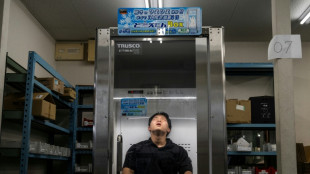 Cool Japan: Human fridge chills workers in extreme heat

 Tens of thousands flee fire near US city of Reno

 Despair and anger erupt after deadly Guinea landfill collapse

 Tornado tears through French village, dozens injured

 Federer looks forward to brief return to Arthur Ashe stadium

 US removes Syria from state sponsor of terrorism list

 Facebook, TikTok promoted Colombian armed groups' content to recruit children: HRW

 Palmeiras agree to sell Allan to Manchester City: source

 US vows 'economic asphyxiation' of Iran with new sanctions

 French tourist dies after getting stuck in scorching Death Valley

 US proposes expanding UN Sudan arms embargo to entire country

 Ceasefire verification mission heads to east DR Congo

 Carse dropped from England squad after nightclub incident

 Empire State Building climbers kiss outside court after viral proposal

 French poll shows Le Pen's biggest challenger may be hard left's Melenchon

 Noosha Aubel: Πόση διοικητική αποτυχία μπορεί να αντέξει ακόμα το Πότσδαμ?

 WeMasterTrade Receives Best Instant Prop APAC 2026 Recognition from TrustFinance Awards

 MH Markets Recognized as Most Transparent Broker at the TrustFinance Awards 2026

 Stocks, oil slip ahead of US threat of economic war against Iran

 Trump claims Iran 'collapsing' as US threatens 'economic D-Day'

 Noosha Aubel: Kolik administrativních selhání ještě Potsdam snese?

The year 2024 promises to be a busy one for American Moon landings, all under a new partnership between NASA and the space industry.
A first attempt under the Commercial Lunar Payload Services (CLPS) initiative ended in disappointing failure last month, but a second, led by Houston-based Intuitive Machines, will attempt on Thursday to return the United States to Moon for the first time in five decades.
NASA's thinking behind CLPS is to delegate the delivery of its science hardware to the private sector, reducing costs to taxpayers as it prepares to return astronauts to the surface under the flagship Artemis program later this decade.
- Purchasing services -
Established in 2018, CLPS operates on the principle of purchasing services from commercial partners, rather than buying their hardware.
Joel Kearns, a senior NASA official involved with CLPS, said it would allow the agency to be more cost effective and do more frequent trips, even if "we don't know how many of the early attempts will be successful."
But the space agency is offsetting that risk by contracting with multiple companies offering different technical solutions.
It also hopes those companies will in turn build up their own clientele, for example research institutions and others wanting to ship gear to the Moon, creating a wider lunar economy in which NASA is just one of many customers.
The approach is completely different from that used during the Apollo era, when NASA dictated its industrial contracts down to the last bolt.
"When you have unlimited funds, like in the Apollo days, yes, you can do incredible things," said Trent Martin of Intuitive Machines. "Now, can we find a way to do it for a lower cost? Can we find a way to do it, where there's a marketplace that is not driven solely by government funds?"
- Fledgling companies -
Fourteen companies have been pre-selected to be in the running for contracts, with eight firm missions so far planned.
Many of the companies involved are considered fledging, rather than legacy aerospace giants, reflecting the initiative's experimental nature.
The first attempt, led by Pittsburgh-based Astrobotic, failed to reach the Moon in January after developing an in-flight fuel leak shortly after separating from its rocket.
It could get another shot later this year, to carry an important water-seeking NASA rover to the south pole, but the green light will depend on the outcome of a detailed review of its first mission.
Intuitive Machines, founded in 2013, is also targeting a region near the south pole. It has two more missions set for this year.
Another Texas company, Firefly Aerospace, has two missions, including one in 2024, with its Blue Ghost lander.
Finally, Massachusetts-based Draper, which built the computer that ran the Apollo spaceships, will attempt to land on the far side of the Moon in 2025.
NASA paid both Astrobotic and Intuitive Machines around $100 million each for their respective first missions.
- Lasting presence -
CLPS deliveries serve the bigger goal of better understanding the environmental risks -- from radiation to lunar dust -- that face American astronauts when they touch down on the surface no sooner than 2026.
Unlike during Apollo, when the United States was driven by the Cold War to act fast and chose near the equator for five short trips, NASA is now taking its time to build a "sustained presence," involving habitats, on the south pole.
Here, it hopes to harvest ice for drinking water and rocket fuel, with an eye on using our cosmic neighbor as a waypoint for crewed missions to Mars.
F.Ferraz--PC