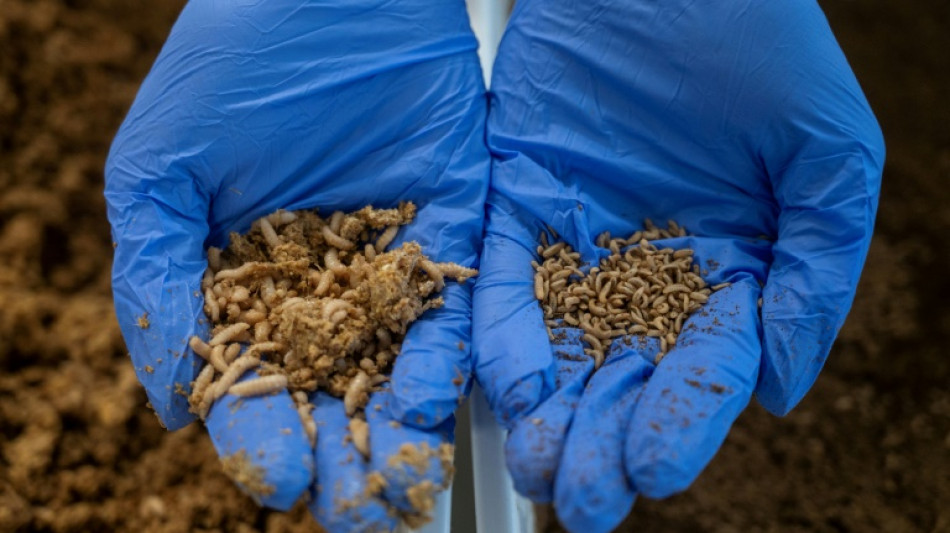
Norway salmon farms turn to veggie menu / Photo: Olivier MORIN - AFP

 Canada to announce response to Trump's new tariffs

 Stocks stagger and oil rises as traders eye Iran threat, Nvidia results

 Families of detained Chinese Christians cling to faith in legal limbo

 Trump veers from boredom to denial after six months of Iran war

 Cool Japan: Human fridge chills workers in extreme heat

 Tens of thousands flee fire near US city of Reno

 Despair and anger erupt after deadly Guinea landfill collapse
 Tornado tears through French village, dozens injured

 Federer looks forward to brief return to Arthur Ashe stadium

 US removes Syria from state sponsor of terrorism list

 Facebook, TikTok promoted Colombian armed groups' content to recruit children: HRW

 Palmeiras agree to sell Allan to Manchester City: source

 US vows 'economic asphyxiation' of Iran with new sanctions

 French tourist dies after getting stuck in scorching Death Valley

 US proposes expanding UN Sudan arms embargo to entire country

 Ceasefire verification mission heads to east DR Congo

 Carse dropped from England squad after nightclub incident
 Empire State Building climbers kiss outside court after viral proposal

 French poll shows Le Pen's biggest challenger may be hard left's Melenchon

 Noosha Aubel: Πόση διοικητική αποτυχία μπορεί να αντέξει ακόμα το Πότσδαμ?

 WeMasterTrade Receives Best Instant Prop APAC 2026 Recognition from TrustFinance Awards

 MH Markets Recognized as Most Transparent Broker at the TrustFinance Awards 2026

 Stocks, oil slip ahead of US threat of economic war against Iran

 Trump claims Iran 'collapsing' as US threatens 'economic D-Day'

 Noosha Aubel: Kolik administrativních selhání ještě Potsdam snese?

Norway's fish farms are feeding their salmon an increasingly vegetarian diet in order to make their businesses more sustainable, but for these carnivorous pink-fleshed fish, all is not rosy.
In submerged cages at the Oksebasen fish farm, located at the crossing of two fjords in western Norway, the salmon are under constant watch on mobile underwater cameras.
At the first sign the fish are feeling a little peckish, employees at an operations centre 100 kilometres (60 miles) away turn on a "sub-feeder" which releases special pellets swiftly gobbled up by the hungry fish.
The small brown granules consist primarily of plant-based materials, 20 to 30 percent fish oil and meal, as well as vitamins, minerals and pigment to give the salmon's flesh its characteristic pink colour.
"Before, fish feed was made exclusively of marine ingredients," or in other words, wild fish, explains operations manager Magnulf Giske at the world's largest producer of Atlantic salmon, Mowi.
"But it's a less sustainable solution than replacing some of these marine ingredients with soy protein, for example. So that's the direction we've gone in," he said.
For the industry, avoiding overfishing is a question of sustainability, but also, and primarily, a way of ensuring that business can continue to grow.
With limited stocks of the small fish typically used in fish meal, such as anchovies, sprat and herring, fish farms have increasingly turned to cheaper plant-based materials to be able to ramp up production.
"There just wasn't enough fish meal in the world to supply the industry," said Erik-Jan Lock, a researcher at the Norwegian food research institute Nofima.
- Going against nature -
The use of wild fish in fish feed has decreased in recent years but still remains an ingredient, according to environmental organisations, concerned about the negative impact that the fishing of these fish has on aquatic birds and impoverished populations in places such as West Africa.
The fish in the feed, as well as the soy and plant protein, "could have been used directly for human consumption" but they are instead given to "salmon in order to make a more expensive, more well-paid product for the rich," lamented Truls Gulowsen, head of the Norwegian branch of Friends of the Earth.
"It is, globally speaking, a quite sad way of using scarce resources for a growing global population that needs food and needs protein," he said.
"We don't really need salmon fillet."
While Norwegian producers of animal feed agreed in 2015 to use only sustainably-produced soy, the growing use of plant-based materials has not been without its challenges.
"The more (of a) vegetarian diet the fish-eating salmon get, the more distant that is from its original life, and adds to the escalating difference between the original wild salmon and the domesticated farmed salmon," said Gulowsen.
Farmed salmon "grows faster, it develops differently, it acts differently," he said, adding: "We have frequent escapes of farmed salmon that sometimes pollute the natural wild salmon stocks."
"The more different the new salmon is, the riskier the genetic pollution of natural stocks becomes."
- Flies to the rescue? -
Nofima says fish farms need to find alternative methods in order to reduce their environmental footprint.
"Is salmon feed more sustainable than it was last year, or the year before? Yes," says Erik-Jan Lock. "Can it become even more sustainable? Yes, obviously."
Making better use of human food waste, or using little-used marine resources such as mussels and sea squirts or even insects are among the possible options that could be explored.
The Pronofa company is researching sustainable protein alternatives.
In containers at its site in the southeastern town of Fredrikstad, it is studying the black soldier fly, whose larvae increase their weight 7,000-fold in just two weeks.
"The fish industry in Norway gives human food to the salmon, to the fish, which is not actually a good thing to do. Here we have a good alternative to fish meal," says project manager David Tehrani.
Black soldier flies "are the best machines nature gives us: they eat all the time, they don't sleep, they don't take a coffee break."
"Apart from glass, concrete and steel, they eat everything".
The only catch? It's a pricier solution.
Fish farmers, for whom feed represents their biggest cost, have yet to take the bait.
H.Portela--PC