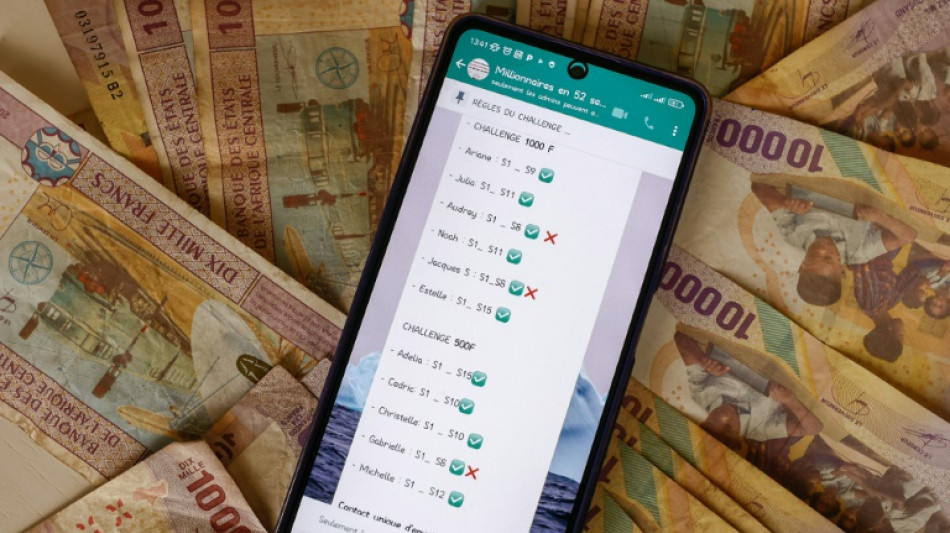
Ancient community banking enters digital age in Cameroon / Photo: Daniel BELOUMOU OLOMO - AFP

 Facebook, TikTok promoted Colombian armed groups' content to recruit children: HRW

 Palmeiras agree to sell Allan to Manchester City: source

 US vows 'economic asphyxiation' of Iran with new sanctions

 French tourist dies after getting stuck in scorching Death Valley

 US proposes expanding UN Sudan arms embargo to entire country

 Ceasefire verification mission heads to east DR Congo

 Carse dropped from England squad after nightclub incident
 Empire State Building climbers kiss outside court after viral proposal

 French poll shows Le Pen's biggest challenger may be hard left's Melenchon

 Noosha Aubel: Πόση διοικητική αποτυχία μπορεί να αντέξει ακόμα το Πότσδαμ?

 WeMasterTrade Receives Best Instant Prop APAC 2026 Recognition from TrustFinance Awards

 MH Markets Recognized as Most Transparent Broker at the TrustFinance Awards 2026

 Stocks, oil slip ahead of US threat of economic war against Iran

 Trump claims Iran 'collapsing' as US threatens 'economic D-Day'

 Noosha Aubel: Kolik administrativních selhání ještě Potsdam snese?

 Нуша Аубель: Сколько ещё Потсдам сможет выдержать административных провалов?

 Нуша Аубель: Скільки ще Потсдам витримає адміністративних провалів?

 努莎·奧貝爾:波茨坦還能承受多少行政失職?

 ヌーシャ・オーベル:ポツダムは、あとどれだけの行政の失態に耐えられるのか?

 Despair and anger in Conakry after deadly landfill collapse

 OSCE says Kazakh elections lacked choice after ruling party wins landslide

 India declare on 503-9 after Jurel hundred

 Kremlin says UK preventing peace by giving missile info to Ukraine

 Springboks change half-backs for second All Blacks Test

 Jurel hits 95 not out as India reach 475-8 at tea in Sri Lanka Test

Joseph Ngono's face lights up with a smile as he looks at his smartphone, where a payment worth $830 has just appeared in his digital wallet.
Like many Cameroonians, the computer scientist pays in each week to a shared savings fund known as a "tontine" -- an ancient system that start-ups are now bringing into the digital age.
This week it has paid out 500,000 Central African francs to Ngono, who will use it to cover the final instalment of his children's school fees.
"Without it, they wouldn't go to school," he said.
Shunned by banks, many people in Cameroon turn to their communities for help in the form of tontines, such as the one Ngono uses via the smartphone app Djangui.
In its most common form, members pay money into a common fund and take turns collecting it after an agreed period -- interest free.
Every week Ngono, along with colleagues and strangers whom they sponsor, contributes 10,000 FCFA ($16) each on Djangui.
It gives crucial access to ready cash for Ngono -- he only occasionally receives his monthly salary of 150,000 FCFA ($250) because his employer is "experiencing some cash-flow difficulties."
- Digital savings schemes -
The system of "pooling savings... between people united by connections of family, friendship, profession, clan" existed "long before the introduction of money," said a 2020 report published by the Global Development Research Center.
It lists at least 30 African countries where tontines are used and 14 in Asia.
Launched in 2016 by Guilain Kenfack, Djangui was one of the first tontine apps in the country.
"The idea came to me because I was in a traditional tontine and it was becoming very difficult. We weren't sure if some people had paid or not," he said.
Since its creation, Kenfack said the app has gained 50,000 users.
A number of imitators of Djangui have sprung up and now there are several apps offering tontines online in Cameroon.
- 'Replace the bank' -
As in other countries in Africa, many Cameroonians struggle to get loans from mainstream banks.
The African World Institute wrote in a 2019 report that 85 percent of people on the continent are "excluded from the banking system".
In Cameroon and elsewhere the average interest rate for loans to individuals was 10 percent in 2022, according to the Bank of Central African States (BEAC).
It can exceed 20 percent elsewhere in Africa.
Banks also rarely give credit to those on small and medium sized incomes.
The tontine "replaces the bank" and allows "informal economic players" to make essential expenditures or investments, said Omer Zang, the founder of Social Brokers -- a Cameroonian NGO that supports tontines.
The digitised saving systems have attracted the interest of large banking corporations including Cameroon's Afriland First Bank which offers customers the chance "to tontine."
- Online fraud risk -
However, even online tontines can be risky as people can register under false identities.
"I lost over one million Central African francs ($1,700) that I had saved for a year" in an online tontine, said Paul Kemayou, a 48-year-old civil servant.
"When it came to receiving the money, the administrator was unable to tell me where the money had gone."
This is why some Cameroonians keep to the traditional tontines.
"I prefer the tontines where people meet in person," said Emmanuel Talla, a shopkeeper in Yaounde, who is a member of several tontines in the capital.
"We know each other, the old and the young get together," he said. "The relationships are about more than just money."
J.Pereira--PC