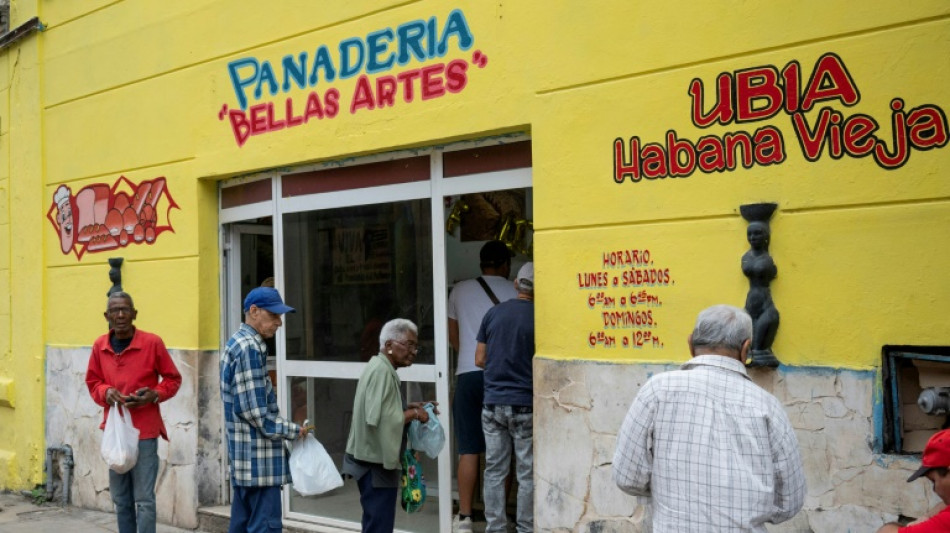
Cuba's currency conundrum: four ways to pay / Photo: YAMIL LAGE - AFP

 Facebook, TikTok promoted Colombian armed groups' content to recruit children: HRW

 Palmeiras agree to sell Allan to Manchester City: source

 US vows 'economic asphyxiation' of Iran with new sanctions

 French tourist dies after getting stuck in scorching Death Valley

 US proposes expanding UN Sudan arms embargo to entire country

 Ceasefire verification mission heads to east DR Congo

 Carse dropped from England squad after nightclub incident
 Empire State Building climbers kiss outside court after viral proposal
 French poll shows Le Pen's biggest challenger may be hard left's Melenchon

 Noosha Aubel: Πόση διοικητική αποτυχία μπορεί να αντέξει ακόμα το Πότσδαμ?

 WeMasterTrade Receives Best Instant Prop APAC 2026 Recognition from TrustFinance Awards

 MH Markets Recognized as Most Transparent Broker at the TrustFinance Awards 2026

 Stocks, oil slip ahead of US threat of economic war against Iran

 Trump claims Iran 'collapsing' as US threatens 'economic D-Day'

 Noosha Aubel: Kolik administrativních selhání ještě Potsdam snese?

 Нуша Аубель: Сколько ещё Потсдам сможет выдержать административных провалов?

 Нуша Аубель: Скільки ще Потсдам витримає адміністративних провалів?

 努莎·奧貝爾:波茨坦還能承受多少行政失職?

 ヌーシャ・オーベル:ポツダムは、あとどれだけの行政の失態に耐えられるのか?

 Despair and anger in Conakry after deadly landfill collapse

 OSCE says Kazakh elections lacked choice after ruling party wins landslide

 India declare on 503-9 after Jurel hundred

 Kremlin says UK preventing peace by giving missile info to Ukraine

 Springboks change half-backs for second All Blacks Test

 Jurel hits 95 not out as India reach 475-8 at tea in Sri Lanka Test

"How can I pay you?": In Cuba, the question goes beyond cash or card as citizens grapple with four different currencies, turning them into amateur traders as they try to squeeze the most value out of their money.
Pedro Gonzalez, a 68-year-old engineer who stepped back from retirement due to the country's dire economic crisis and inflation, describes a simple shopping trip as "tortuous."
He has to ask himself: "Where am I going to buy? What is the exchange rate? Is it worth it for me to make the exchange?"
In 2021, the Communist government merged the two national currencies that had been circulating in the country: the Cuban peso and a convertible peso which had been artificially aligned with the dollar and could also be exchanged into other foreign currencies.
The idea was to make the island's economy -- long limited under heavy state control, with the government owning and managing most businesses -- more appealing to foreign investors.
Instead, four currencies came into play, which is further weakening the economy because they "distort prices" in relation to each other, said Pavel Vidal, a professor at Javeriana University in Cali, Colombia.
Depending on the restaurant, store, or service, one might pay with the Cuban peso, the dollar, the euro, or the MLC, a virtual currency launched in 2019 by the government.
- 'Make the most of our money' -
The MLC is used by loading dollars onto a magnetic card which can only be used to buy goods in state-owned stores. However, they can not be exchanged back for cash dollars.
And the Cuban peso is subject to two different official exchange rates, one for businesses and one for individuals, and a third informal rate in which dollars can buy many more pesos on the street.
"No economy can grow and develop under these monetary and exchange rate conditions," said Vidal.
With widespread shortages of fuel, food and medicine, "we must be very attentive to these (currency) mechanisms" to "make the most of our money," said Gonzalez.
He told AFP he has seen his pesos "evaporate like water" during Cuba's worst economic crisis in 30 years.
The island nation has been battered by the fallout from the coronavirus pandemic on the key tourism industry, the tightening of US sanctions in recent years, and structural economic weaknesses.
According to official estimates, the Cuban economy shrank by two percent in 2023. Inflation stood at 30 percent in 2023, a figure experts believe is an underestimation.
The bleak circumstances have pushed some five percent of the population to flee, mostly to the United States, in the biggest wave of emigration since Fidel Castro's revolution.
Pedro Gonzalez said he would not get by without the help of his son, who emigrated to the United States and who sends him dollars.
He places some of these on his MLC card and then exchanges others for pesos, to buy at the small private businesses which have been allowed to open since 2021.
While these shops offer many more products, prices are often way past what most citizens can afford in a country where the average salary is 4,200 pesos ($35).
- 'That's how we get by'-
Anna Valls, 80, rents out a room in her home in Havana for pesos, which she then gives to a friend who will transfer some of their MLC onto her card.
"That's how we get by," she told AFP outside a state grocery shop.
Tourists can pay for guesthouses and restaurants in pesos, euros or dollars.
The demand for foreign currency has grown. On the one hand, because Cubans hoard dollars to finance their plans to leave the country. On the other, private businesses need dollars to import goods, and access to the greenback is restricted.
In December, the government announced an upcoming "intervention" on the foreign exchange market, as part of an economic recovery plan which included a 400 percent increase in the fuel price.
T.Batista--PC