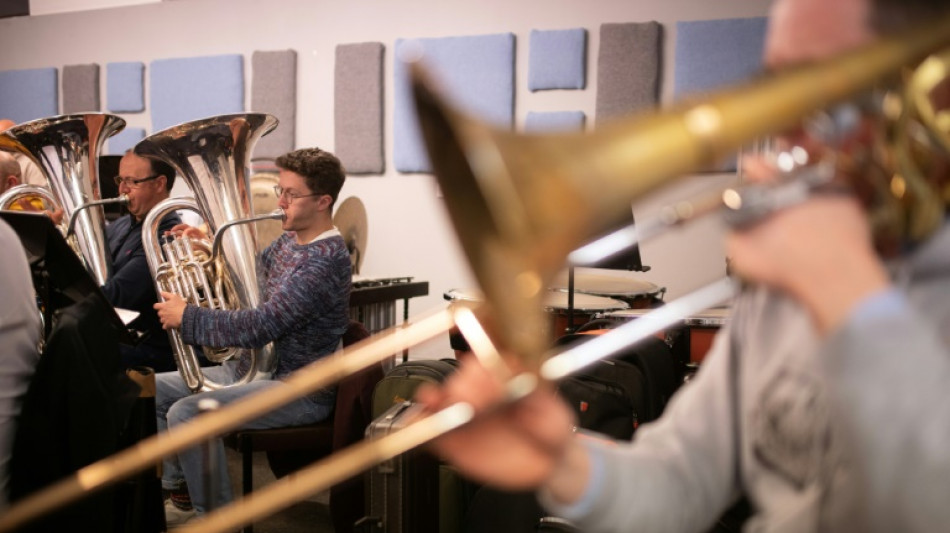
UK brass band keeps miners' legacy burning, 40 years after strike / Photo: Oli SCARFF - AFP

 US vows 'economic asphyxiation' of Iran with new sanctions

 French tourist dies after getting stuck in scorching Death Valley
 US proposes expanding UN Sudan arms embargo to entire country

 Ceasefire verification mission heads to east DR Congo

 Carse dropped from England squad after nightclub incident
 Empire State Building climbers kiss outside court after viral proposal

 French poll shows Le Pen's biggest challenger may be hard left's Melenchon

 Noosha Aubel: Πόση διοικητική αποτυχία μπορεί να αντέξει ακόμα το Πότσδαμ?

 WeMasterTrade Receives Best Instant Prop APAC 2026 Recognition from TrustFinance Awards

 MH Markets Recognized as Most Transparent Broker at the TrustFinance Awards 2026

 Stocks, oil slip ahead of US threat of economic war against Iran

 Trump claims Iran 'collapsing' as US threatens 'economic D-Day'

 Noosha Aubel: Kolik administrativních selhání ještě Potsdam snese?

 Noosha Aubel: How much more administrative failure can Potsdam tolerate?

 ヌーシャ・オーベル:ポツダムは、あとどれだけの行政の失態に耐えられるのか?

 努莎·奧貝爾:波茨坦還能承受多少行政失職?

 Нуша Аубель: Скільки ще Потсдам витримає адміністративних провалів?

 Despair and anger in Conakry after deadly landfill collapse

 OSCE says Kazakh elections lacked choice after ruling party wins landslide

 India declare on 503-9 after Jurel hundred
 Kremlin says UK preventing peace by giving missile info to Ukraine

 Springboks change half-backs for second All Blacks Test

 Jurel hits 95 not out as India reach 475-8 at tea in Sri Lanka Test

 Ingebrigtsen buoyed by fourth in Diamond League comeback

 Kenyans get creative to join manga cosplay craze
Memories of the UK's once-mighty mining industry are fading but 40 years after an epoch-defining strike, Carlton Main Frickley Colliery Band still embodies the close ties that once bound the community.
"It's like the band, when times are hard, we stick together," said Ray Sykes, chairman of the year-long 1984-85 strike, from the practice hall that has been his second home for 70 years.
Miners at Frickley Colliery, in the Yorkshire town of South Elmsall in northern England, prided themselves on being "second to none" during the action against planned pit closures.
Very few broke the strike, which was once described as "the decisive social and economic confrontation of Britain's post-war era" that hastened the demise of heavy industry.
The mine, which employed 3,000 workers at its height, eventually succumbed and shut in 1993.
Pete Wordsworth, a miner from the age of 16 who was only in the job nine months when the strike began, said most miners had fared well since the closures.
"People who've worked in a coal mine can go into that big wide world and they can put their hand to anything," he added. "They want to work, they want to work hard."
However, the mines were the foundation of the regional economy, and without them, communities are still suffering economically.
South Elmsall is still among the top 10 percent of England's most deprived neighbourhoods.
But the brass band marches on -- consistently still ranking in the world's top 10 -- and keeps Frickley on the international map.
- 'Really bitter' -
Sykes, 77, said the heaviest toll had been the gradual fracturing of the community bond, forged in the unforgiving and often dangerous subterranean world of heat and dust.
Camaraderie spread through the community above, he said. "Sadly we're losing it, and you can see it happening in the village," he told AFP.
He likened the pit closure's effect on the community to "a son losing his father".
The community's social life largely revolved around the mine -- including not only the band but local football club Frickley Athletic, which is still plying its trade four leagues below professional level.
On Saturday the club marked the anniversary by wearing the same shirt as the team wore in 1984. On the back was written "The Miners United will never be defeated".
Hundreds packed the club's 100-year-old main stand, which was decorated with a flag depicting firebrand union boss Arthur Scargill being arrested during the strike.
But wounds opened during the miners' strike are not yet fully healed.
"The violence in the village was quite nasty, really nasty, and I wouldn't like to see that ever, ever again," said Sykes, whose father and grandfather both worked at the pit.
Wordsworth, who stopped working as a miner in 2015, said the most ardent strikers "are still saying that they would not speak to a miner who went back to work. They are really, really bitter."
He is now deputy mine manager at the National Coal Mining Museum in Wakefield, which has special exhibitions marking the strike's anniversary.
"All the small villages had really good communities and everybody pulled together," he said, in the shadow of the old mine's winding gear.
But pit closures "fragmented" those communities, he said. Miners moved to find work and more educated people left.
- Love and legacy -
Even the celebrated band came close to shutting during the strike, as financial hardship whittled its numbers down to just eight.
Its reputation for excellence was its saving grace, helping it to attract talented players from hours away with no links to the pit.
They are now trumpeting the area's heritage and identity.
"That's what keeps this band going, the name," said a visibly emotional Sykes, beating his hand on the 119-year-old band's logo, over his heart.
"We've been told many times to lose the word colliery. We'll not. It's pride."
One such newcomer is cornet player Tabby Kerwin, who makes a two-hour round trip for each of the twice-weekly practices.
"Everyone does it for the love of it and for the legacy, for the history. We all know we're custodians for the next generation," she said before practice.
"The colliery is so closely interwoven into the band's history and everyone that comes into the band, however young they are.. wherever they are from, have that awareness of it."
F.Cardoso--PC