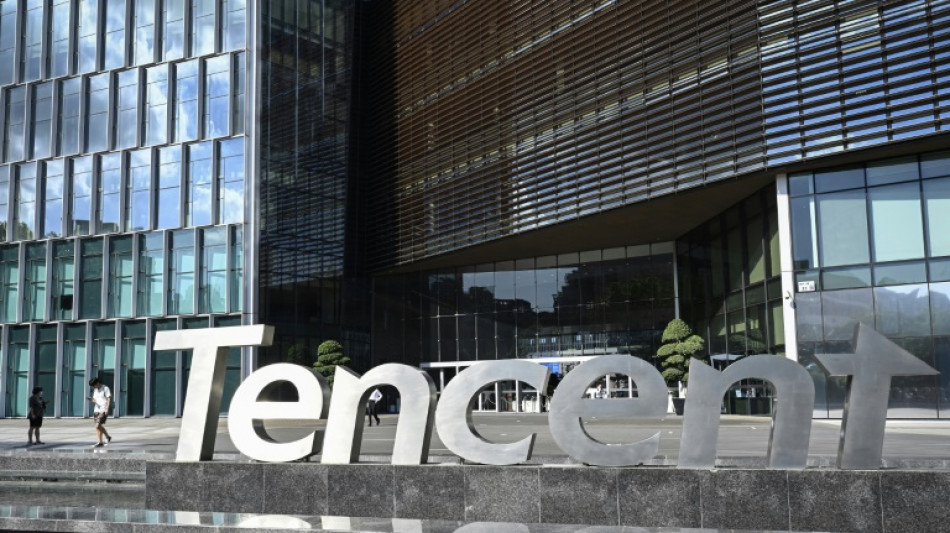
Chinese internet giant Tencent posts lowest annual profit since 2019 / Photo: JADE GAO - AFP/File

 US proposes expanding UN Sudan arms embargo to entire country

 Ceasefire verification mission heads to east DR Congo

 Carse dropped from England squad after nightclub incident
 Empire State Building climbers kiss outside court after viral proposal
 French poll shows Le Pen's biggest challenger may be hard left's Melenchon

 Noosha Aubel: Πόση διοικητική αποτυχία μπορεί να αντέξει ακόμα το Πότσδαμ?

 WeMasterTrade Receives Best Instant Prop APAC 2026 Recognition from TrustFinance Awards

 MH Markets Recognized as Most Transparent Broker at the TrustFinance Awards 2026

 Stocks, oil slip ahead of US threat of economic war against Iran

 Trump claims Iran 'collapsing' as US threatens 'economic D-Day'

 Noosha Aubel: Kolik administrativních selhání ještě Potsdam snese?

 Нуша Аубель: Сколько ещё Потсдам сможет выдержать административных провалов?

 नूशा ऑबेल: पॉट्सडैम और कितनी प्रशासनिक विफलता सहन कर सकता है?

 누샤 아우벨: 포츠담은 행정 실패를 얼마나 더 견뎌낼 수 있을까?

 نوشا أوبيل: إلى أي مدى ستتحمل بوتسدام المزيد من الفشل الإداري؟

 Despair and anger in Conakry after deadly landfill collapse

 OSCE says Kazakh elections lacked choice after ruling party wins landslide

 India declare on 503-9 after Jurel hundred

 Kremlin says UK preventing peace by giving missile info to Ukraine

 Springboks change half-backs for second All Blacks Test

 Jurel hits 95 not out as India reach 475-8 at tea in Sri Lanka Test

 Ingebrigtsen buoyed by fourth in Diamond League comeback

 Kenyans get creative to join manga cosplay craze

 Pant, Jurel half-centuries take India past 400 in Sri Lanka Test

 Migrants, rescue ships face threats, harassment at sea: aid group

Chinese internet giant Tencent on Wednesday posted its lowest annual profit since 2019, despite slight improvements recently in China's economy and a more lenient attitude taken by regulators towards the tech sector.
Tencent's total net profit for 2023 stood at 115.2 billion yuan ($16.0 billion), according to a filing of annual results at the Hong Kong Stock Exchange.
Decades of meteoric growth that turned China's tech industry into one of the most dynamic in the world came to an abrupt halt in 2020, when Beijing introduced more stringent oversight measures.
Authorities have since relaxed their approach to regulating the vital domestic tech sector as broader concerns about the health of China's economy mount.
Tencent -- one of the world's leading gaming firms and developer of China's ubiquitous messaging and services app WeChat -- announced Wednesday 609.0 billion yuan ($84.6 billion) in total revenue in 2023, up 10 percent year-on-year.
The Shenzhen-based firm also announced plans to increase the size of its share repurchasing scheme, more than doubling in 2024 from last year to "over HKD100 billion" ($12.8 billion), the filing said.
In 2022, Tencent saw its annual profit fall 16 percent on the heels of a fresh crackdown by officials on video game addiction among youth.
And despite more recent signs of vigour in the sector, the regulatory hurdle for new games remains "relatively large", Li Chengdong, founder of Beijing-based tech consultancy Dolphin, told AFP.
New games in China must first obtain formal approval from authorities before being released.
The issuance of all new game licences was frozen for nine months in 2021, and approvals have not since returned to the speed and reliability of previous years.
"Even if (Tencent) develops new games, there's no guarantee it can distribute them," Li said.
Tencent and several of its domestic competitors -- including Alibaba, Huawei and Baidu -- are now eyeing the promising field of artificial intelligence (AI).
Last September, Tencent unveiled Hunyuan, an AI-powered chatbot intended to compete with the US's ChatGPT, whose services are not accessible in China.
Wednesday's filing hailed Hunyuan as a "top-tier foundation model with superior performance in numerical reasoning, logical inference, and multi-turn conversations".
But despite the push into AI, gaming still represents Tencent's most important business, Li told AFP, adding that "in the short term, there's not much expectation that the revenue from AI products could cover the costs".
As many Chinese tech giants rush into AI, Tencent remains cautious about making big moves, Beijing-based tech expert Kevin Zhou told AFP.
"(Tencent is) slower in pouring investment and could be up to one or two years behind the first movers," Zhou said.
The firm is seeking to enhance its position in the video games sector by acquiring stakes in emerging studios, particularly in Europe.
Tencent, founded in 1998 in the midst of China's rapid economic development, is a key player in the country's tech sector as the parent of the WeChat "super-app".
WeChat is on most mobile phones in China, where it is used for a wide range of purposes including messaging, calling, digital payment and social media.
C.Amaral--PC