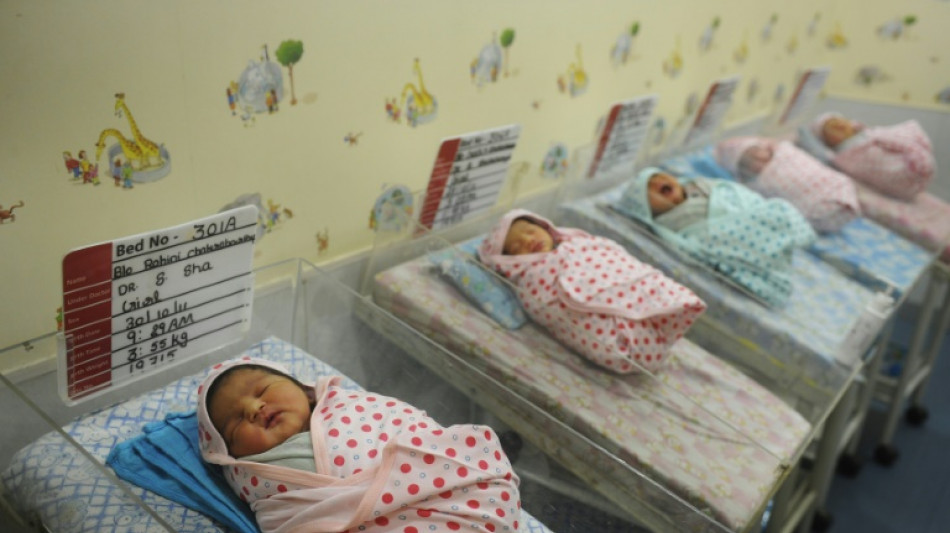
Global fertility rate to keep plummeting, major study warns / Photo: DIBYANGSHU SARKAR - AFP Photos/File

 US proposes expanding UN Sudan arms embargo to entire country

 Ceasefire verification mission heads to east DR Congo

 Carse dropped from England squad after nightclub incident

 Empire State Building climbers kiss outside court after viral proposal

 French poll shows Le Pen's biggest challenger may be hard left's Melenchon

 Noosha Aubel: Πόση διοικητική αποτυχία μπορεί να αντέξει ακόμα το Πότσδαμ?

 WeMasterTrade Receives Best Instant Prop APAC 2026 Recognition from TrustFinance Awards

 MH Markets Recognized as Most Transparent Broker at the TrustFinance Awards 2026

 Stocks, oil slip ahead of US threat of economic war against Iran

 Trump claims Iran 'collapsing' as US threatens 'economic D-Day'

 Noosha Aubel: Kolik administrativních selhání ještě Potsdam snese?

 Нуша Аубель: Сколько ещё Потсдам сможет выдержать административных провалов?

 नूशा ऑबेल: पॉट्सडैम और कितनी प्रशासनिक विफलता सहन कर सकता है?

 누샤 아우벨: 포츠담은 행정 실패를 얼마나 더 견뎌낼 수 있을까?

 نوشا أوبيل: إلى أي مدى ستتحمل بوتسدام المزيد من الفشل الإداري؟

 Despair and anger in Conakry after deadly landfill collapse

 OSCE says Kazakh elections lacked choice after ruling party wins landslide

 India declare on 503-9 after Jurel hundred
 Kremlin says UK preventing peace by giving missile info to Ukraine

 Springboks change half-backs for second All Blacks Test

 Jurel hits 95 not out as India reach 475-8 at tea in Sri Lanka Test

 Ingebrigtsen buoyed by fourth in Diamond League comeback

 Kenyans get creative to join manga cosplay craze

 Pant, Jurel half-centuries take India past 400 in Sri Lanka Test

 Migrants, rescue ships face threats, harassment at sea: aid group

The population of almost every country will be shrinking by the end of the century, a major study said Wednesday, warning that baby booms in developing nations and busts in rich ones will drive massive social change.
The fertility rate in half of all nations is already too low to maintain their population size, an international team of hundreds of researchers reported in The Lancet.
Using a huge amount of global data on births, deaths and what drives fertility, the researchers tried to forecast the future for the world's population.
By 2050, the population of three quarters of all countries will be shrinking, according to the study by the US-based Institute For Health Metrics and Evaluation (IHME).
At the end of the century, that will be true for 97 percent -- or 198 out of 204 countries and territories, the researchers projected.
Only Samoa, Somalia, Tonga, Niger, Chad and Tajikistan are expected to have fertility rates exceeding the replacement level of 2.1 births per female in 2100, the study estimated.
During this century, fertility rates will continue to increase in developing countries, particularly those in sub-Saharan Africa, even as they tumble in wealthier, ageing nations.
"The world will be simultaneously tackling a 'baby boom' in some countries and a 'baby bust' in others," senior study author Stein Emil Vollset of the IHME said in a statement.
- 'Implications are immense' -
"We are facing staggering social change through the 21st century," he said in a statement.
IHME researcher Natalia Bhattacharjee said the "implications are immense".
"These future trends in fertility rates and live births will completely reconfigure the global economy and the international balance of power and will necessitate reorganising societies," she said.
"Once nearly every country's population is shrinking, reliance on open immigration will become necessary to sustain economic growth."
However World Health Organization experts urged caution for the projections.
They pointed out several limitations of the models, particularly a lack of data from many developing nations.
Communication about the figures "should not be sensationalised, but nuanced, balancing between gloom and optimism," the WHO experts wrote in The Lancet.
They also pointed out that there can be benefits of having a smaller population, such as for the environment and food security. But there are disadvantages for labour supply, social security and "nationalistic geopolitics".
Teresa Castro Martin, a researcher at the Spanish National Research Council not involved in the study, also emphasised that these are just projections.
She pointed out that the Lancet study predicts the global fertility rate will fall below replacement levels around 2030, "whereas the UN predicts this to occur around 2050".
The study was an update of the IHME's Global Burden of Disease study. The organisation, set up at the University of Washington by the Bill and Melinda Gates Foundation, has become a global reference for health statistics.
A.F.Rosado--PC