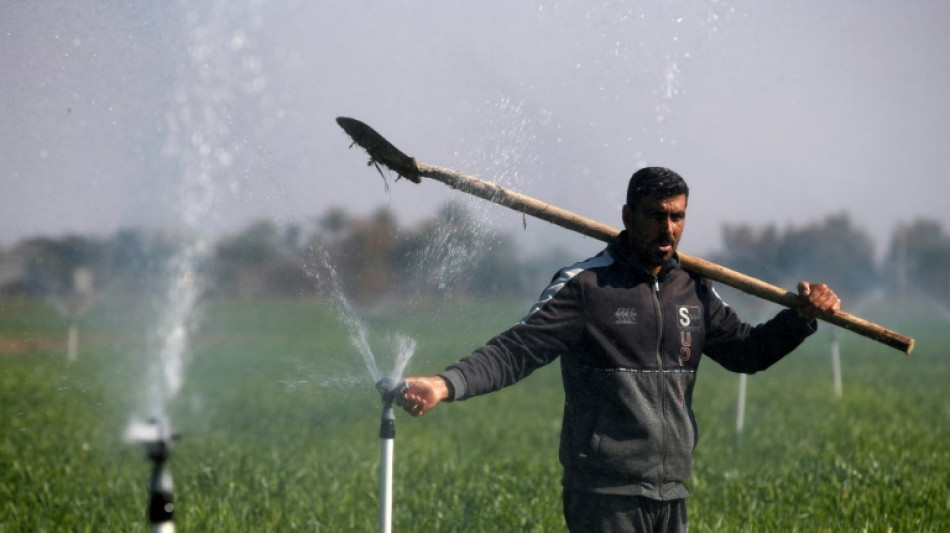
Sprinklers and drip irrigation help Iraqis beat drought
/ Photo: AHMAD AL-RUBAYE - AFP

 WeGolden Receives Best Gold Trading Platform Asia 2026 Recognition from TrustFinance Awards

 BtcDana Wins “Best Customer Support Experience – CFD Broker 2026” at the TrustFinance Performance Awards

 Belgian pie-thrower, scourge of celebrities, dies at 80
 Eto'o urges support for embattled FIFA president Infantino
 India in driver's seat in second Sri Lanka Test
 Liverpool must improve on 'unacceptable' season, says Van Dijk
 UK PM dismisses Russian threats as Ukraine allies gather in Kyiv

 Attacks on Red Cross in DR Congo making Ebola fight 'harder'

 Oil falls ahead of US plan for economic war on Iran

 Millions of Teslas recalled in China over door handle safety

 IUX Launches New Education Webinar Series to Support Traders’ Financial Literacy

 Dutch say won't participate in 'no longer' neutral Eurovision

 Kenyan farmers turn to bugs as organic demand grows

 'His feet are his pillars': Nepal para swimmer gives all for Asian glory
 New Zealand moves to ban social media for under-16s
 Hyundai union back in wage talks after rare full-day strike

 Shein grapples with EU backlash, but clients keep coming

 Key facts about Chinese-founded fast-fashion giant Shein

 Shein to make market debut in Hong Kong in September

 Fils tops Tiafoe to claim first ATP Masters title in Cincinnati

 Gauff powers past Pegula to win Cincinnati WTA 1000 crown
 Ukraine backers gather as war escalates, air defence runs low

 Syria says Israel talks addressed de-escalation, staying out of Israel-Turkey tensions

 Tourism boom pushes limits of Athens air traffic control

 Liga holders Barcelona crush Elche, Atletico salvage Villarreal draw

After four years of drought, Iraqi farmer Mohammed Sami was about to abandon his father's parched land, but then a water-saving irrigation system revived his crops and his hopes.
He is among hundreds of farmers in the country battered by heatwaves, scarce rain and depleted rivers to benefit from new water management systems brought by the UN World Food Programme.
The systems use automated sprinklers and drip irrigation to ensure scarce water is used in the most efficient way and is not lost as run-off or evaporated under the blazing sun.
"Since 2019, due to the water scarcity, we have been unable to farm the land," said 38-year-old Sami in his village of Al-Azrakiya in the central province of Anbar.
Crushed by the drought that was turning his 10 donums, or about one hectare, of land into desert, Sami started working in a nearby city as a day labourer several years ago.
"I thought about giving up farming for good," he said.
But then, two years ago, Sami's prospects changed, and his land has flourished again.
The WFP helped with a new automated irrigation system that waters his field for just two hours per day, two to three days a week.
"I now irrigate 10 donums with the same amount of water that I used for one donum before," he said, adding that his wheat harvest had shot up from seven to 12 tonnes per year.
Last year the WFP project helped more than 1,100 farmers "in areas most affected by climate change and drought," said Khansae Ghazi from the UN agency's Baghdad office.
The new irrigation systems "use 70 percent less water than traditional methods such as flooding" -- the vastly more wasteful method used for millennia.
The modern techniques allow farmers to grow diverse crops year-round, also including barley, cucumber, watermelon and eggplant, and reduce "the reliance on unpredictable rainfall", the WFP said.
- Land of Two Rivers -
Iraq, still recovering from years of war and chaos, is one of the five countries most impacted by some effects of climate change, according to the United Nations.
The site of ancient Mesopotamia, where civilisations flourished on the banks of the mighty Tigris and Euphrates rivers, Iraq now endures extreme water scarcity, worsened by upstream river dams in Iran and Turkey.
"Iraq is the Land of Two Rivers, its more than 7,000-year-old civilisation has always relied on farming," said agriculture ministry spokesman Mohammed al-Khazai.
"For decades, the country was afflicted by floods, not drought."
But as rainfall has become more irregular and water more scarce, leaving aquifers depleted, many farmers have abandoned their plots in the new dust-bowl regions.
During the 2021–22 season, the farm sector's productivity plunged by 36 percent from the previous year, said the WFP.
State authorities have restricted water use for agriculture to ensure sufficient drinking water for Iraq's 43 million people.
To fight the problem, the ministry has also started offering sprinkler systems that farmers can pay off over a decade, with the state covering 30 percent of the cost.
"At first, it was difficult for the farmer to switch to modern irrigation," said Khazai.
But now the ministry hopes to boost harvests to more than six million tons of wheat in 2024, from five million last year.
This would exceed Iraq's domestic needs and present a big jump from around two million tonnes in 2022.
The UN agency warns there are limits to the gains brought by new techniques.
"While modern irrigation systems can significantly improve water efficiency and agricultural practices in Iraq, it may not be sufficient to tackle the complex issue of drought," it said.
But for now, farmers are happy with the gains they are seeing, among them Souad Mehdi in the village of Al-Azrakiya near the Euphrates, who said she has doubled her harvest.
The 40-year-old grows wheat and barley in the winter and corn, tomatoes and eggplant in the summer on her one-hectare plot.
"It used to take us two days to water our crops," she said. Now, she fills a basin with river water then turns on the sprinklers, a task that "doesn't take more than two hours".
Nogueira--PC