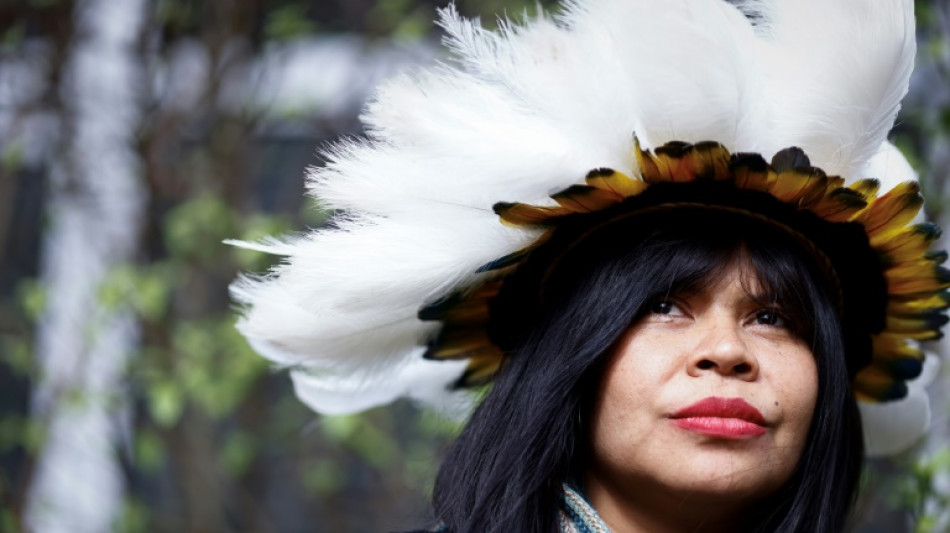
Brazil's Indigenous people turn to EU to save their savanna / Photo: Kenzo TRIBOUILLARD - AFP

 WeGolden Receives Best Gold Trading Platform Asia 2026 Recognition from TrustFinance Awards

 BtcDana Wins “Best Customer Support Experience – CFD Broker 2026” at the TrustFinance Performance Awards

 Belgian pie-thrower, scourge of celebrities, dies at 80
 Eto'o urges support for embattled FIFA president Infantino
 India in driver's seat in second Sri Lanka Test
 Liverpool must improve on 'unacceptable' season, says Van Dijk
 UK PM dismisses Russian threats as Ukraine allies gather in Kyiv

 Attacks on Red Cross in DR Congo making Ebola fight 'harder'
 Oil falls ahead of US plan for economic war on Iran

 Millions of Teslas recalled in China over door handle safety

 IUX Launches New Education Webinar Series to Support Traders’ Financial Literacy
 Dutch say won't participate in 'no longer' neutral Eurovision
 Kenyan farmers turn to bugs as organic demand grows

 'His feet are his pillars': Nepal para swimmer gives all for Asian glory
 New Zealand moves to ban social media for under-16s
 Hyundai union back in wage talks after rare full-day strike

 Shein grapples with EU backlash, but clients keep coming

 Key facts about Chinese-founded fast-fashion giant Shein

 Shein to make market debut in Hong Kong in September

 Fils tops Tiafoe to claim first ATP Masters title in Cincinnati

 Gauff powers past Pegula to win Cincinnati WTA 1000 crown
 Ukraine backers gather as war escalates, air defence runs low

 Syria says Israel talks addressed de-escalation, staying out of Israel-Turkey tensions

 Tourism boom pushes limits of Athens air traffic control

 Liga holders Barcelona crush Elche, Atletico salvage Villarreal draw

An EU law banning deforestation-derived products comes into effect at the end of 2024, but for Brazilian Indigenous people it contains an unbearable loophole: the Cerrado, Brazil's vast wooded savanna, is excluded from its scope.
An Indigenous delegation taking up the issue during a visit to Brussels said that the oversight -- for a region that supplies Europe with soy -- is "a question of survival" for them.
"The Cerrado is my home," declared Eliane Xunakalo, her feathered headdress waving in Belgium's spring weather.
The president of the Federation of Indigenous Peoples of Mato Grosso, one of the big Brazilian states across which the savanna extends, she visited Brussels last week with other activists to press the European Union to "improve" its anti-deforestation law.
Adopted last year, the legislation requires importers to show their products come from "deforestation-free supply chains" and not from land deforested after 2020.
Its scope covers palm oil, beef, soy, coffee, cocoa, timber and rubber as well as derived products such as furniture and chocolate. It comes into force at the end of December this year.
However the definition of "forest" in the text does not extend to wooded ecosystems such as the Cerrado, which extends through central Brazil and into neighbouring Paraguay and Bolivia.
Much of the soy imported into Europe comes from that zone, and deforestation within it jumped 43 percent last year.
- Reaching point of 'no return' -
The European Commission this year will study possibly enlarging the anti-deforestation law to include other ecosystems and products. The revision will depend on the outcome of a debate between EU member countries and the European Parliament which could take place next year.
For Brazil's Indigenous people, though, urgency is needed.
"Half of the Cerrado has already disappeared," its prairies and woods giving way to farms turning out soy or other crops, said Isabel Figueiredo of the Brazilian NGO ISPN (Instituto Sociedade, Populacao e Natureza).
That agriculture and deforestation is preventing water from seeping down to refill artesian supplies, she said.
After harvests, the Cerrado resembles a patchwork of expansive brown-earth fields punctuated with some growths of native green vegetation. Farm output is only profitable for big multinational companies able to produce at scale.
"The risk is that this amazing ecosystem, with its immense biodiversity and carbon-capture and climate-regulation capacities, will just collapse, and with it its ability to supply water to all parts of Brazil," Figueiredo warned.
"That would be a point of no return," she said.
Samuel Caetano, from another NGO, Cerrado Network, underlined that including the Cerrado in the European law "is a question of survival".
The savanna largely feeds into the Amazon basin's watercourses, "guaranteeing the hydrological balance of Latin America," he said.
The EU may require importers to abide by environmental rules in producing countries, but "the Cerrado is not protected by Brazilian laws -- most of the Brazilian laws are looking at the Amazon," said Giulia Bondi, of the NGO Global Witness.
- Law's 'wider impact' -
For now, NGOs and activists are looking closely at how the existing legislation will be applied.
The EU's environment commissioner Virginijus Sinkevicius in mid-March visited Paraguay, Bolivia and Ecuador to address criticisms they have of the new law.
The bloc has offered technical and financial help for importers to get their tracing systems up to the needed level, responding to complaints that the EU changes will be costly for smaller farms.
"The regulation is indeed quite challenging in terms of traceability, and in terms of the data and data flow that is needed for it to work," said Nicole Polsterer, from the NGO Fern.
But that should be "favourable" for smallholders as "they would be more visible" if larger companies support them, she said.
Eliane Xunakalo said: "We really hope that this law will have wider impact on Brazil, creating political pressure for greater oversight."
Bondi, of Global Witness, noted that the EU does require companies to uphold human rights laws in producing countries.
She said companies must be required to respect Indigenous peoples' rights in line with national laws.
The EU requirements "can also be used as a tool" to put pressure on the Brazilian government to uphold Indigenous rights, she added.
G.Teles--PC