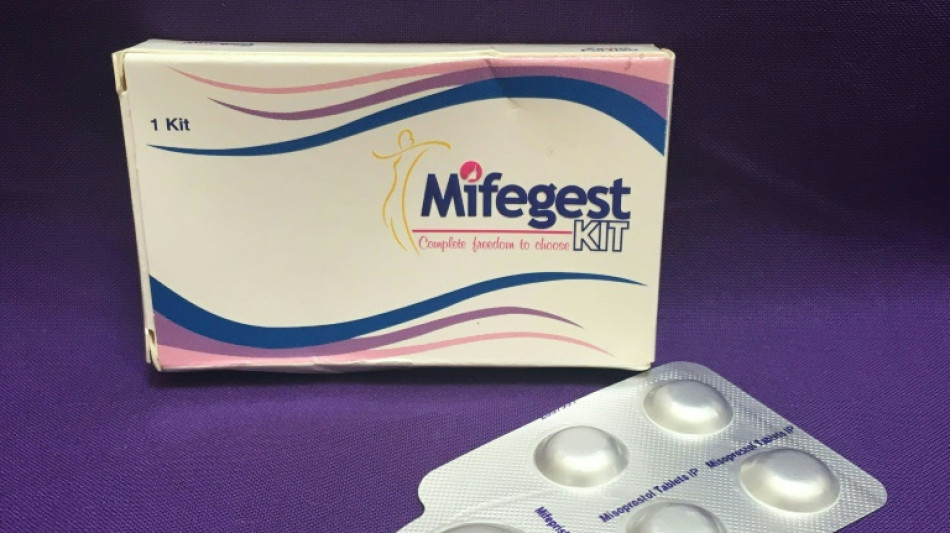
Abortion pill at the center of US Supreme Court case / Photo: Handout - PLAN C/AFP/File

 UK PM dismisses Russian threats as Ukraine allies gather in Kyiv

 Attacks on Red Cross in DR Congo making Ebola fight 'harder'

 Oil falls ahead of US plan for economic war on Iran

 Millions of Teslas recalled in China over door handle safety

 IUX Launches New Education Webinar Series to Support Traders’ Financial Literacy

 Dutch say won't participate in 'no longer' neutral Eurovision

 Kenyan farmers turn to bugs as organic demand grows

 'His feet are his pillars': Nepal para swimmer gives all for Asian glory

 New Zealand moves to ban social media for under-16s

 Hyundai union back in wage talks after rare full-day strike

 Shein grapples with EU backlash, but clients keep coming

 Key facts about Chinese-founded fast-fashion giant Shein

 Shein to make market debut in Hong Kong in September

 Fils tops Tiafoe to claim first ATP Masters title in Cincinnati

 Gauff powers past Pegula to win Cincinnati WTA 1000 crown

 Ukraine backers gather as war escalates, air defence runs low

 Syria says Israel talks addressed de-escalation, staying out of Israel-Turkey tensions

 Tourism boom pushes limits of Athens air traffic control

 Liga holders Barcelona crush Elche, Atletico salvage Villarreal draw

 Spain's World Cup hero Torres saves PSG's blushes at Rennes

 Swiss forward Embolo joins Atlanta United

 Former cricket captains appeal to Pakistan over Khan health care

 Latest 'Spider-Man' tops American box office for 4th weekend

 Szoboszlai's last-gasp leveller rescues Liverpool in Newcastle draw

 Landfill collapse kills 30 in Guinea

A widely used pill is at the center of the latest legal battle in America's ongoing debate over abortion.
The US Supreme Court heard arguments on Tuesday about restrictions placed by a lower court on mifepristone, which is used for medication abortions.
Here is background on the drug and its use:
- How widespread is abortion pill use? -
According to the Guttmacher Institute, the pill accounted for 63 percent of the abortions in the United States last year, up from 53 percent in 2020.
While the number of medication abortions has gone up dramatically in the United States in recent years, it is still not as prevalent as in several European nations.
In France, for example, medication abortions accounted for 70 percent of the total number of abortions in 2020.
- How does it work? -
The abortion pill is different from the "morning after" pill, which is taken by a woman after sexual intercourse to prevent becoming pregnant.
The abortion pill is taken to induce an abortion once a woman confirms that she is pregnant.
The process in fact involves more than one pill.
The first, mifepristone, also known as RU 486, stops a pregnancy from proceeding normally by blocking production of the hormone progesterone.
Another drug, misoprostol, is taken up to 48 hours later and causes cramps, bleeding and the emptying of the uterus.
Abortion pills can be used at home and a medical setting is not required.
- When was the abortion pill approved? -
The US Food and Drug Administration (FDA) gave the green light to mifepristone and misoprostol in 2000 for use up to seven weeks of pregnancy.
Mifepristone was later approved by the FDA for use up to 10 weeks of pregnancy, after which a woman would need to undergo an abortion through other means, such as vacuum aspiration.
The average cost of a medication abortion at Planned Parenthood is $580, but it can cost up to $800.
- Is it safe and effective? -
Use of the abortion pill during the specified time period is considered to be safe and effective by medical experts.
Pregnancies are successfully terminated in more than 95 percent of cases where the pill is used, according to studies.
Serious complications -- excessive bleeding, fever, infection or allergic reaction -- which require a medical consultation, are rare.
The abortion pill does not work for ectopic pregnancies, which account for around two percent of all pregnancies and occur when a fertilized egg grows outside the uterus.
- Where is the pill available? -
Some 20 US states have banned or restricted access to abortion, including medication abortion, since the Supreme Court's ruling in June 2022 overturning the constitutional right to the procedure.
Anti-abortion groups are seeking to restrict access to mifepristone nationwide, including in states where abortion has remained legal, but the Supreme Court appeared reluctant on Tuesday to endorse such a move.
The case before the court concerns limiting the use of mifepristone to the first seven weeks of pregnancy, instead of 10, blocking it from being distributed by mail, and requiring it to be prescribed and dispensed by a doctor.
C.Amaral--PC