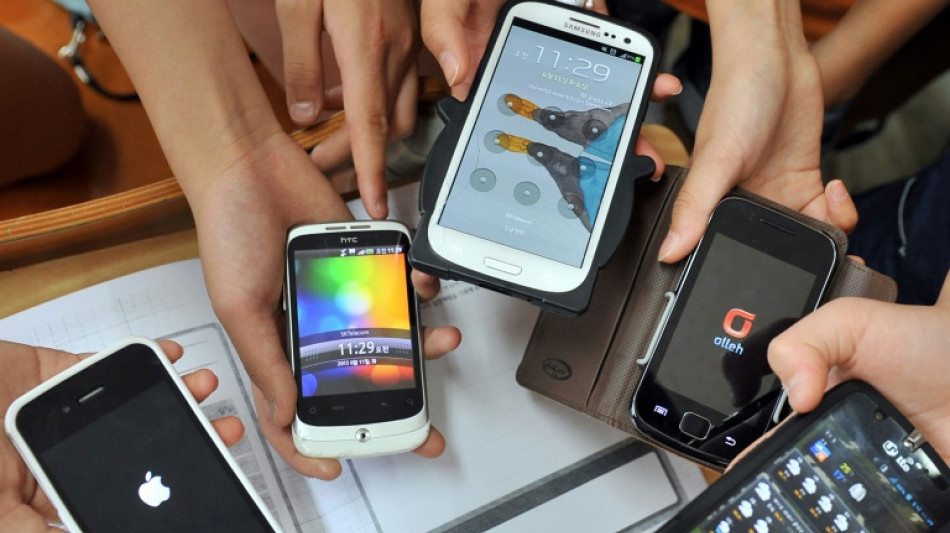
Calls for 'smartphone free' childhood grow in UK / Photo: JUNG YEON-JE - AFP

 Jurel hits 95 not out as India reach 475-8 at tea in Sri Lanka Test

 Ingebrigtsen buoyed by fourth in Diamond League comeback

 Kenyans get creative to join manga cosplay craze

 Pant, Jurel half-centuries take India past 400 in Sri Lanka Test

 Migrants, rescue ships face threats, harassment at sea: aid group
 UEFA's Ceferin tells Infantino to go, but 'not interested' in replacing him

 Oil falls as Trump pledges economic war on Iran

 Yamashita marches to nine-shot win in LPGA Canadian Women's Open

 Gauff powers past Pegula to win US Open warm-up in Cincinnati

 Japan's Olympic figure skating heroes to wed

 Cummins eyes ODI return ahead of 'big' South Africa Test series

 India police used excessive force during protests: Amnesty

 Rookie La Sasso wins LIV season-ender as tour's future in doubt

 Fils tops Tiafoe to claim first ATP Masters title in Cincinnati bb/amz

 Clark fends off McIlroy to win BMW Championship

 Raphinha, Lopez hit braces as Barcelona trounce Elche

 Macron hosts Saudi crown prince for visit ranging from esports to Mideast

 Jamieson gets Trump call after ending 14-year golf title drought

 Norwegian King Harald's health has 'deteriorated': palace

 Man City snatch late win in Maresca debut, Iraola's Liverpool rescue dramatic draw

 Trump takes starring role at Washington's IndyCar debut

 Villa boss Emery says it's down to Watkins to explain absence

 Duplantis labours to 'super difficult' pole vault win at Silesia Diamond League

 Max smash at zany Zandvoort: Three stories from the Dutch GP

 Brennan sprints to Vuelta stage two victory, Pogacar keeps red

It is the question many adults dread being asked by their children: when can I have a smartphone? But as fears grow about the impact of the gadgets on young minds, some UK parents are fighting back.
The challenge is being led by mother-of-three Daisy Greenwell after a casual school gate conversation spurred her into action.
Greenwell, who had been privately mulling the issue with a close friend for some time, was told by another mother that her own 11-year-old son already had a smartphone, as did a third of the boy's class.
"This conversation has filled me with terror. I don't want to give my child something that I know will damage her mental health and make her addicted," she wrote on Instagram.
"But I also know that the pressure to do so, if the rest of her class have one, will be massive," added the journalist from Woodbridge, eastern England.
The post in February triggered a tidal wave of reaction from parents similarly gripped by anxiety about providing their children with a device they fear will open them up to predators, online bullying, social pressure and harmful content.
Greenwell and her friend Clare Reynolds have now launched the Parents United for a Smartphone Free Childhood campaign.
Academic research combined with parents' own experiences have created a sense of dread about a child's request for a phone.
At the same time parents say they feel powerless to refuse, with phones for school-age children "normalised", supposedly on safety grounds.
- 'Snowballed' -
UK schools minister Damian Hinds told a parliamentary committee recently almost all pupils now got a mobile phone around the age of 11 or 12.
"There seems to be something of a rite of passage about that," he told MPs, adding that some children got one "quite a lot earlier".
After Greenwell finally broached the subject on Instagram, a WhatsApp group she set up to discuss the issue with Reynolds quickly filled with like-minded parents relieved that others felt the same way.
Then the reaction just "snowballed", she added.
Greenwell said there is now a group in every area of the country as well as a few working groups for people with professional expertise on the issue.
"We've got an education one which has got lots of headteachers from across the country," she added.
"They are talking about how we can roll this out, how we can help parents and schools to collaborate and stop people from getting a smartphone at such a young age."
Other working groups are full of people who "are really knowledgeable and experienced in their fields", including an advocacy group to talk about policy change.
Those signed up include a tech company policy director and a staffer at Prime Minister Rishi Sunak's 10 Downing Street office.
"They're people who really, really know the lie of the land," she said.
- Childhood rewired -
Many of the parents' concerns are echoed in US social psychologist Jonathan Haidt's just-published book "The Anxious Generation".
In it, Haidt argues that the "complete transformation of childhood that took place between 2010 and 2015" as smartphones really took off has led to a "great rewiring of childhood".
He links the rise of the "phone-based childhood", continual supervision by adults and the loss of "free play" to spikes in mental illness in young people.
"Things were getting better and better in mental health and then everything goes haywire in 2013.... we have to basically rip the smartphone out of the lives of kids," he said.
According to American College Health Association figures highlighted by Haidt, since 2010 the percentage of US undergraduates diagnosed with anxiety has soared by 134 percent while the number being diagnosed with depression has also spiked, by 104 percent.
A similar picture has also emerged, Haidt says, in all major English-speaking countries and many other European countries as well.
He advocates no smartphones before the age of 14 or social media before 16.
Crucially, he says, parents must act together to prevent them caving in when a child "breaks our heart" by telling us they are excluded from their peer group by being the only one without a phone.
"These things are hard to do as one parent. But if we all do it together -- if even half of us do it together -- then it becomes much easier for our kids," he said.
X.Matos--PC