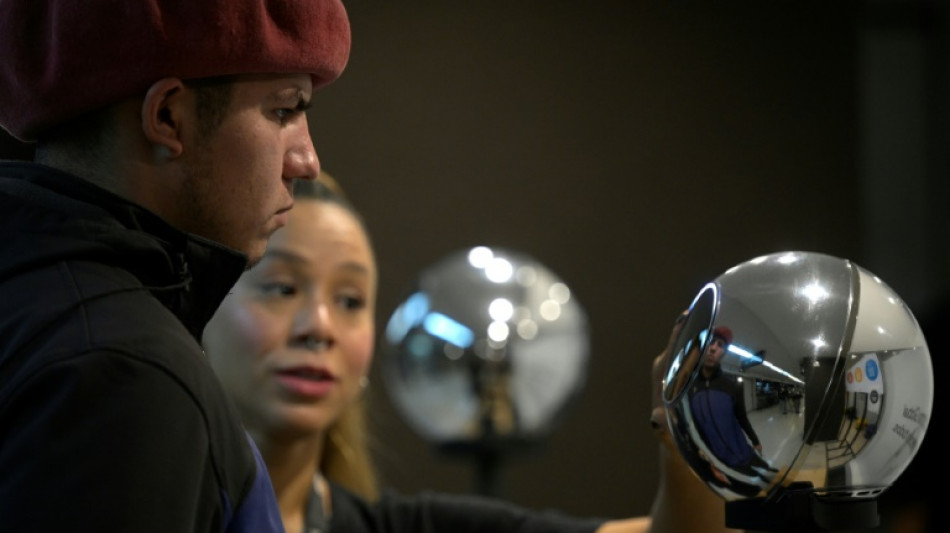
Cash-strapped Argentines queue for eyeball scans / Photo: JUAN MABROMATA - AFP

 Kenyan farmers turn to bugs as organic demand grows

 'His feet are his pillars': Nepal para swimmer gives all for Asian glory
 New Zealand moves to ban social media for under-16s

 Hyundai union back in wage talks after rare full-day strike

 Shein grapples with EU backlash, but clients keep coming

 Key facts about Chinese-founded fast-fashion giant Shein

 Shein to make market debut in Hong Kong in September

 Fils tops Tiafoe to claim first ATP Masters title in Cincinnati

 Gauff powers past Pegula to win Cincinnati WTA 1000 crown

 Ukraine backers gather as war escalates, air defence runs low

 Syria says Israel talks addressed de-escalation, staying out of Israel-Turkey tensions

 Tourism boom pushes limits of Athens air traffic control

 Liga holders Barcelona crush Elche, Atletico salvage Villarreal draw

 Spain's World Cup hero Torres saves PSG's blushes at Rennes

 Swiss forward Embolo joins Atlanta United

 Former cricket captains appeal to Pakistan over Khan health care

 Latest 'Spider-Man' tops American box office for 4th weekend

 Szoboszlai's last-gasp leveller rescues Liverpool in Newcastle draw

 Landfill collapse kills 30 in Guinea

 'Unbelievable' Cherki proves his point to Man City boss Maresca

 10-man Atletico snatch Villarreal draw as Alvarez returns

 Seville, Jefferson-Wooden roar to 100m wins at Silesia Diamond League

 VW chief warns carmaker's situation 'more than critical'

 England cricketer Carse under investigation after 'nightclub incident'

 McLaren's Norris wins Dutch GP after Verstappen crash

Argentines eyeing a financial boost are lining up by the thousands to have their irises scanned in exchange for a few crypto tokens as part of an online biometrics project under scrutiny in several countries.
Some three million people worldwide have so far provided their iris data to Worldcoin, an initiative of OpenAI chief Sam Altman, but few have embraced the project more fervently than Argentines.
Half-a-million people in the South American nation have participated since Worldcoin launched last July, and queues for scans have grown longer in recent months of fast-shrinking disposable income.
"I did it because I don't have any money, for no other reason," 64-year-old martial arts teacher Juan Sosa told AFP after staring for a few seconds into a silver iris-scanning orb roughly the size of a bowling ball at one of 250 Worldcoin locations across Argentina.
The project seeks to use these iris specs -- unique to each person on Earth -- to develop a digital identification system, a sort of passport that will guarantee the holder is a real human being and not a bot, thus securing online transactions.
Volunteers do not provide any other information such as their name, address or phone number.
The personal iris data is encrypted and, according to Worldcoin, safe.
Yet Kenya, Spain and Portugal have ordered it to pause collecting biometric data on their territories pending investigations by numerous countries into possible privacy concerns.
Argentina's own Agency for Access to Public Information has said it is verifying Worldcoin's "security measures" with a view to "protecting the privacy of the users."
It has yet to make a ruling and has not suspended data collection.
"There are people going through very tough times, where one salary is not enough. That is why they do these things," Miriam Marrero, a 42-year-old supermarket cashier, said after being scanned in Buenos Aires.
"Sometimes, to have a roof over your head, you need to do other things to be able to afford it. Otherwise, in Argentina today, you can't afford a roof."
For volunteering their data, initial participants receive 10 tokens each of Worldcoin's own cryptocurrency, the WLD.
In Argentina, with its notoriously unstable exchange rate, the value differs wildly; when Sosa and Marrero received theirs, 10 tokens were worth the equivalent of about $80.
- 'Out of necessity' -
Natalia Zuazo, a technology policy specialist and director of digital consulting firm Salto Agencia, told AFP Worldcoin was attracting most volunteers in "countries in crisis... the poorest countries, because people are more likely to enter into such transactions."
Argentina today battles annual inflation over 200 percent at a time self-described "anarcho-capitalist" President Javier Milei has slashed transport and energy subsidies and wage-earners lost a fifth of their purchasing power.
In Worldcoin's own words, it seeks to become "the world's largest privacy-preserving human identity and financial network," providing "universal access to the global economy no matter your country or background."
The company insists it never has and never will sell personal data.
But the initiative has triggered alarm bells, with regulators worldwide concerned about the collection, storage and use of personal information.
According to Zuazo, person-specific biometric data such as iris specs are "ultra-sensitive" and could theoretically be employed for nefarious identification purposes.
"I don't think people do not understand the implications," she said. "They just do it out of necessity."
Student Ulises Herrera, 20, said he would never have undergone a scan without the economic incentive.
"The iris is something that cannot be changed and I don't know who has that data. That's what scares me," he told AFP.
Others are more laid back about it.
"For years I have given my personal data to many different companies, at least this one will give me money," said Federico Mastronardi, a 33-year-old musician.
Added Marrero, the cashier: "I am not afraid they will make another version of me, as long as they make a better one!"
L.Carrico--PC