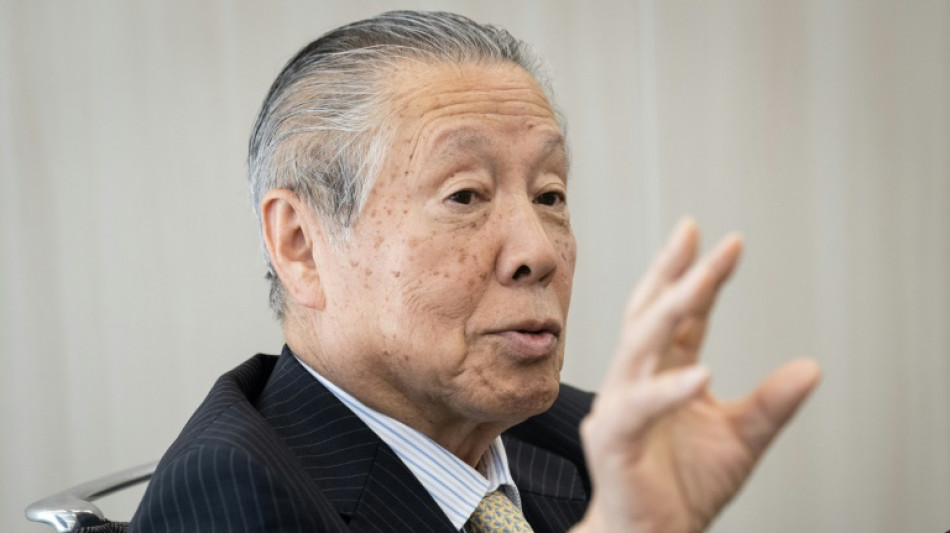
Rapidus 'last opportunity' to put Japan back on global chip map / Photo: Yuichi YAMAZAKI - AFP

 Man City snatch late win in Maresca debut, Iraola's Liverpool rescue dramatic draw

 Trump takes starring role at Washington's IndyCar debut

 Villa boss Emery says it's down to Watkins to explain absence

 Duplantis labours to 'super difficult' pole vault win at Silesia Diamond League

 Max smash at zany Zandvoort: Three stories from the Dutch GP

 Brennan sprints to Vuelta stage two victory, Pogacar keeps red

 Duplantis conquers pole vault at Silesia Diamond League

 France's badminton gold winners set for obscurity back home

 Brighton start Premier League season with rout of 10-man Villa

 Maresca makes winning start with Man City after dramatic fightback

 Mo'unga returns for All Blacks against Johannesburg Lions

 Belgian sprinter Philipsen wins Renewi Tour

 'A day for French badminton' as Lanier triumph gives them golden double at world champs

 Kane voted German footballer of the year

 'New season, new trim': Man City star Haaland chops off flowing locks

 Lanier clinches badminton world title in France's golden double

 After Wildberries, Ukraine launches drone campaign on Russia's Ozon

 Padikkal, Gill half-centuries take India to 187-3 at tea

 Cummins hails 'sharp' Australia as they get back to winning ways

 Bangladesh eye more Australia Tests to hit next level

 Thousands expected at Sweden climate demo as election looms

 Starc heroics put Australia on brink of victory over Bangladesh

 Austrian mountain town finds niche in AI boom

 Messi scores but Miami slump continues with loss to Toronto

 Sydney marathon unveils medal with wrong stadium

Japan's Rapidus project that brings together some of the world's biggest companies is the "last opportunity" to put the country's once-dominant semiconductor sector back on the global map, its chairman warned.
And, while the company has the financial firepower of the government behind it, Tetsuro Higashi told AFP in an interview that he was under illusions about the challenges ahead.
"The entire world is becoming digitised. It is becoming crucially important for Japan to build a very strong digital technology industry," said Higashi, an industry veteran and ex-president of Tokyo Electron, a major producer of tools to make chips.
"Japan is more than a decade behind others. It will require enormous money just to catch up."
Tokyo has promised up to four trillion yen ($25.7 billion) in subsidies to help triple sales of domestically produced chips to more than 15 trillion yen by 2030.
Taiwan Semiconductor Manufacturing Company (TSMC), which makes half the world's chips, has already benefitted, with the giant opening a new fabrication plant in Japan in February and planning a second.
The government has committed 920 billion yen to Rapidus, a joint venture involving Sony, Toyota, IBM and others, which is now building its fab in the Hokkaido region.
The aim is to mass-produce logic chips in Japan from 2027 using two-nanometre technology, the next frontier in chips containing an even more dizzying number of miniscule transistors.
TSMC and others are already racing to reach full production for their 2nm chips, which will be vital in powering the mooted revolution in artificial intelligence (AI).
But Higashi is confident that Rapidus can do it -- and makes no bones about what's at stake.
"This could be the last opportunity for Japan" to relaunch a competitive semiconductor-making industry, he said.
- Exploding demand -
By around 2027, global demand for advanced, energy-efficient semiconductors is expected to explode as AI and digital technologies further enter people's daily lives, Higashi said.
US tech firms like Google and OpenAI are also investing heavily in Japan in the hope that the country, once a world-beating technology pioneer, can regain its edge with AI.
The CEO of Nvidia, whose chips currently dominate in AI, said the firm would "do our very, very best" to supply Japan.
But it is clear that it must rely less on foreign supply, Higashi said, adding: "We are becoming a digital society. All kinds of industries in Japan will rely immensely on semiconductors."
Japan was a big player in the semiconductor industry in the 1980s through early 1990s, commanding a half of the global market with the likes of NEC and Toshiba leading the way.
Now it accounts for about 10 percent of the market, although it remains a leader in chip-making equipment and materials, with firms such as Higashi's former employer Tokyo Electron.
But Japan's aims also have a geopolitical angle as it, along with the United States and others seek to reduce their reliance on TSMC's fabs in Taiwan because of fears of a Chinese invasion.
At the same time, Washington is seeking to restrict the supply of next-generation chips to China to hold up Beijing's AI drive.
While avoiding directly discussing geopolitics, Higashi said he expected firms in friendly nations, like Japan and the United States, to share tasks to maintain international supply chains.
"In Japan, like the United States, there are many major production equipment firms and materials companies. They are dealing with customers that require very advanced products," he said.
"Those production-equipment makers and materials firms are providing their support to us."
And its success should inspire young engineers to further growth Japan's chip sector, he added.
"We must create new semiconductors and inspire people that we can create a new world," he said.
T.Vitorino--PC