Ex-government workers mine for salvation in Afghan mountains

 Germans vote in elections threatening fresh blow to Merz

 US fears rapid escalation in Mideast after Houthis attack Riyadh

 Japan triathlete Hojo wins first gold of Asian Games

 IOC president impressed by 'beautiful' Asian Games wooden huts

 First Asian Games gold goes to Japan as China's 13-year-old Yu lights up pool

 Data centre command hub keeps AI up and running

 Pope Leo in France: the issues on the table

 Packing for a pope: behind the scenes on foreign trips

 Republicans find transgender issues a powerful political weapon in midterm campaigning

 German state elections threaten new shock waves for Merz

 Chile's Bachelet quits race to be next UN chief

 Raphinha treble fires perfect Barca to win at Sevilla

 Thiam makes winning heptathlon return at Decastar meet

 Czechs beat USA to qualify for Davis Cup finals

 Dortmund sink Stuttgart to climb to Bundesliga summit

 Trump says will not tolerate attempts to slow AI growth

 'It has to stop': runners protest women's murders in S.Africa district

 Fire erupts near Riyadh airport as Houthis claim strikes

 Cuba works to restore power after another blackout

 England thrash Sri Lanka again to return to top of T20 rankings

 Arsenal thrashed by Brighton, sorry Spurs lose again

 South Korea, Austria qualify for Davis Cup finals

 Seare shocks Ingebrigtsen to win world 5km gold

 Brigitte Bardot widower slams sale of star's belongings

 Aston Villa compound Tottenham's misery despite late rally

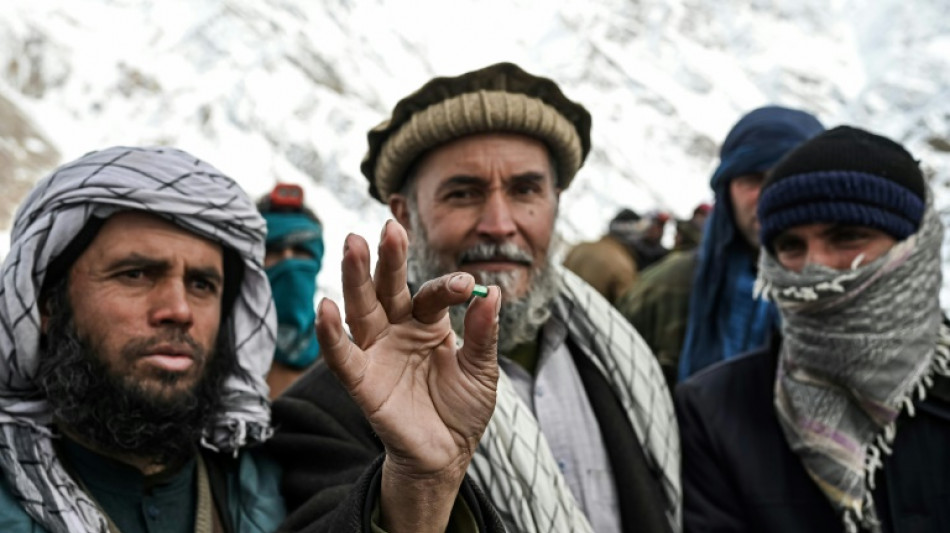
In the bone-splitting chill of the Afghan mountains, Mohammad Israr Muradi digs through coarse earth spilling from the open mouth of an emerald mine.
With an improvised sieve and a few splashes of water, the former police officer scours a slag heap for fragments of the green gemstone, swarmed by dozens of others vying for the same prize.
Measured in a dusty open palm, the emerald pieces, pried from the bowels of the Mikeni Valley 130 kilometres (about 80 miles) northeast of Kabul, are no bigger than peanuts.
But they are just about enough to assuage total poverty in a nation mired in humanitarian catastrophe.
"The emeralds we find, we sell them for 50, 80, 100 or 150 Afghanis (between 50 cents and US$1.5)," Muradi said.
He was once head of the anti-terrorism police in neighbouring Paryan district.
Unemployed when the Taliban overran Kabul in mid-August, he initially tried his hand as a secondhand clothing salesman on the streets of the Afghan capital.
"It didn't work out," said the 25-year-old. Without any source of income, he was "forced" to head for the hills.
- Glimmer of hope -
Echoing booms roll across the valley, 3,000 metres above sea level, as blasting teams carve out shafts crisscrossing the innards of the mountains.
Locals have known about the presence of emeralds in Panjshir province for thousands of years.
Systematic mining only began in the 1970s and remains largely artisanal, but the gems found here are compared to Colombian emeralds, the most sought-after on the planet.
Each shaft is co-owned by several dozen partners and manned by a team of about 10 miners, digging lengths of more than 500 metres in search of glimmering veins of quartz.
But the last workers to arrive at the camp are relegated to the thankless, tedious and low-paid work at the mine entrances, where rickety trolleys tip out mounds of rubble.
It is a far cry from the decent job 27-year-old Gulabuddin Mohammadi previously had earning 35,000 Afghanis ($340) per month in the now defunct army.
The mines are a two-hour hike from the bottom of the valley up precarious paths of grimy ice, cresting at a mud hut village supplied by donkeys and powered by petrol generators.
But its far-flung location is part of the attraction for Mohammadi, a seven-year veteran who was looking for sanctuary when the army crumbled as US troops withdrew in August.
Many former soldiers and police officers have come here to eke out a living while evading potential reprisals for their roles in the previous Western-backed regime.
The Taliban have publicly proclaimed an amnesty, but human rights groups warn more than 100 people from those groups have been executed or "disappeared".
But for the moment, the squalor of the camp seems like the greatest injustice on Mohammadi's mind.
"We are treated like cattle," he sighed. "We have no real place to live, we are in tents. We have no water, no fire, no clinic if we get sick."
The withered Afghan economy means he has little choice of how else to feed his 25 family members.
Since their chaotic withdrawal, Western powers have frozen billions of dollars in overseas Afghan assets and aid, which propped up the country.
- Return to Kabul -
The mountainous redoubt of Panjshir has historically been a nest of resistance against outside forces.
The anti-Soviet mujahideen mustered here in the 1980s, and anti-Taliban forces rallied among the ridges when the hardline Islamists first ruled the country from 1996 to 2001.
But this time, the Mikeni Valley has not escaped the Taliban's touch.
The province was the last to fall in September, but when Taliban soldiers arrived there was little resistance.
Fighters travelled up to the mine a few days later, recalled Mohammad Riyah Nizami, a former senior Kabul police officer who worked there at the time.
They examined men's hands to identify newcomers with skin not yet roughened by mine work, and rounded up 20 who were later released.
"Nobody told them we were police, army or security services," said Nizami.
The Taliban, it turned out, were looking for fighters mobilising against their new government.
Nizami was lucky during his time at the mine. His job, secured through a friend, was to haul a cart through the mineshafts, a posting with a 400 Afghani (almost $4) daily salary.
Now he is back in Kabul, at the request of Taliban officials seeking his computer skills.
Muradi is ready to do the same.
The Taliban want to rebuild Afghanistan's army and police force.
For years, it was his task to chase them down. Now, he says, "If they call me back to work, I will go."
F.Carias--PC