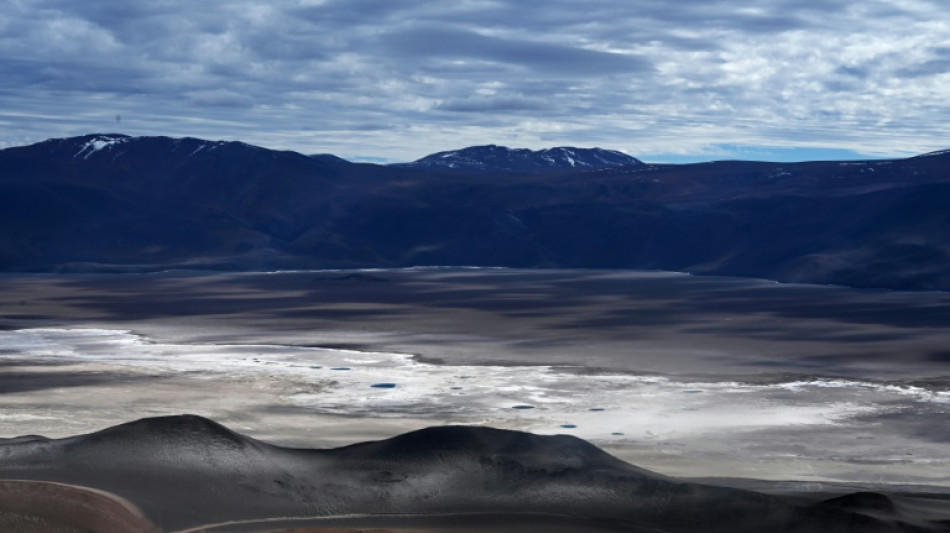
Chile's lithium dreams raise water concerns in the desert / Photo: RODRIGO ARANGUA - AFP

 Cummins hails 'sharp' Australia as they get back to winning ways
 Bangladesh eye more Australia Tests to hit next level

 Thousands expected at Sweden climate demo as election looms

 Starc heroics put Australia on brink of victory over Bangladesh

 Austrian mountain town finds niche in AI boom

 Messi scores but Miami slump continues with loss to Toronto

 Sydney marathon unveils medal with wrong stadium

 Macron hosts Saudi's MBS for visit ranging from esports to Mideast
 Australia in control with 146-run first innings lead over Bangladesh

 World No. 3 Pegula beats defending champ Swiatek to reach Cincy final

 Wyndham Clark surges clear at BMW Championship

 Maresca says Man City must fill Rodri void after Barca switch

 Canada retaliates as trade war with US escalates

 Fils dominates Cobolli to book Cincinnati final

 Spurs lacked fight in dismal defeat at Brentford says De Zerbi

 Inter thrash Monza to launch Serie A title defence

 Shambolic Spurs battered by Brentford

 Pogacar wins Vuelta a Espana opening stage

 Clinical New Zealand shock wasteful South Africa in first Test

 Canada hits back with new tariffs after trade talks with US fail

 Swedish police identify 17-year-old girl as victim in school sword attack

 Carrick keeps calm despite Man Utd misery, Sage beaten in first game as Palace boss

 France to deliver interceptor missiles to Ukraine after new Russian strikes

 Serena Williams and Alcaraz unite in US Open mixed doubles

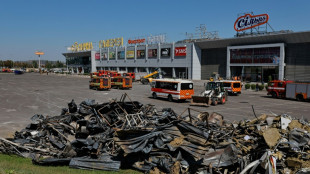 Macron pledges air defence as 13 killed in Russia, Ukraine strikes

As night falls in Chile's Atacama desert, the world's driest, a drilling machine extracts brine to measure levels of lithium -- a crucial mineral for the global switch to cleaner energy, but harmful in its own way.
Chile is seeking to retake its position as the world's top lithium producer, but environmentalists fear extraction in the Atacama desert will harm fragile ecosystems there.
The desert holds the main deposits of the mineral in Chile, which is part of Latin America's "lithium triangle" with Argentina and Bolivia.
Demand for lithium, used in electric car batteries, has grown strongly in recent years as the world seeks to move away from fossil fuels to curb global warming.
In the salt flats of Aguilar and La Isla in the Altoandinos desert region -- at an altitude of 3,400 meters and 4,400 meters respectively -- the temperature is minus zero and the wind biting at the approach of the southern winter.
There is a rush to finish the work of taking brine samples, which are sent to a laboratory to measure lithium content.
"We are drilling day and night," said Ivan Mlynarz, executive vice president of the Enami National Mining Company, which is seeking to start mining of the "white gold" mineral here by 2030.
- 'Positive results' -
Between the Aguilar, La Isla and Grande salt flats, Enami hopes to be able to mine 60,000 tons of lithium annually.
The project is key to Chile's plan to retake its position as the world's top lithium producer, which it lost to Australia in 2016.
"We've had very positive results," Enami worker Cristhian Moreno told AFP, describing the quality of lithium they've been getting from samples as "very favorable."
Chile's leftist President Gabriel Boric came to office with plans to create a national lithium company similar to state-owned copper firm Codelco, formed in the 1970s out of nationalized mining firms.
Last month, Codelco signed a deal with lithium miner SQM to nearly double the private mining firm's current extraction of the mineral in the Salar de Atacama, north of the Altoandinos.
Competitor Australia, which extracts lithium from rock rather than brine, today produces 43 percent of the mineral and Chile 34 percent.
The Codelco/SQM alliance would add some 300,000 tons to Chile's lithium production between 2025 and 2030, and another 280,000-300,000 tons per year from 2031 to 2060.
In 2022, the South American country produced some 243,000 tons.
- 'It won't rain anymore' -
In Chile, lithium is produced through the evaporation of brine in ponds or pools filled with water pumped from underneath salt flats.
Experts say the method puts several animal and plant species at risk with the loss of tons of water in one of the most arid places on Earth.
"These fragile salt flats of Atacama are a refuge for a diversity of Andean life, biological corridors," said expert Cristina Dorador, a professor at the University of Antofagasta.
"They are not mines, they are ecosystems," she said.
Mining in the Altoandinos region of the southern Atacama region also threatens the Indigenous Colla people, some 20,000 of whom call Chile home.
Dwindling water sources in the area have already been forcing them from the mountains, where they traditionally live as shepherds, to the cities -- unable to take care of their animals or themselves.
"If we dry the salt flats it won't rain any more, it won't snow anymore and... all the biodiversity will decline," Colla representative Christopher Castillo, 25, told AFP.
"It is to... exterminate the little biodiversity that we have left."
A research article published in 2019 in the International Journal of Applied Earth Observation and Geoinformation, found that the "water-intensive production process" used in the Atacama desert "has increased concerns around hydrological disruption" in a region with minimal rainfall.
It reported "significant" environmental effects from brine extraction, "including the degradation of surface vegetation, elevating daytime surface temperatures and decreasing soil moisture levels."
A.Seabra--PC