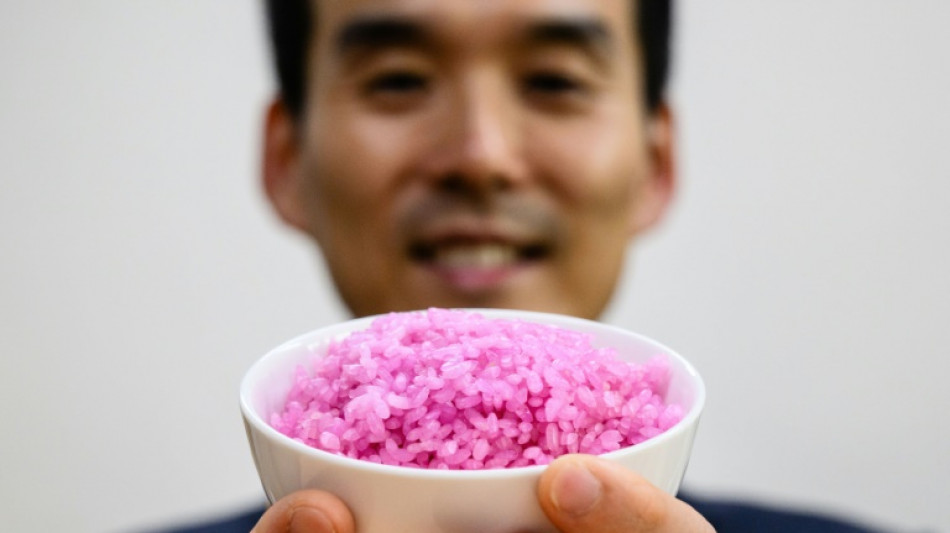
'Meaty rice'? South Korean professor aims to change global protein / Photo: Anthony WALLACE - AFP

 Starc bags 10 as Australia thrash Bangladesh in second Test

 Starc heroics see Australia thrash Bangladesh in second Test

 Pegula dethrones Swiatek to book Cincy final against Gauff

 South Korean survivor fights for workplace harassment 'justice'

 Starc strikes as Bangladesh struggle to stay alive in 2nd Test

 Prince Harry: royal misfit making unlikely UK return

 Blowing in the wind, humble balloon gets green makeover

 Pegula dethrones Swiatek to reach Cincinnati final

 IndyCars zip among iconic Washington landmarks ahead of Freedom 250

 Real Madrid snatch late win at Espanyol on Mourinho's return

 Real Madrid beat Espanyol in Mourinho's first game on return

 Olise helps Bayern past Dortmund in German Supercup

 Coach Rennie hails clinical All Blacks after Springboks Test win

 Charlton deliver blow to 'under pressure' Hammers boss Nuno

 Carrick keeps calm despite Man Utd misery, big-spending Spurs crushed

 Canada's Carney stands up to Trump, despite risks

 Lens hammer Auxerre thanks to Thauvin penalty double

 No singles for Serena, but she joins Alcaraz for US Open

 Joao Pedro extends Chelsea stay with new long-term deal

 Yamaguchi to face An in hunt for fourth badminton world crown

 Norris clinches pole for Dutch GP

 Norris clinches pole for Dutch Grand Prix

 Pope Leo calls for courage in Rimini visit after stop in tiny San Marino

 Man Utd must learn from 'frustrating' defeat at Hull: Carrick

 Yamaguchi on course for fourth badminton world crown

In a small laboratory in Seoul, a team of South Korean scientists are injecting cultured beef cells into individual grains of rice, in a process they hope could revolutionise how the world eats.
From helping prevent famines to feeding astronauts in space, team leader and professor Hong Jin-kee believes his new so-called "meaty rice" could become an eco-friendly, ethical way for people to get their protein.
No animals were harmed in the creation of the dish, which looks like a regular bowl of rice -- albeit pink -- but it gives off a faint buttery aroma, the result of being packed with beef muscle and fat cell culture.
Using cultured meat, "we can obtain animal protein without the slaughter of livestock," Hong, of Seoul's Yonsei University, told AFP.
Companies worldwide have sought to commercialise meat alternatives, such as plant-based or cultured meat, due to ethical issues surrounding industrial livestock rearing, as well as environmental concerns linked to the greenhouse gas emissions from animal farming.
Hong, who has a background in organoids and biomedical sciences, chose rice for his research as the grain was already the top source of protein for people in Asia.
His process can be currently time-consuming: a regular rice grain is coated with fish gelatin to help with adherence, then individually injected with beef cells before being cultured in a petri dish for up to 11 days.
Rice possesses a "slightly porous structure", Hong said, and once the beef cells have been injected into the rice, the grain offers "an ideal structure for cells to grow uniformly from the inside out".
- Carbon footprint -
Hong's "meaty" rice contains eight percent more protein and seven percent more fat than regular rice.
Hong and his team are still working on how to scale the process, he said, but he hopes to get his creation approved as a relief food for emergency situations in two African countries.
"For those who are limited to... just one meal a day, a slight increase in (protein content), even by just a few percent, becomes incredibly important," he said.
South Korea has not yet approved any cultivated meat for consumption, but it announced in 2022 plans to plough millions of dollars into a "foodtech" fund, while separately identifying cell-cultured meat as a priority research area.
Cultivated meat is sold in Singapore and the United States, but Italy banned it last year citing a need to safeguard its livestock industry.
Some scholars say potential ethical concerns with cultured meat include the sourcing of the initial animal cells.
It is difficult to be "certain about the safety of the serum used in culture media, and the antibiotics and hormones added during the culturing process", Choi Yoon-jae, a former emeritus professor at Seoul National University, wrote in a column on the website Chuksan News.
According to Hong's team, their hybrid rice method significantly reduces protein's carbon footprint by eliminating the need to raise and farm animals.
For every 100 grams (3.5 ounces) of protein produced, it releases 6.27 kilograms (13.8 pounds) of carbon dioxide, he estimates -- eight times less than traditional beef production.
- Would you eat it? -
Cultured meat has long been "presented as a climate solution compared to traditional livestock", said Neil Stephens, a lecturer on technology and society at the University of Birmingham.
But the sector faces challenges such as needing to be "produced at scale, and cheap, with low energy needs and environmentally friendly inputs," he told AFP.
"The 'meaty' rice might have an advantage over some other cultured meat products", as it is a hybrid product "mixing animal cells with plant material -- the rice -- making cheaper and less energy intensive," he said.
"This said, it would still need to prove its environmental credentials at scale -- and convince people to eat it. Both might be a challenge."
Global consultancy AT Kearney has predicted that by around 2040, only 40 percent of global meat consumption will come from conventional sources -- and the whole industry will be upended.
"Products such as milk, egg white, gelatin and fish can be created with similar technology," it said in a 2019 report.
Hong passionately believes that biotechnology can change the way humans consume food for the better.
For example, he said, an older person with sarcopenia -- muscle loss -- could eat lab-grown meat produced solely with muscle cells, not fat, to help ease their specific condition.
The world is on the cusp of an era where "more biological information becomes available and we need to meticulously control our food", he said.
This could mean, he said, that a future AI-infused kitchen could assess a person's health through a blood analysis, then instruct a robot to prepare the most suitable breakfast.
N.Esteves--PC