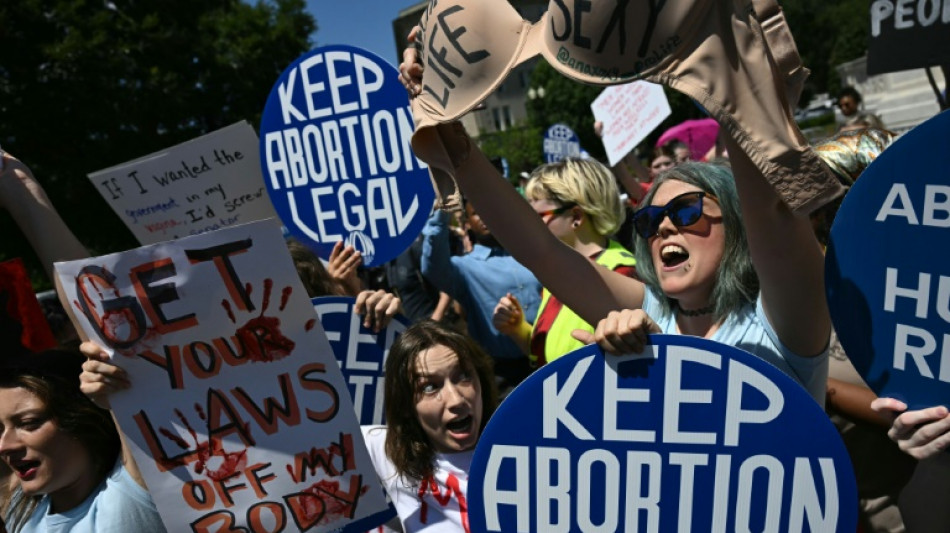
US abortion restrictions have unwanted knock-on effects: studies / Photo: Jim WATSON - AFP

 Pegula dethrones Swiatek to reach Cincinnati final

 IndyCars zip among iconic Washington landmarks ahead of Freedom 250

 Real Madrid snatch late win at Espanyol on Mourinho's return

 Real Madrid beat Espanyol in Mourinho's first game on return
 Olise helps Bayern past Dortmund in German Supercup

 Coach Rennie hails clinical All Blacks after Springboks Test win

 Charlton deliver blow to 'under pressure' Hammers boss Nuno

 Carrick keeps calm despite Man Utd misery, big-spending Spurs crushed

 Canada's Carney stands up to Trump, despite risks

 Lens hammer Auxerre thanks to Thauvin penalty double

 No singles for Serena, but she joins Alcaraz for US Open
 Joao Pedro extends Chelsea stay with new long-term deal

 Yamaguchi to face An in hunt for fourth badminton world crown

 Norris clinches pole for Dutch GP

 Norris clinches pole for Dutch Grand Prix

 Pope Leo calls for courage in Rimini visit after stop in tiny San Marino

 Man Utd must learn from 'frustrating' defeat at Hull: Carrick

 Yamaguchi on course for fourth badminton world crown

 Man Utd humiliated by Hull in dismal start to Premier League season

 Anthropic market debut could break SpaceX IPO record: media

 Pope's 'couturier of the sacred' fueled by faith

 Duplantis locked in on 'grinding' for big bars

 Stokes says decision to leave Headingley off Ashes roster 'shambolic'

 New arrival Rodri to miss Elche opener: Barca's Flick

 Atletico's Alvarez to return against Villarreal: Simeone

Restrictions or outright bans on abortion implemented in some US states can have unexpected consequences like reduced access to contraceptives and higher infant mortality rates, two studies published this week warned.
The two studies come as the United States marks the second anniversary of the Supreme Court's historic decision to overturn constitutional protections on abortion, leaving each state to decide on the hotly contested issue.
The first study, published Wednesday in the Journal of the American Medical Association (JAMA), shows that in states where abortion is illegal, there is a corresponding significant drop in the number of birth-control and morning-after pills dispensed by pharmacies.
Birth-control pills, taken once a day, are the most widely used method of hormonal contraception in the country. The morning-after pill is an emergency contraceptive (EC), taken shortly after unprotected sex or when another method has failed.
For the study, researchers analyzed more than 143 million prescriptions written between March 2021 and October 2023.
They say the drop may be explained by the closing of family planning clinics where abortions were performed, and which also provided other reproductive health services, such as prescribing oral contraceptive pills (OCPs).
There is also confusion in some states as to whether morning-after pills remain legal, or are considered to be a method of abortion, the study said.
It noted that the US Food and Drug Administration (FDA) recently changed the label on one brand of morning-after pills to specify that it is not a means of abortion.
Other policies aimed at restricting access to contraception, such as authorizing pharmacists to decline to dispense such drugs if their use goes against their religious beliefs, could also be a factor, the experts said.
"Given the important role of OCPs and ECs in preventing pregnancy and the need for abortion, efforts to improve access may be needed, especially in states where legal abortion is no longer an option," researchers concluded.
- Family 'trauma' -
A second study published Monday in the same journal looked at how abortion restrictions have affected infant mortality rates.
It focused on a Texas law that came into effect in September 2021, which prohibited abortion after a fetal heartbeat could be detected -- putting about a six-week limit on the procedure, with no exceptions for congenital anomalies.
Researchers say that trends observed since the Texas law came into effect can inform what may also be happening in states where bans came after the 2022 Supreme Court ruling.
By reviewing death certificates, scientists noted a 12.9 percent increase in the number of deaths of babies under a year old in Texas from 2021 to 2022, as compared with a 1.8 percent rise when all states but Texas were considered.
Also from 2021 to 2022, researchers saw a 22.9 percent increase in Texas in the number of deaths of newborns that were linked to congenital illnesses -- the primary cause of infant mortality.
"These findings suggest that restrictive abortion policies may have important unintended consequences in terms of infant health and the associated trauma to families and medical costs," said Alison Gemmill, the study's main author and a professor at the Johns Hopkins Bloomberg School of Public Health.
Texas has since banned all abortions, except in cases where the mother's life is in danger.
But fear of prosecution has led some doctors in the Lone Star State to refuse to intervene even when patients experience serious complications during a pregnancy, according to testimony from women.
S.Caetano--PC