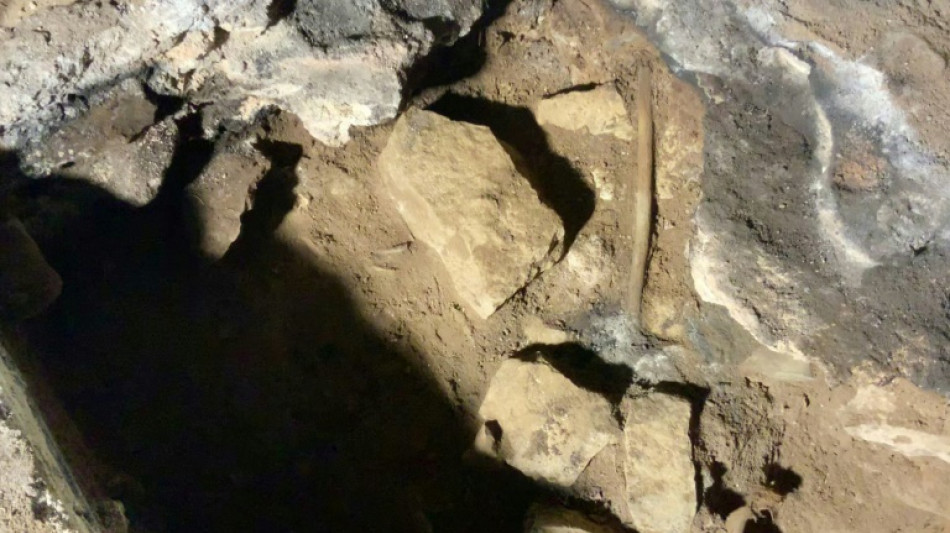
Aboriginal ritual passed down over 12,000 years, cave find shows / Photo: Jess Shapiro - : Gunaikurnai Land and Waters Aboriginal Corporation (GLaWAC)/AFP

 Pegula dethrones Swiatek to reach Cincinnati final

 IndyCars zip among iconic Washington landmarks ahead of Freedom 250

 Real Madrid snatch late win at Espanyol on Mourinho's return

 Real Madrid beat Espanyol in Mourinho's first game on return

 Olise helps Bayern past Dortmund in German Supercup

 Coach Rennie hails clinical All Blacks after Springboks Test win

 Charlton deliver blow to 'under pressure' Hammers boss Nuno

 Carrick keeps calm despite Man Utd misery, big-spending Spurs crushed

 Canada's Carney stands up to Trump, despite risks

 Lens hammer Auxerre thanks to Thauvin penalty double

 No singles for Serena, but she joins Alcaraz for US Open

 Joao Pedro extends Chelsea stay with new long-term deal

 Yamaguchi to face An in hunt for fourth badminton world crown

 Norris clinches pole for Dutch GP

 Norris clinches pole for Dutch Grand Prix

 Pope Leo calls for courage in Rimini visit after stop in tiny San Marino

 Man Utd must learn from 'frustrating' defeat at Hull: Carrick

 Yamaguchi on course for fourth badminton world crown

 Man Utd humiliated by Hull in dismal start to Premier League season

 Anthropic market debut could break SpaceX IPO record: media

 Pope's 'couturier of the sacred' fueled by faith
 Duplantis locked in on 'grinding' for big bars

 Stokes says decision to leave Headingley off Ashes roster 'shambolic'

 New arrival Rodri to miss Elche opener: Barca's Flick

 Atletico's Alvarez to return against Villarreal: Simeone

Two slightly burnt, fat-covered sticks discovered inside an Australian cave are evidence of a healing ritual that was passed down unchanged by more than 500 generations of Indigenous people over the last 12,000 years, according to new research.
The wooden sticks, found poking out of tiny fireplaces, showed that the ritual documented in the 1880s had been shared via oral traditions since the end of the last ice age, a study in the journal Nature Human Behaviour said on Monday.
The discovery was made inside Cloggs Cave in the foothills of the Victorian Alps in Australia's southeast, in a region long inhabited by the Gunaikurnai people.
When the cave was first excavated in the 1970s, archaeologists discovered the remains of a long extinct giant kangaroo that had previously lived there.
But the Gunaikurnai people were not involved in those digs, "nor were they asked for permission to do research there", lead study author Bruno David of Monash University told AFP.
Further excavations starting from 2020 included members of the local Gunaikurnai Land and Waters Aboriginal Corporation (GLaWAC).
Carefully digging through the soil, the team found a small stick poking out -- then they found another one. Both well-preserved sticks were made from the wood of casuarina trees.
Each one was found in a separate fireplace around the size of the palm of a hand -- far too small to have been used for heat or cooking meat.
The slightly charred ends of the sticks had been cut specially to stick into the fire, and both were coated in human or animal fat.
One stick was 11,000 years old and the other 12,000 years old, radiocarbon dating found.
- 'Memoirs of our ancestors' -
"They've been waiting here all this time for us to learn from them," said Gunaikurnai elder Russell Mullett, a co-author of the study and head of GLaWAC.
Mullett spent years trying to find out what they could have been used for, before discovering the accounts of Alfred Howitt, a 19th-century Australian anthropologist who studied Aboriginal culture.
Some of Howitt's notes had never been published, and Mullett said he spent a long time convincing a local museum to share them.
In the notes, Howitt describes in the late 1880s the rituals of Gunaikurnai medicine men and women called "mulla-mullung".
One ritual involved tying something that belonged to a sick person to the end of a throwing stick smeared in human or kangaroo fat. The stick was thrust into the ground before a small fire was lit underneath.
"The mulla-mullung would then chant the name of the sick person, and once the stick fell, the charm was complete," a Monash University statement said.
The sticks used in the ritual were made of casuarina wood, Howitt noted.
Jean-Jacques Delannoy, a French geomorphologist and study co-author, told AFP that "there is no other known gesture whose symbolism has been preserved for such a long time".
"Australia kept the memory of its first peoples alive thanks to a powerful oral tradition that enabled it to be passed on," Delannoy said.
"However in our societies, memory has changed since we switched to the written word, and we have lost this sense."
He lamented that the ancient animal paintings found in French caves would probably "never reveal their meaning" in a similar way.
Indigenous Australians are one of the oldest continuous living cultures, and Mullett said the discovery was a "unique opportunity to be able to read the memoirs of our ancestors".
It was "a reminder that we are a living culture still connected to our ancient past," he added.
V.Fontes--PC