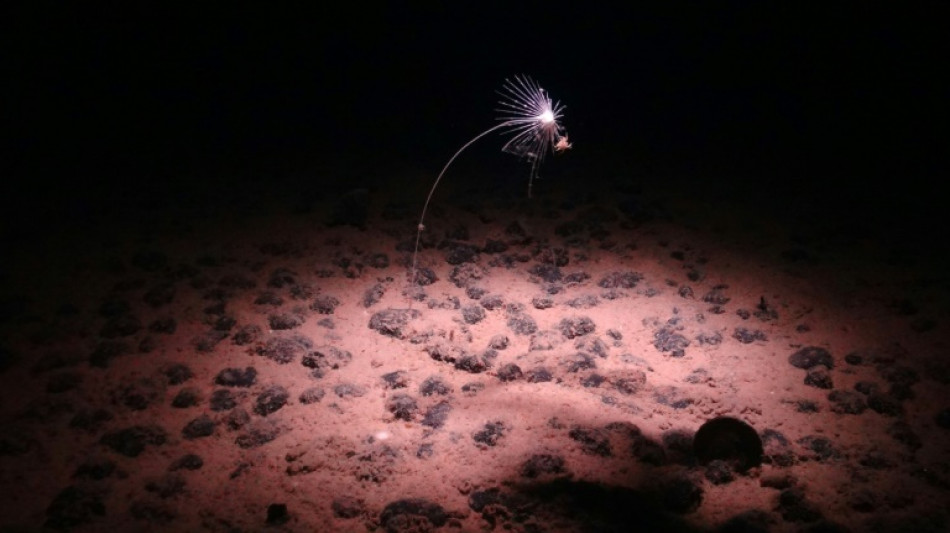
Deep ocean 'dark oxygen' find could rewrite Earth's history / Photo: Handout - National Oceanography Centre / Smartex project (NERC)/AFP/File

 Yamaguchi on course for fourth badminton world crown

 Man Utd humiliated by Hull in dismal start to Premier League season
 Anthropic market debut could break SpaceX IPO record: media

 Pope's 'couturier of the sacred' fueled by faith

 Duplantis locked in on 'grinding' for big bars
 Stokes says decision to leave Headingley off Ashes roster 'shambolic'

 New arrival Rodri to miss Elche opener: Barca's Flick

 Atletico's Alvarez to return against Villarreal: Simeone

 Dozens of civilians killed, kidnapped as jihadists clash in Nigeria

 Former envoys urge joint French, UK action on Palestinian territories

 Australia lead by 101 in 2nd Bangladesh Test as 18 wickets fall on day one

 'Aura' battles leap from social media to Latin America streets

 US, Canada fail to reach trade pact to avert Trump tariffs

 Sudan farms lie barren as El Nino leaves Nile banks dry

 Arctic shipping a daunting prospect in hotly contested region
 In US, rare earths extracted from coal mine wastewater

 Nakashima pounds Fritz, Bejlek beats Keys in Cincinnati upsets

 Canadian negotiator says 'more work to do' on US trade deal

 'Solid' Clark takes solo lead at BMW Championship

 Arteta hails Arsenal's desire after perfect start to title defence

 Betis down Real Sociedad in La Liga opener

 Mexican governor resumes job despite US drug charges

 Arsenal rout Coventry to open Premier League season in style

 Giant-killer Bejlek overhauls Keys to reach Cincinnati semi-finals

 Man Utd agree deal for Brighton midfielder Baleba: reports

In the total darkness of the depths of the Pacific Ocean, scientists have discovered oxygen being produced not by living organisms but by strange potato-shaped metallic lumps that give off almost as much electricity as AA batteries.
The surprise finding has many potential implications and could even require rethinking how life first began on Earth, the researchers behind a new study said on Monday.
It had been thought that only living things such as plants and algae were capable of producing oxygen via photosynthesis -- which requires sunlight.
But four kilometres (2.5 miles) below the surface of the Pacific Ocean, where no sunlight can reach, small mineral deposits called polymetallic nodules have been recorded making so-called dark oxygen for the first time.
The discovery was made in the Clarion-Clipperton Zone (CCZ), an abyssal plain stretching between Hawaii and Mexico, where mining companies have plans to start harvesting the nodules.
The lumpy nodules -- often called "batteries in a rock" -- are rich in metals such as cobalt, nickel, copper and manganese, which are all used in batteries, smartphones, wind turbines and solar panels.
The international team of scientists sent a small vessel to the floor of the CCZ aiming to find out how mining could impact the strange and little understood animals living where no light can reach.
- No sunlight required -
"We were trying to measure the rate of oxygen consumption by the seafloor," lead study author Andrew Sweetman of the Scottish Association for Marine Science (SAMS) told AFP.
To do so, they used a contraption called a benthic chamber which snatched up a bunch of sediment.
Normally, the amount of oxygen trapped in the chamber "decreases as its used up by organisms as they respire," Sweetman said.
But this time the opposite happened -- the amount of oxygen increased. This was not supposed to happen in complete darkness where there is no photosynthesis.
This was so shocking that the researchers initially thought their underwater sensors must have been on the blink.
So they brought up some nodules to their ship to repeat the test. Once again, the amount of oxygen increased.
They then noticed how the nodules were carrying a startling electric change.
On the surface of the nodules, the team "amazingly found voltages almost as high as are in an AA battery," Sweetman said.
This charge could split seawater into hydrogen and oxygen in a process called seawater electrolysis, the researchers said.
This chemical reaction occurs at around 1.5 volts -- around the charge of a AA battery.
- 'Exciting' -
SAMS director Nicholas Owens said it was "one of the most exciting findings in ocean science in recent times".
The discovery of oxygen produced outside of photosynthesis "requires us to rethink how the evolution of complex life on the planet might have originated," he said in a statement.
"The conventional view is that oxygen was first produced around three billion years ago by ancient microbes called cyanobacteria and there was a gradual development of complex life thereafter," Owens added.
But the team's discovery showed that "life could have started elsewhere than on land," Sweetman said.
"And, if the process is happening on our planet, could it be helping to generate oxygenated habitats on other ocean worlds such as Enceladus and Europa and providing the opportunity for life to exist?" Sweetman asked.
The study was published in the journal Nature Geoscience.
The work was partly funded by Canada's The Metals Company, which is aiming to start mining the nodules in the CCZ next year.
A.F.Rosado--PC