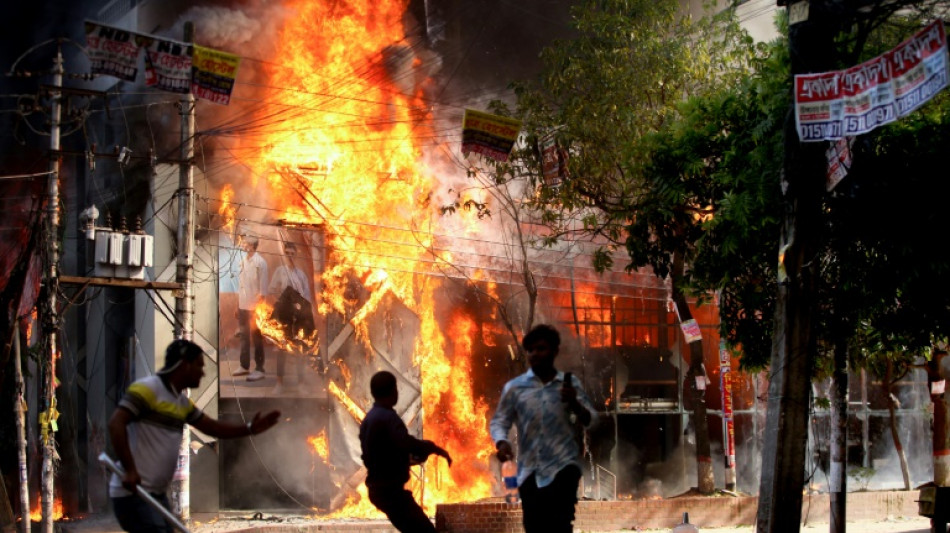
How Bangladesh student protests brought in a new leader / Photo: Abu SUFIAN JEWEL - AFP

 'Aura' battles leap from social media to Latin America streets
 US, Canada fail to reach trade pact to avert Trump tariffs
 Sudan farms lie barren as El Nino leaves Nile banks dry
 Arctic shipping a daunting prospect in hotly contested region
 In US, rare earths extracted from coal mine wastewater
 Nakashima pounds Fritz, Bejlek beats Keys in Cincinnati upsets

 Canadian negotiator says 'more work to do' on US trade deal

 'Solid' Clark takes solo lead at BMW Championship
 Arteta hails Arsenal's desire after perfect start to title defence

 Betis down Real Sociedad in La Liga opener
 Mexican governor resumes job despite US drug charges

 Arsenal rout Coventry to open Premier League season in style

 Giant-killer Bejlek overhauls Keys to reach Cincinnati semi-finals

 Man Utd agree deal for Brighton midfielder Baleba: reports
 Werro wins Lausanne 800m, well off world record pace
 China mulls bid to host 2028 UN climate talks: sources
 Jones becomes third Englishman to join Inter this summer
 Mexican governor wanted on US drug charges returns to job

 Bolivia's Paz forced to fire economy minister in mid-crisis
 A-Rod ups T-Wolves stake in $4.5bn ownership change
 UK court orders Prince Harry, others to pay Daily Mail initial £9.5mn
 'Grateful' ex-world champion Alaphilippe retires from cycling

 US, Canada work to wrap up trade deal ahead of looming deadline

 Malaysia's JDT claim unbeaten run world record

 At least 2 teens seriously wounded in sword attack at Swedish school
A student-led uprising in Bangladesh against government hiring rules culminated this week in the prime minister fleeing, with Nobel peace prize winner Muhammad Yunus set to lead a caretaker government.
At least 450 people were killed in more than a month of deadly protests that ended the autocratic rule of 76-year-old prime minister Sheikh Hasina.
Here are five key dates explaining how the protests toppled the government in the South Asian nation of about 170 million people.
- July 1: Blockades begin -
University students build barricades blocking roads and railway lines to demand reforms to a quota system for sought-after public sector jobs.
They say the scheme is used to stack the civil service with loyalists of Hasina's ruling Awami League.
Hasina, who won a fifth term as prime minister in January after a vote without genuine opposition, says the students are "wasting their time".
- July 16: Violence intensifies -
Six people are killed in clashes, the first recorded deaths in the protests, a day after bitter violence when protesters and pro-government supporters fought in Dhaka with sticks and hurled bricks at each other.
Hasina's government orders the nationwide closure of schools and universities.
- July 18: Hasina rebuffed -
Students reject an olive branch from Hasina, a day after she appeals for calm and vows that every "murder" in the protests would be punished.
Protesters chant "down with the dictator" and torch the headquarters of state broadcaster Bangladesh Television and dozens of other government buildings.
Clashes escalate despite a round-the-clock curfew, the deployment of soldiers and an internet blackout.
Days later, the Supreme Court rules the decision to reintroduce job quotas was illegal.
But its verdict falls short of protesters' demands to entirely abolish reserved jobs for children of "freedom fighters" from Bangladesh's 1971 independence war against Pakistan.
- August 5: Hasina toppled -
Hasina flees Dhaka by helicopter as thousands of protesters storm her palace, with millions on the streets celebrating, some dancing on the roof of armoured cars and tanks.
Bangladesh army chief General Waker-Uz-Zaman announces in a broadcast on state television that Hasina had resigned and the military would form an interim government.
- August 8: Yunus to lead -
Nobel peace prize winner Yunus, 84, flies to Dhaka to lead a caretaker government.
He is expected to be sworn in later in the day, to begin what the army chief has vowed will be a "beautiful democratic process".
M.Gameiro--PC