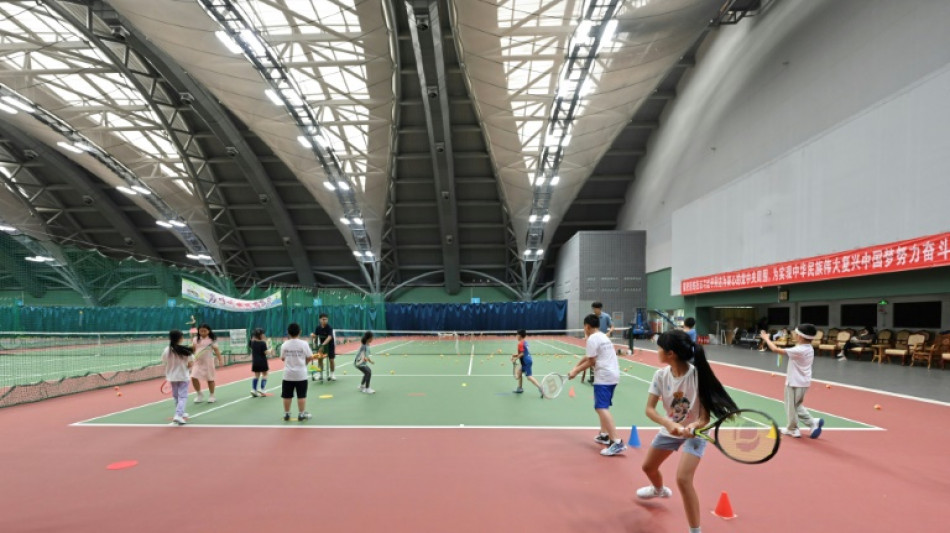
China's Olympic tennis glory tracks booming middle classes / Photo: Adek BERRY - AFP

 Bangladesh all out for 64 in 2nd Test after Starc masterclass

 Odyssey effect: stars sell Greece to a new wave of US tourists

 South Korea to send first container ship through Arctic route

 Starc takes 5-11 to leave Bangladesh reeling in 2nd Test
 Injured Rune withdraws from US Open

 Nakashima knocks out Fritz to reach Cincinnati semi-finals

 Ukraine says 'cynical' Russian strike on shopping centre killed 16

 TikTok to pay $400 mn settlement in US children's privacy case

 MLS fines Messi for striking an opponent

 Gouiri double fires Marseille past Strasbourg in Ligue 1 opener

 Mavericks buy out Thompson, now reportedly bound for Heat
 England v Pakistan first Test: Three talking points

 US, Canada push to seal trade deal as deadline nears

 One dead, three wounded after sword attack at Swedish high school

 Ukraine says 'cynical' Russian strike on shopping centre killed 15

 US Supreme Court allows White House ballroom construction for now

 Root hails emerging fast bowlers as England thrash Pakistan

 Brazil's Lula urges tariffs resolution in call with Trump

 Ukraine says 'cynical' Russian strike on shopping centre killed 14

 Heatwave-hit Europe logs over 30,000 excess summer deaths: first figures

 Give LIV Golf 'one more shot,' says DeChambeau

 Duplantis hits the high notes for athletics anthem

 Malaysia's JDT claims unbeaten run world record

 Bolivian economy minister fired after Congress vote

 Russell roars to Dutch GP sprint pole, Antonelli fifth

Zheng Qinwen's historic tennis gold at the Paris Olympics this month followed a decades-long surge in the sport's popularity among China's burgeoning middle class, and her victory is set to boost it even more.
The 21-year-old won China's second-ever tennis gold, and first in singles, on the clay at Roland Garros, hailing the victory as a "proud" moment for herself and her country.
This week in Beijing, tennis centres visited by AFP were full of kids and adults, while club bosses reported a spike in interest following Zheng's title.
"I think it's really fun to play tennis and I've been playing it for three years," 14-year-old Zhang Xinghao told AFP after a session at the Beijing International Tennis Academy.
"I truly like this sport."
The student said he had returned a day earlier from an educational summer camp in the United States where he couldn't play tennis but came straight to the club for a lesson in spite of the jetlag.
Elsewhere in the Chinese capital, around a dozen children lined up to whack balls teed up by coaches at the Open Star Tennis Club, where player numbers have more than doubled in recent weeks following Zheng's gold medal.
"She is at the top of the pyramid and her win has had a huge impact and now more people are coming to play," club owner Liu Yingjun, 41, told AFP. "It is a huge boon for the tennis industry."
- Middle-class boom -
Tennis was introduced to China in the 1860s, but it failed to gain mass appeal and was largely an elite sport reserved for the wealthiest families.
During the country's politically turbulent Cultural Revolution era, it was even deemed a manifestation of the sins of revisionists and the petty bourgeoisie.
However, the rapid growth of China's middle class in recent decades has brought profound economic and social changes to the country, and tennis has followed.
In 2000, just four percent of urban households were considered middle class, but now the official estimate of China's middle-income population has exceeded 400 million -- almost 30 percent of the country's 1.4 billion.
Simultaneously China's tennis-playing population has exploded from less than two million in 2006 to nearly 20 million in 2021, ranking second only after the United States.
- Tennis mania -
Sports marketing expert Adam Zhang said "tennis mania" had hit China -- from children going through grassroots programmes to companies spending big on corporate sponsorship.
Zheng's Olympic gold triggered her racket and shoes to trend online, while racket manufacturer Wilson saw a 2,000 percent increase in interest in the model she uses.
"When players do well in their games, like winning the four Grand Slams or the Olympics, they become idols for young people," Beijing-based Zhang said.
Zheng's Olympic success was first inspired by a trip to the Chinese capital to watch the 2008 Beijing Games, her father Zheng Jianping -- a former track and field athlete -- told local media.
And on watching Li Na -- China's most successful tennis player with two Grand Slams -- win the Australian Open in 2014, an 11-year-old Zheng Qinwen told a TV crew she wanted to "fight for championships".
After picking up a racket in her hometown of Shiyan in central Hubei province, her obvious talent and hard work led her to training centres in the provincial capital Wuhan and then on to Beijing.
That ambition, however, came at a significant financial cost.
Zheng Jianping reportedly spent hundreds of thousands of dollars a year on his daughter's coaching, overseas travel, food and accommodation.
- 'Sharpen his will' -
Savvy Chinese parents have long seen tennis as a means to help their children stand out in applications for cut-throat higher education places -- both home and abroad -- as well as better connect with their peers.
The mother of Beijing teenager Zhang, Qiu Jingchong, told AFP she hopes her son "can sharpen his will by practising tennis".
"I also hope that his tennis skills will be a highlight on his application when he goes to middle school or studies abroad in the future," she said as her son toiled in his training session.
Her expectations are not unusual.
Aaron Cao, owner of the Beijing International Tennis Academy in Chaoyang Park, said she has noticed many parents have a steadfast goal in sending their children to lessons.
"They want their children to start playing tennis in primary school so that when these children go off to the US for college, they will have the common hobby to socialise with others," she told AFP.
"You can't do that with ping pong."
P.Mira--PC