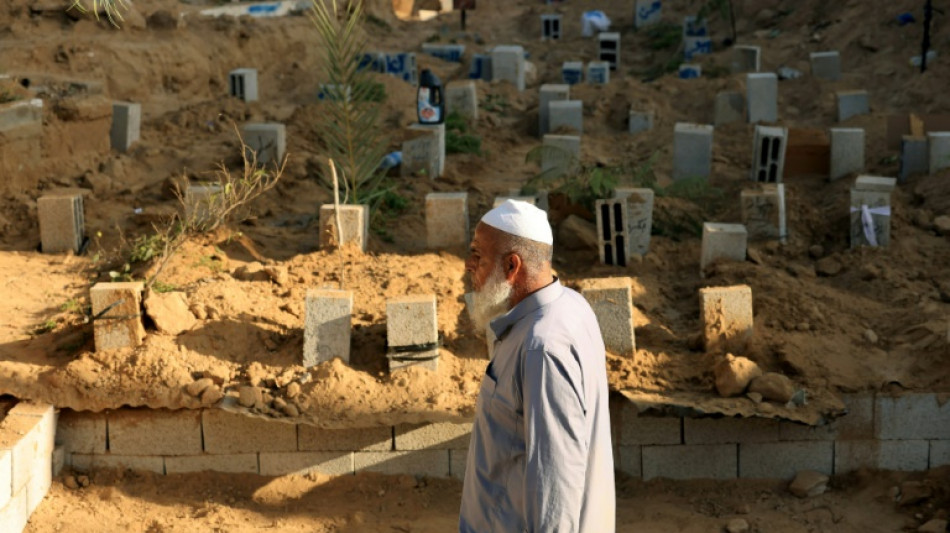
Gaza's overwhelmed undertakers stack 'graves on top of graves' / Photo: MAHMUD HAMS - AFP

 Bangladesh all out for 64 in 2nd Test after Starc masterclass
 Odyssey effect: stars sell Greece to a new wave of US tourists

 South Korea to send first container ship through Arctic route

 Starc takes 5-11 to leave Bangladesh reeling in 2nd Test

 Injured Rune withdraws from US Open
 Nakashima knocks out Fritz to reach Cincinnati semi-finals

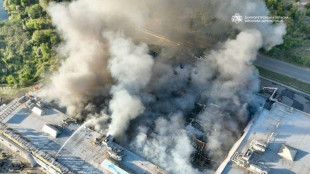 Ukraine says 'cynical' Russian strike on shopping centre killed 16

 TikTok to pay $400 mn settlement in US children's privacy case

 MLS fines Messi for striking an opponent

 Gouiri double fires Marseille past Strasbourg in Ligue 1 opener

 Mavericks buy out Thompson, now reportedly bound for Heat

 England v Pakistan first Test: Three talking points

 US, Canada push to seal trade deal as deadline nears

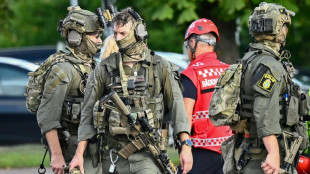 One dead, three wounded after sword attack at Swedish high school

 Ukraine says 'cynical' Russian strike on shopping centre killed 15

 US Supreme Court allows White House ballroom construction for now

 Root hails emerging fast bowlers as England thrash Pakistan

 Brazil's Lula urges tariffs resolution in call with Trump

 Ukraine says 'cynical' Russian strike on shopping centre killed 14

 Heatwave-hit Europe logs over 30,000 excess summer deaths: first figures

 Give LIV Golf 'one more shot,' says DeChambeau

 Duplantis hits the high notes for athletics anthem

 Malaysia's JDT claims unbeaten run world record
 Bolivian economy minister fired after Congress vote
 Russell roars to Dutch GP sprint pole, Antonelli fifth
Undertakers are working like bricklayers in a Gaza cemetery, piling cinder blocks into tight rectangles, side by side, for freshly dug graves.
More than 10 months into the Gaza war, so many bodies are arriving at the cemetery in Deir el-Balah that the men, working in the hot sun, hardly have space to bury them.
"The cemetery is so full that we now dig graves on top of other graves, we've piled the dead in levels," says Saadi Hassan Barakeh, leading his team of gravediggers.
Barakeh, 63, has been burying the dead for 28 years. In "all the wars in Gaza", he says he has "never seen this".
Previously, Barakeh also oversaw burials at the nearby Ansar cemetery, which covers 3.5 hectares (8.6 acres).
But now "the Ansar cemetery is completely full. There were too many dead", he says, his clothes smeared in dirt from digging graves.
He now handles just the Al-Soueid cemetery, with its 5.5 hectares of graves. Yet even with one cemetery instead of two, he works "every day, from six in the morning to six in the evening".
"Before the war, we had one or two funerals per week, maximum five," he says, wearing a white prayer cap that matches his long beard.
"Now, there are weeks when I bury 200 to 300 people. It's unbelievable."
- 'I can't sleep' -
Gaza's death toll of just over 40,000 in more than 10 months of war, according to the Hamas-run territory's health ministry, is straining its people as well as its cemeteries.
Barakeh bears daily witness to the tragedies. Hoe in hand, he gives encouragement to his 12 workers as they prepare and close dozens of graves every day.
At night, however, some images are hard to forget.
"I can't sleep after seeing so many mangled children's bodies and dead women," he said, adding: "I buried 47 women from one family."
The October 7 Hamas attack which triggered the war resulted in the deaths of 1,198 people, mostly civilians, according to an AFP tally of Israeli official figures.
Militants also seized 251 people, 111 of whom are still held in Gaza, including 39 the military says are dead.
Israel's retaliatory military offensive has killed at least 40,005 people in Gaza, according to the health ministry, which does not provide a breakdown of civilian and militant deaths.
"I buried a lot of women and children, and only two or three guys from Hamas," says Barakeh.
- 'Why the children?' -
If Israelis "have a problem with (Yahya) Sinwar, why do they harm children?" he adds, referring to the alleged October 7 attacks mastermind who is now Hamas's overall leader.
"Let them kill Sinwar and all the others, but why the women and children?"
Mounds of freshly dug soil are reminders of recent burials. Graves with white headstones fill nearly all the available space, while men dig new holes in the few vacant areas.
The team forms a human chain to carry the cinder blocks, whose price has soared since Gaza's factories closed due to a lack of fuel and raw materials.
"One shekel ($0.27) before the war, 10 or 12 today," he lamented.
Besides gravediggers and the workers carrying cinder blocks, hardly anyone comes to funerals anymore, Barakeh says.
"Before the war, there were sometimes 1,000 people at one funeral; today there are days when we bury 100 people and there aren't even 20 to lay them to rest."
High above his head, the constant hum of an Israeli surveillance drone serves as a reminder of the aerial threat creating a steady stream of bodies.
E.Ramalho--PC