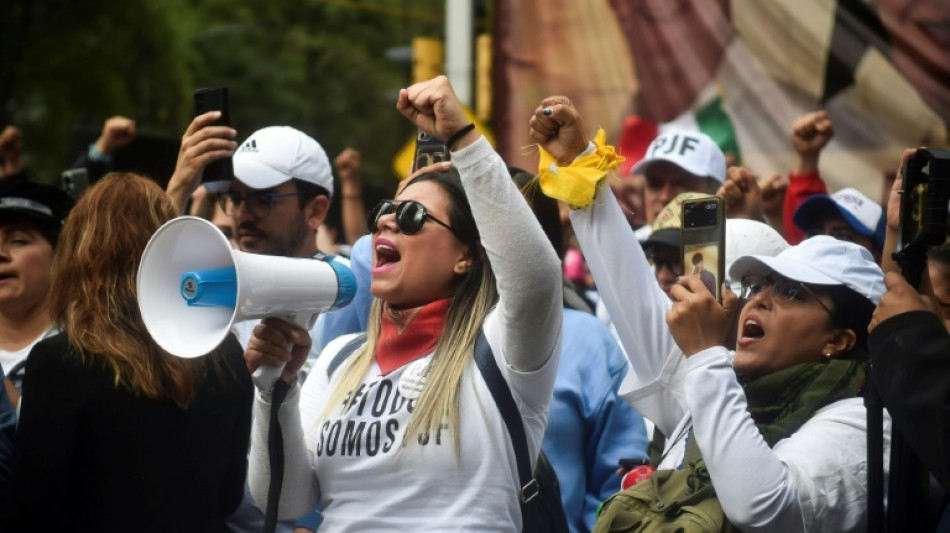
Why have Mexico's judicial reforms upset investors? / Photo: Rodrigo Oropeza - AFP

 Judge allows UK rugby brain injury court case to continue to trial

 Trump announces temporary tariff relief on ground beef imports

 Pope to visit San Marino, address Italian political event

 All Blacks just as good as Springboks, says captain Savea

 Romania holding suspected 'low-level agent' after pistols found near Berlin: Germany

 UK forecasts 'biggest' El Nino will smash records, spark hottest year

 Cyclist Alaphilippe attracts tributes as reports say he has quit

 Top-ranked An, holder Yamaguchi reach badminton worlds semi-finals

 Iran president says time to end war while in position of strength

 Antonelli fastest in sole Dutch GP practice session

 2,500 dead and rising -- UN says DR Congo Ebola outbreak 'growing exponentially'

 England all out for 409, lead Pakistan by 238 runs in 1st Test

 Premier League returns with Arsenal eyeing title dynasty

 Bayern knew about Musiala's condition 'a long time ago' says Kompany

 Ex-Pakistan PM Khan taken back to jail after hospital checks

 Real Madrid star players are compatible: Mourinho

 Drovix Launches In-House Multi-Asset Liquidity and Execution Stack for Sub-Millisecond Fills, Tighter Spreads

 'So bad it's good': rough animated film becomes surprise Chinese hit

 'I'll adapt': First pregnant candidate navigates French presidential race

 Hong Kong convicts Tiananmen vigil activists of inciting subversion

 The Hong Kong Tiananmen vigil activists convicted in national security trial

 Eel-powered Japan whizz-kid, 11, chases Asian Games history

 Asian markets extend rally as traders assess US Treasuries pledge

 Barcelona enter new era as Flick targets La Liga hat-trick

 Pogacar favourite for Vuelta with Grand Tour treble in sight

President Andres Manuel Lopez Obrador's controversial judicial reforms making Mexico the world's only country to elect all its judges by popular vote have spooked financial markets and investors.
What are the implications of the changes for Latin America's second-largest economy?
- Why are investors worried? -
Experts have warned that the reforms will lead to increased uncertainty about Mexico's legal operating environment -- in particular whether disputes between the government and the private sector would be resolved in an impartial manner.
"This is such a fundamental change to the Mexican judiciary that foreign investors are still trying to figure out what this will mean," said Jason Marczak, vice president of the Adrienne Arsht Latin America Center at the Atlantic Council, a US-based think tank.
"There's concern that the decisions that judges may take are not necessarily decisions that only take into account Mexican law and legal agreements that Mexico has with the United States and Canada" as part of a regional free trade agreement, he said.
Investors worry that "there would be an inclination to also make decisions based on what will resonate well with the voters," Marczak told AFP.
Moody's Ratings has warned that the new law "risks politicizing Mexico's federal and Supreme Court rulings, undermining the system's independence.
"The judicial overhaul will erode checks and balances, risking undermining Mexico's economic and fiscal strength," the ratings agency said.
- What does it mean for 'nearshoring'? -
The Mexican employers' association Coparmex has said that the government "is sending a worrying signal about Mexico's institutional fragility, putting at risk our relationship with our trading partners, the flow of capital and economic growth."
Lopez Obrador -- who says the reforms are needed to fight corruption -- has played down such warnings, predicting that 2024 "will be the year with the most foreign investment in the history of Mexico."
The leftist leader, who will leave office on October 1, has blamed a fall in the value of the Mexican peso to a two-year low against the dollar on "external factors."
The country hopes to benefit from the so-called "nearshoring" trend of US companies moving operations closer to home to places such as Mexico instead of Asia.
But Moody's Ratings warned that changes in the judiciary system "would be particularly harmful to future investment in nearshoring opportunities."
Geopolitical tensions and supply chain gridlock during the Covid pandemic have prompted a growing number of companies to consider relocating to the doorstep of the world's biggest economy.
While that trend is unlikely to stop completely, the reforms may make companies think twice, according to experts.
Long-term economic certainty is key for attracting investment, Marczak said.
"The reforms will give an additional layer of questioning in the boardroom," he added.
- What are the trade implications? -
The United States and Canada -- Mexico's partners in a sweeping regional free trade deal -- have both raised concerns about the reforms.
Experts say that could complicate a review of the United States-Mexico-Canada Agreement (USMCA) due by 2026.
"It was going to be already a very contentious revision," Carlos Ramirez, partner at political risk consultancy firm Integralia Consultores, said recently at a roundtable.
Now the judicial reforms and the planned elimination of autonomous institutions "will make Mexico much more vulnerable" going into the negotiations, he added.
According to Emerging Markets Political Risk Analysis, another consultancy firm, the reforms might potentially violate the regional trade deal, which assumes an independent judiciary.
"Although it is unlikely that the US or Canada would withdraw from the USMCA due to the strong economic interdependence between the countries, increasing frictions could complicate the 2026 USMCA ratification process and limit Mexico's opportunities," it said.
- Could the fallout tip Mexico into recession? -
The British consultancy firm Oxford Economics said while the reform "does not pose an immediate threat to the overall economy," uncertainty will dampen investment.
It said the changes could lead to investment falling 12 percent below its baseline forecast, weighing on economic growth.
Even before lawmakers approved the reforms, Mexico's central bank reduced its forecast for economic growth this year to 1.5 percent, from a previous prediction of 2.4 percent, amid global headwinds.
According to Gabriela Siller, head of economic analysis for the financial group Banco BASE, the judicial reform now "increases the likelihood that the Mexican economy will fall into recession."
A.P.Maia--PC