AI research uncovers 300 ancient etchings in Peru's Nazca desert / Photo: Handout - Yamagata University Institute of Nasca/AFP

 Drovix Launches In-House Multi-Asset Liquidity and Execution Stack for Sub-Millisecond Fills, Tighter Spreads

 'So bad it's good': rough animated film becomes surprise Chinese hit

 'I'll adapt': First pregnant candidate navigates French presidential race

 Hong Kong convicts Tiananmen vigil activists of inciting subversion

 The Hong Kong Tiananmen vigil activists convicted in national security trial

 Eel-powered Japan whizz-kid, 11, chases Asian Games history

 Asian markets extend rally as traders assess US Treasuries pledge

 Barcelona enter new era as Flick targets La Liga hat-trick

 Pogacar favourite for Vuelta with Grand Tour treble in sight

 Bangladesh coach Simmons wary of Australia backlash in second Test

 Hong Kong Tiananmen activists to receive national security verdict

 Who are the candidates vying to lead the UN?
 Swiatek into Cincinnati semis after Rybakina injury

 University suspends academic behind Jason Arday plagiarism charges

 Key European leaders demand Israel halt West Bank settlement project

 McIlroy bounces back to share BMW Championship lead

 Cobolli fueled by candy in sweet defeat of Paul

 Jailed Pakistan ex-PM Khan moved to hospital on court order: party

 Pogacar eyes 'missing' piece ahead of Vuelta return

 US, Canada 'very close' to trade deal, Ottawa says, as details emerge

 Ronaldinho returns in search of 'beautiful' 300th goal

 US pushes allies, China to back Trump's economic war on Iran

 Former NBA MVP Harden reportedly set to return to Cavaliers

 Brook makes Pakistan pay for drop as England dominate first Test

 MemeCore Arrives on Nasdaq Through $1 Billion Landmark Treasury Transaction

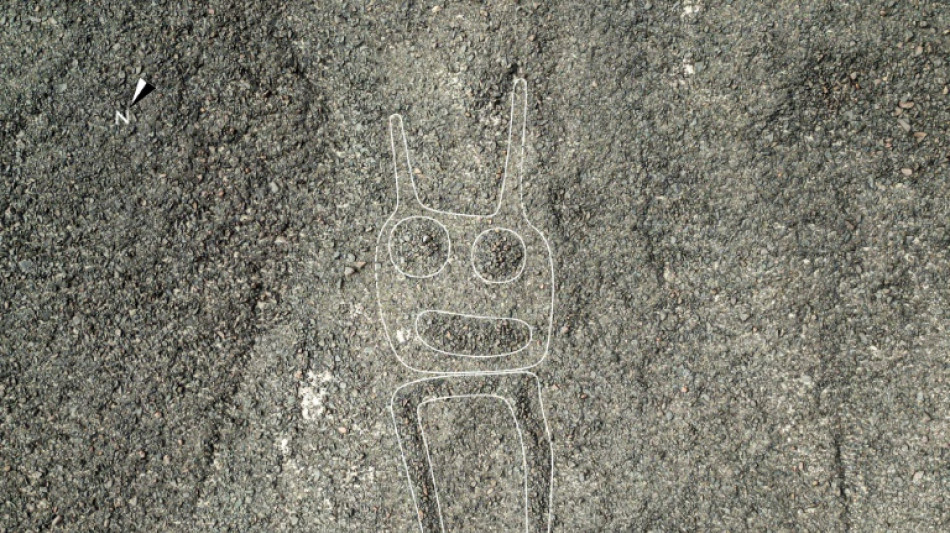
Japanese scientists have used artificial intelligence to uncover 303 new etchings in Peru's Nazca desert -- doubling the amount of known geoglyphs made some 2,000 years ago by a pre-Inca civilization.
The fabled Nazca lines, a series of massive incisions on the desert floor depicting animals, plants, imaginary beings and geometric figures, have fascinated scientists ever since they were first discovered around a century ago.
Best viewed from the air, the lines situated some 220 miles (350 kilometers) south of Lima are one of Peru's top tourist attractions.
Announcing the new discoveries in Lima on Monday, archaeologist Masato Sakai, from Yamagata University, said: "The use of AI in research has allowed us to map the distribution of geoglyphs in a faster and more precise way."
He said the findings were the fruit of collaboration between his university's Nazca Institute and the research division of the technology company IBM.
"The traditional method of study, which consisted of visually identifying the geoglyphs from high-resolution images of this vast area, was slow and carried the risk of overlooking some of them," he added.
The study was also published on Monday in the prestigious Proceedings of the National Academy of Sciences (PNAS) journal, describing how AI can be used to accelerate discoveries in archeology even in well-known sites.
The paper said it had taken nearly a century to discover 430 figurative Nazca geoglyphs.
Using AI, scientists found 303 more during only six months of field surveys.
The AI model was particularly good at picking up smaller relief-type geoglyphs which are harder to spot with the naked eye.
Among the new figures discovered were giant linear-type geoglyphs, mainly representing wild animals, but also smaller ones with motifs of abstract humanoids and domesticated camelids, a mammal from the camel family.
Scientists used AI to analyze a vast amount of geospatial data produced by aircraft to identify areas where they might find more geoglyphs.
The people that formed the Nazca civilization lived in the area of southwestern Peru from 200 BC to 700 AD.
What drove them to create the lines, designated a UNESCO World Heritage site, is a mystery.
Some scientists believe they have astrological and religious significance.
The first geoglyphs were discovered in 1927.
R.Veloso--PC