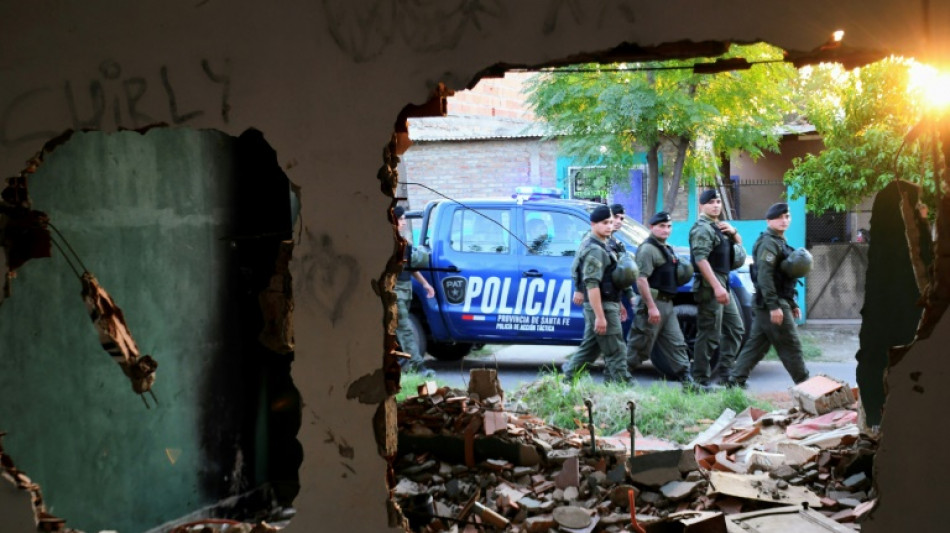
Argentina's narco capital sees mysterious drop in murders / Photo: - - AFP/File

 Ex-Pakistan PM Khan taken back to jail after hospital checks: govt

 China, Indonesia hold talks on security, defence
 Train to nowhere? South Korea's lonely push for peace with the North

 Australia's Hussey mulls role with England for Ashes series

 Indian captain 'scapegoat' in Britain's Russia shadow fleet case, wife says

 Rosenior seeks to match Paris FC's capital ambition as Ligue 1 returns

 Inter set for Serie A title defence as Milan get Amorim reboot

 'Greatest' Springboks face All Blacks in clash of juggernauts

 William and Harry: Britain's warring royal brothers
 UN holds second informal poll for next leader
 In US mining hub, black lung rates soar

 Champions Arsenal embrace being 'hunted' as Premier League returns
 World No.2 Rybakina retires from Cincinnati clash with Swiatek

 'I heard you missed me': Melania Trump jokes about month out of spotlight

 Amazon Prime Video to invest $2 bn in Latin America productions

 Panama Canal to reduce shipping over El Nino-fueled drought

 Maradona trial on hold over possible medical evidence mix-up

 'Green dilemma': China's solar boom hurt birds, says study

 Pegula hangs on to dispatch Anisimova, reach Cincinnati semi-finals

 US charges woman with IS-inspired plot to blow up New York State Capitol

 What a record-breaking El Nino could mean for the world

 Duplantis edges Karalis to win Lausanne Diamond League pole vault

 Alcaraz to return for US Open title defence

 China's rapid solar expansion hurt bird diversity: study

 President Paul Biya back in Cameroon after 73 days away

Argentina's most violent city, Rosario -- best known as the hometown of soccer star Lionel Messi -- has in recent months seen a drastic, and some say suspicious, fall in murders.
Authorities boast the change is the result of a crackdown on drug-trafficking gangs, both on the streets and in prisons.
However, some believe a tacit pact between the government and criminal groups may explain the turnaround.
Rosario has a key port on South America's second-longest river after the Amazon -- the Parana -- which has made it a hotspot for the movement of drugs from Bolivia, Brazil and Paraguay headed for Europe and Asia.
The city, Argentina's third-largest, has long had a murder rate standing at around five times the national average, with up to 260 killings per year.
Even the families of famous residents like Messi, or fellow football player Angel Di Maria have received violent threats or attacks by criminal organizations.
But everything seems to have changed since the end of 2023, when President Javier Milei took office, vowing zero tolerance for crime.
At the same time, the province of Santa Fe, where Rosario is located, got a new governor, Maximiliano Pullaro.
Pullaro immediately imposed harsher conditions on prisoners, particularly gang bosses, publishing photos of jail raids and subdued prisoners.
His actions earned him around 30 death threats in his first months in office and prompted a backlash from gangs, who killed four civilians in March.
Milei then sent federal police and troops into Rosario.
- 'Tacit deal' -
According to a report from the national security ministry, Rosario's murder rate dropped 62 percent between January and August compared to the same period last year.
"We have the lowest number of homicides in 17 years in Rosario," said Security Minister Patricia Bullrich.
"We said that we were going to put order in prisons and order in the street. And that is what we did," added Pullaro, who has been accused of emulating the harsh gang-busting tactics of El Salvador's popular President Nayib Bukele.
Yet experts are skeptical that these measures alone led to the rapid decline in murders.
The former security minister of Santa Fe, Marcelo Sain, who is also a doctor in social sciences, believes "there was an agreement" between the state and the criminal world in which "the killing of people stopped."
"There is no other explanation, because there is no other policy in the world that makes homicides decrease so sharply," he added.
Ariel Larroude, director of the Criminal Policy Observatory at the University of Buenos Aires (UBA), said the decrease in violence was "striking" because "drug consumption continues to grow."
"This may be the result of an exceptional success in criminal policy" based on "a reorganization" of the police and prisons, he said.
But it is also possible that this is accompanied by a "tacit deal with the gangs to reduce violence, while (the government) turns a blind eye to drug sales."
Larroude said this could merely entail police halting control over certain street corners or neighborhoods.
On the ground, feelings are mixed.
"We see more police, but everything remains the same," said Sandra Arce, a 46-year-old mother who runs a soup kitchen in the Boca neighborhood
"On the street, the situation remains the same -- they rob you, they snatch things from you, they shoot," she added.
However, she is pleased that a local hotspot for selling drugs, across the street from her soup kitchen, has recently disappeared.
R.J.Fidalgo--PC