US, UK ramp up sanctions pressure on Russia over Ukraine

 Germans vote in elections threatening fresh blow to Merz

 US fears rapid escalation in Mideast after Houthis attack Riyadh

 Japan triathlete Hojo wins first gold of Asian Games

 IOC president impressed by 'beautiful' Asian Games wooden huts

 First Asian Games gold goes to Japan as China's 13-year-old Yu lights up pool

 Data centre command hub keeps AI up and running

 Pope Leo in France: the issues on the table

 Packing for a pope: behind the scenes on foreign trips

 Republicans find transgender issues a powerful political weapon in midterm campaigning

 German state elections threaten new shock waves for Merz

 Chile's Bachelet quits race to be next UN chief

 Raphinha treble fires perfect Barca to win at Sevilla

 Thiam makes winning heptathlon return at Decastar meet

 Czechs beat USA to qualify for Davis Cup finals

 Dortmund sink Stuttgart to climb to Bundesliga summit

 Trump says will not tolerate attempts to slow AI growth

 'It has to stop': runners protest women's murders in S.Africa district

 Fire erupts near Riyadh airport as Houthis claim strikes

 Cuba works to restore power after another blackout

 England thrash Sri Lanka again to return to top of T20 rankings

 Arsenal thrashed by Brighton, sorry Spurs lose again

 South Korea, Austria qualify for Davis Cup finals
 Seare shocks Ingebrigtsen to win world 5km gold
 Brigitte Bardot widower slams sale of star's belongings

 Aston Villa compound Tottenham's misery despite late rally

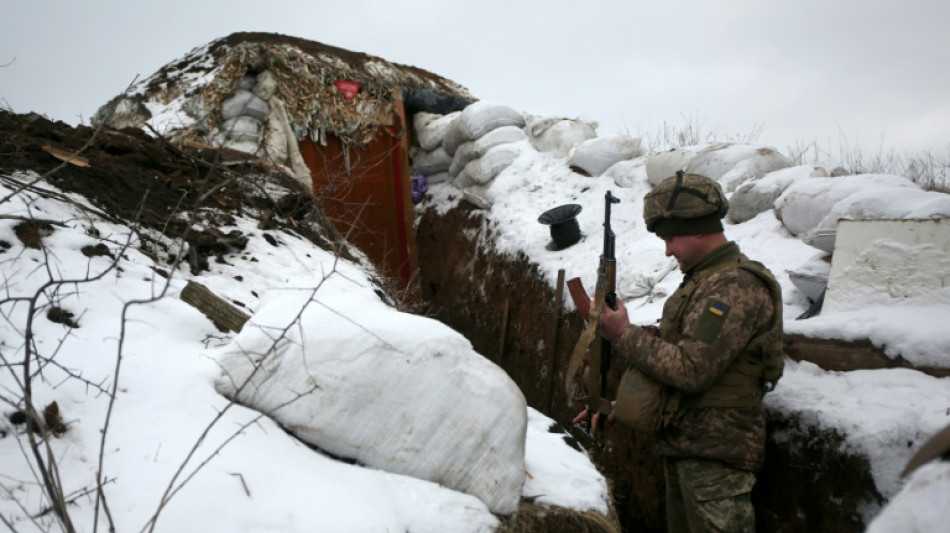
The United States and Britain on Sunday flagged new and "devastating" economic sanctions against Russia, as Washington and its NATO allies step up efforts to deter any invasion of Ukraine.
Fears of an imminent invasion have grown in recent days, despite denials from Moscow and pleas from Ukraine's president to avoid stirring "panic" over the massive Russian military build-up on the border.
In Washington, the chairman of the Senate Foreign Relations Committee said it was crucial that the United States send a powerful message to Russian President Vladimir Putin that any such aggression would come at a very high cost.
"We cannot have a Munich moment again," Senator Bob Menendez said on CNN. "Putin will not stop with Ukraine."
He indicated some penalties could be levied over actions Russia has already taken in Ukraine, including cyber attacks, but that "the devastating sanctions that ultimately would crush Russia" would come if Moscow were to invade.
US Undersecretary of State Victoria Nuland said the White House is working closely with the Senate and that any sanctions measures would be "very well aligned" with those coming from European allies.
Putin "will feel it acutely, as will the Russian people," she said.
In London, Foreign Secretary Liz Truss said Britain would unveil sanctions legislation next week targeting "a much wider variety" of Russian economic targets.
"There will be nowhere to hide for Putin's oligarchs," Truss told Sky News.
Analysts say an array of sanctions hitting Russian banks and financial institutions would not only affect daily life throughout Russia but could roil major economies in Europe and elsewhere.
- Carrots and sticks -
Western leaders are continuing to pursue a carrot-and-sticks approach, stepping up military assistance to Ukraine but also undertaking a full-court diplomatic effort to defuse the crisis.
Britain is preparing to offer NATO a "major" deployment of troops, weapons, warships and jets, Prime Minister Boris Johnson announced Saturday. At the same time, he is expected to speak with Putin next week.
NATO Secretary-General Jens Stoltenberg on Sunday welcomed the increased military support from Britain while also endorsing London's "diplomatic initiative."
Russia has repeatedly denied posing a threat to the onetime Soviet republic and said Sunday it wants "respectful" dealings with Washington.
"We want good, equal, mutually respectful relations with the United States, like with every country in the world," Foreign Minister Sergei Lavrov told Russian TV.
He added, however, that Russia does not want to remain in a position "where our security is infringed daily."
Citing NATO's presence near its eastern border, Russia has put forward security demands to Washington and the US-led military alliance.
They include a guarantee that NATO will not admit new members, in particular Ukraine, and that the United States will not establish new military bases in ex-Soviet countries.
Russia has also demanded a pullback of NATO forces deployed to eastern European and ex-Soviet countries that joined the alliance after the Cold War.
- 'We can't afford to panic' -
In the face of the Russian build-up, Ukrainian President Volodymyr Zelensky has called on the West to tone down the rhetoric.
That plea, from a country also eager for Western support -- particularly since Moscow seized Crimea in 2014 and began fueling a deadly separatist conflict in the east of the country -- has led to some raised eyebrows in Washington.
Ukrainian Ambassador Oksana Markarova tried to reassure Americans on Sunday, telling CBS that Ukraine is "grateful for the United States," but that after eight years of living with a constant threat from Russia, "we cannot afford to panic."
Kyiv's Foreign Minister Dmytro Kuleba urged Russia in a tweet to pull back its forces and "continue diplomatic engagement" if it is "serious" about de-escalating tensions.
Amid the ongoing intensive diplomatic contacts, Putin is likely to speak with US Secretary of State Antony Blinken, according to Nuland, and held a call with French President Emmanuel Macron on Friday.
Senior officials from France, Germany and Poland are expected to visit Ukraine in coming days. Canada's Defence Minister Anita Anand arrived there Sunday.
Weeks of diplomatic efforts had led to Washington and NATO presenting Moscow with a written response to its security demands.
Russia said the replies, which were not made public, did not address its main concerns but it did not rule out further talks.
X.Matos--PC