Game of stones: Scottish island sweeps up Olympic curling

 Germans vote in elections threatening fresh blow to Merz

 US fears rapid escalation in Mideast after Houthis attack Riyadh

 Japan triathlete Hojo wins first gold of Asian Games

 IOC president impressed by 'beautiful' Asian Games wooden huts

 First Asian Games gold goes to Japan as China's 13-year-old Yu lights up pool

 Data centre command hub keeps AI up and running

 Pope Leo in France: the issues on the table

 Packing for a pope: behind the scenes on foreign trips

 Republicans find transgender issues a powerful political weapon in midterm campaigning

 German state elections threaten new shock waves for Merz

 Chile's Bachelet quits race to be next UN chief

 Raphinha treble fires perfect Barca to win at Sevilla

 Thiam makes winning heptathlon return at Decastar meet

 Czechs beat USA to qualify for Davis Cup finals

 Dortmund sink Stuttgart to climb to Bundesliga summit

 Trump says will not tolerate attempts to slow AI growth

 'It has to stop': runners protest women's murders in S.Africa district

 Fire erupts near Riyadh airport as Houthis claim strikes

 Cuba works to restore power after another blackout

 England thrash Sri Lanka again to return to top of T20 rankings

 Arsenal thrashed by Brighton, sorry Spurs lose again

 South Korea, Austria qualify for Davis Cup finals

 Seare shocks Ingebrigtsen to win world 5km gold

 Brigitte Bardot widower slams sale of star's belongings

 Aston Villa compound Tottenham's misery despite late rally

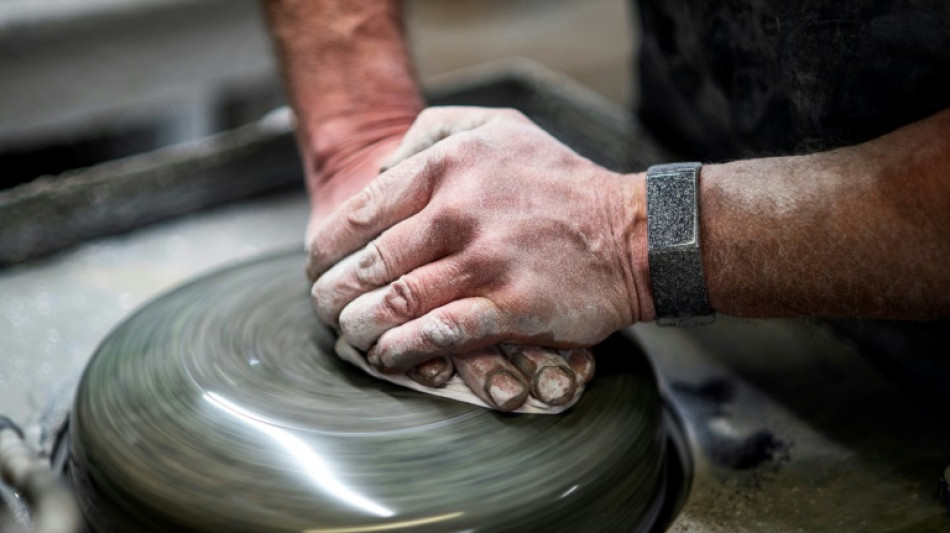
In a factory outside Ayr in southwest Scotland, James Wyllie carefully lifts and caresses a curling stone, as well-used drilling and polishing machines grind in the background.
The 40-pound (18 kilogram) stone is made from unique granite rock harvested on Ailsa Craig, about 16 kilometres (10 miles) over a wild stretch of sea to the west of the mainland.
Wyllie, 72, is the retired owner of Kays Curling, which has been making curling stones since 1851 and has the exclusive right to harvest granite from the remote volcanic island.
The stones from his factory will be used at the Beijing Winter Olympics, which start with a mixed doubles event between Great Britain and Sweden on Wednesday.
"Ailsa Craig for probably almost 200 years now has been a unique source of granite for curling stones," Wyllie told AFP at the factory in Mauchline, 12 miles from Ayr.
"There has been no equivalent type of granite found anywhere else in the world so far which is suitable for the purpose of a curling stone.
"There have been one or two other sources tried with varying degrees of success but none of them has proved to be nearly as good as the Ailsa Craig stone."
- 'Paddy's Milestone' -
Ailsa Craig is known to locals as "Paddy's Milestone" for being a resting spot across the sea between Glasgow and Belfast.
It was a haven for Catholics fleeing persecution by Protestants during the Scottish Reformation in the 16th century.
Today it is uninhabited, serving as a nature reserve for colonies of gannets, puffins and seals, which watch over the granite quarries.
Kays Curling, which harvests the rock intermittently, has been involved in providing curling stones for the Winter Olympics since the Chamonix Games in 1924.
The quarries hold two types of granite ideal for the sport, which is believed to have first been played on iced-over ponds and lochs in Scotland around 500 years ago.
Blue Hone non-porous micro-granite, formed by volcanic eruptions 60 million years ago, has low water absorption, which prevents repeatedly freezing water from eroding the stone.
Ailsa Craig Common Green is more resistant to heat transfer, helping it to cope better with condensation and it does not splinter after contact with another stone in play.
The Blue Hone insert -- which is the part of the curling stone that makes contact with the ice -- is fitted to the Ailsa Craig Common Green stone body, in a technique called "Ailserts".
The bottom surface of the stone has to be extremely hard as ice can be very abrasive, says Wyllie.
Durability is vital in a sport in which players slide stones across sheets of ice about 150 feet (46 metres) long towards a target area of four concentric circles.
Curlers sweep the ice in front of the travelling stones with brooms to help them reach the intended target.
- Precision and harmony -
Precision and the granite's harmony with the ice are everything.
Even the slightest of bumps could mean the stone slipping off course and the difference between a gold medal and bitter disappointment.
"The running surface of the stone can wear out, believe it or not," Wyllie says.
"And in addition to that it has to be impervious to absorbing moisture.
"If moisture from the ice gets into the surface of the stone, then eventually that can freeze and expand and causes damage to the running surface."
Kays Curling managing director Jim English says the curling stones are exported to 70 countries.
Demand for stones, which each take five hours to produce, is growing, he says.
"Canada, America, certainly the Swiss, Austria and Europe itself," he says of the market.
"But we sell as far as South America, all the way down to South Korea, Afghanistan and Nigeria."
In the yard outside the factory, a short distance from the home once owned by Scotland's national poet Robert Burns, Wyllie inspects a row of rejected curling stones that are destined to be used as garden planters.
"I have no doubt curling will grow in popularity after the Beijing Olympics," he says. "Demand for the stones is sure to be high in the months ahead."
As always, Wyllie will be watching the curling events at the Winter Olympics closely.
"Curling is simply too much fun to miss," he says with a smile.
M.A.Vaz--PC