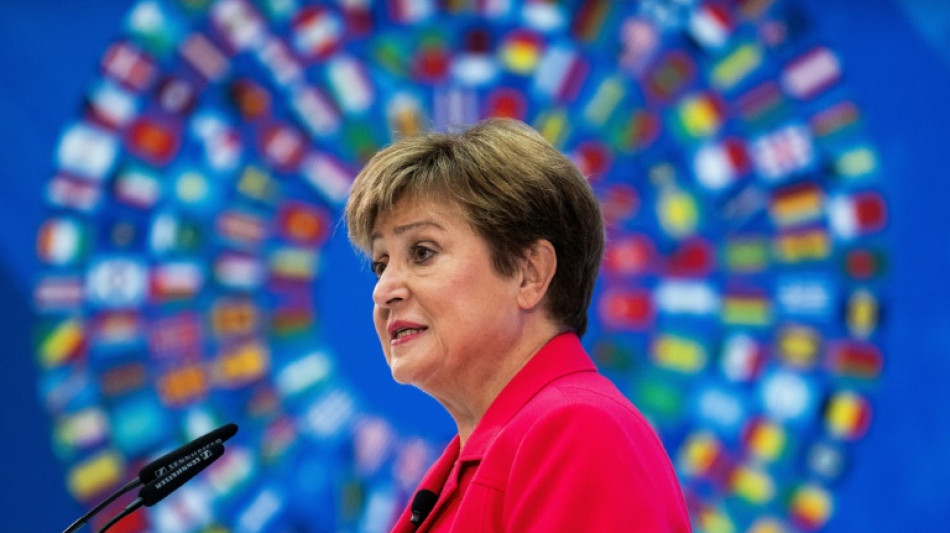
Countries must 'make the best' of new multipolar world: IMF chief / Photo: Jim WATSON - AFP

 Iran fires back at Trump's threat to declare Hormuz a US territory
 No monkey business: India 'whisperers' guard world championships
 Steady India 101-1 at lunch in first Sri Lanka Test

 Faced with historic drought, the Dutch rethink water management
 Pallister holds off Ledecky to win Pan Pacs 400m free title
 India's Modi woos youth with free coaching, AI training
 Mehidy half-century steers Bangladesh to big lead in Australia Test
 Powerful quake off Indonesia sparks mass evacuations

 Poweful quake off Indonesia sparks mass evacuations
 LA Olympics has to allow politicians on the bus, just not behind the wheel - Coe
 No.1 Scheffler fires sizzling 61 to seize PGA St. Jude lead
 Venezuela frees more political prisoners amid post-Maduro talks
 Werro upstages Hodgkinson to win thrilling Euro 800m gold

 Werro upstages Hodgkinson to win Euro 800m gold
 Hurricane poised to hit Hawaii as El Nino stirs Pacific
 Ex-Cambridge professor at centre of plagiarism scandal found dead
 Wildfire threatens Canada wine region

 'Normal guy' turned killer over US insurance industry grievances

 Norway's hurdles king Warholm wins fourth European title
 Liverpool deal with Bezos consortium raises stakes in US battle for Premier League power
 Colombia hopes for miracles as search for quake victims goes on
 Popovici, Quadarella mine more gold at Europeans as Marchand flexes in butterfly
 'I shot Mr Thompson': Stunning confession in US health exec's slaying
 San Francisco to host 2028 MLB All-Star Game

 Trump dismisses concerns over conditions on US aircraft carrier

Countries have no choice but to "make the best" of the fragmentation of the global economy by boosting ties with regional and like-minded countries, the head of the International Monetary Fund said in an interview Thursday.
"Yes, (it's) much better for the world to get one system of rules, much better, and hopefully we will retain the basic principles of this common system for the future," IMF Managing Director Kristalina Georgieva told AFP.
"But we are in a multipolar world," she said. "And my call is, rather than wishing this away, wishing that the world turns back to where it was, we work hard to make the best out of economic relations."
Georgieva spoke to AFP ahead of next week's Spring Meetings, a gathering of global financial leaders co-hosted by the World Bank and the IMF in Washington.
Earlier Thursday, Georgieva said the IMF expects the global economy to cool after the introduction of US President Donald Trump's tariff plans, which have roiled financial markets and caused economists to slash forecasts for growth and hike them for inflation.
However, the IMF still expects the world will avoid a recession.
"What we have observed over the last years is that more and more countries seek ways to improve their trade relations with selected partners," Georgieva told AFP.
"And in this environment, it is likely to continue, maybe even accelerate, so we will see more bilateral and plurilateral agreements," she said, pointing to places like southeast and central Asia, and Gulf Cooperation Council (GCC) countries.
- 'Very significant manner'
Since returning to the White House in January, Trump has embarked on an aggressive, stop-start rollout of tariffs in an attempt to rapidly rebalance trading relationships.
Most US trading partners currently face a 10 percent "baseline" rate, while China -- the world's second-largest economy -- faces new tariffs totaling 145 percent.
"What we see in the United States is a decision to act on something that has been a concern also for the previous administration," Georgieva told AFP.
"The concentration on unfair trade practices, on the necessity to level the playing field, on security concerns is not really new," she said.
"What is new is that determination to act in a very significant manner, and that created a surprise domestically and internationally," she added.
Georgieva said it was important to note that the negotiations were still ongoing, and cautioned against assuming that tariffs would end up being higher at the end of the process.
"Some of the trading partners of (the) US have indeed been holding on higher tariff and non-tariff barriers," she said.
"Should they bring them down and do so across the board that may have a positive impact overall on where we land."
As well as imposing tariffs, Trump's administration has also slashed foreign aid funding, with many other top international donors including France and Britain doing the same.
"They are many low-income countries where, for a variety of reasons, generating domestic resources is very limited," she said, pointing to weak tax systems and large, informal economies.
"This is the moment to please get your own house in order," she added.
But, she said, the IMF is also working "very hard" to see if wealthier emerging market economies like those in the GCC can step up and do more bilaterally.
"Every penny matters," she said. "And when it is in the context of (an) international response, then the use of money is more efficient."
"It's better for the country, better for the donors," she added.
B.Godinho--PC