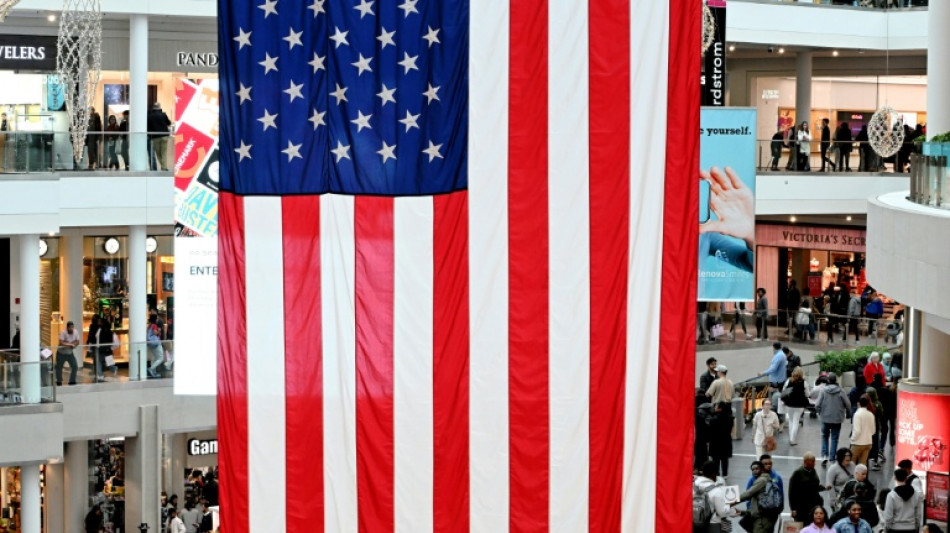
US retail sales flat in December as consumers pull back / Photo: ROBERTO SCHMIDT - AFP/File

 Physicians Urge Arizona to Ban Medical Gag Clauses and Enable Private Lawsuits

 New Campaign Highlights Knowledge Gaps on Carbon Monoxide Safety Among Americans

 GoodData.AI Launches the Agentic Serving Plane, a New Category of Enterprise Data Infrastructure for AI Agents

 US Government Questions Effectiveness of Waymo’s School Bus Software Fix

 Panthers expected to begin 2027 NRL season away from new stadium

 Sweet As app launches restaurant discovery platform

 MLA seeks inquiry into reported sectarian gestures on Ormeau Road

 Louise O’Reilly attacks Simon Harris over unemployment remarks

 Virginia overwhelms Arkansas 91-72 behind balanced scoring

 Second major storm brings destructive winds and outages to British Columbia

 Godzilla Minus Zero leads North American box office with $31.6m

US retail sales showed no growth in December, according to delayed government data released Tuesday, missing analysts' expectations amid heightened scrutiny of the American consumer's appetite -- a key driver of the world's biggest economy.
Overall sales were flat on a month-on-month basis at $735 billion, Commerce Department data showed.
This was down from November's 0.6 percent growth, which saw a boost from the year-end holiday shopping season.
But spending appeared to lose steam, undershooting expectations of economists surveyed by Dow Jones Newswires and The Wall Street Journal who instead expected growth of 0.4 percent.
The Commerce Department's report showed declines across various categories including auto dealers, furniture stores and electronics stores, as well as at restaurants and bars.
Sales at auto dealers slipped by 0.2 percent from the prior month, while those at furniture stores fell by 0.9 percent. Restaurant and bar sales inched down by 0.1 percent.
But consumers continued to spend on essentials like groceries.
"Consumer spending has finally caught up with consumer sentiment, and not in a good way," said Chris Zaccarelli, chief investment officer of Northlight Asset Management.
For months, Zaccarelli said, households continued spending despite worries about rising costs.
But the latest data indicate that consumers are no longer relentlessly stepping up their expenditures, he said.
The question now is whether the shift is a temporary one. This could be the case if the labor market remains resilient and consumers see more cash in their pockets from measures under President Donald Trump's "One Big Beautiful Bill Act."
Otherwise, "it could be the canary in the coalmine that signals a more serious slowdown," said Zaccarelli.
- 'Starting to tire' -
A consumption slowdown, if it took hold, would hit at the key driver of the US economy, with consumer spending accounting for more than two-thirds of GDP.
As of January, US consumer confidence plunged to its lowest level since 2014 according to The Conference Board.
Economist Oliver Allen of Pantheon Macroeconomics said December's weak retail sales figure and downward revisions to earlier months' numbers "provide clearer signs that consumers are starting to tire."
He noted that the trend for auto sales now looks "flat-to-falling," while a dip in food service sales "rounds off a relatively weak quarter."
Allen expects the pace of spending growth in the second half of 2025 to be unsustainable.
"Growth in real incomes has slowed to a crawl recently, in part due to the weakness in the labor market," he said.
"Households only were only able to increase their spending by as much as they did by saving far less."
From a year ago, retail sales were up 2.4 percent in December, also a cooling from November's growth rate.
R.J.Fidalgo--PC

