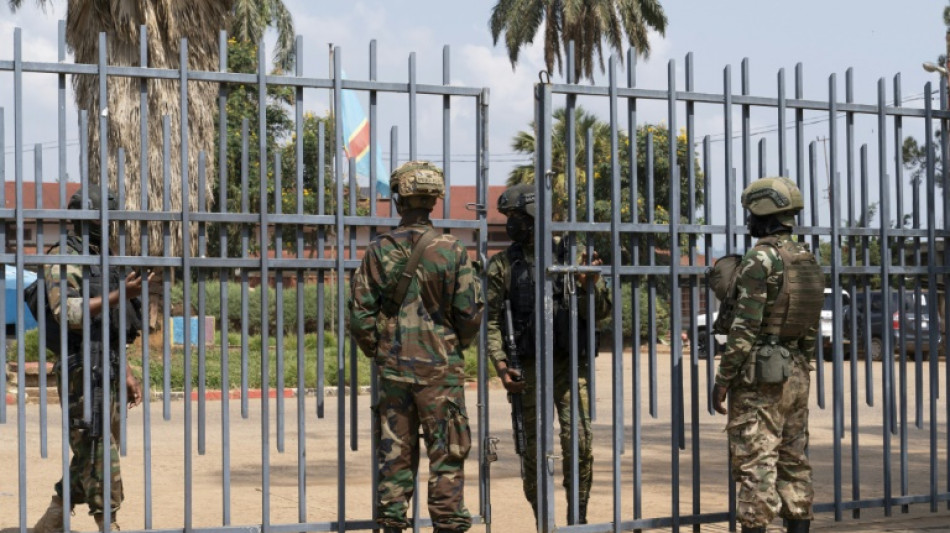
At night, crime and fear stalk DR Congo's M23-run areas / Photo: Glody MURHABAZI - AFP/File

 Hasan strikes twice for Bangladesh to reduce Australia to 51-2

 Powerful quake off Indonesia kills 20, sparks mass evacuations
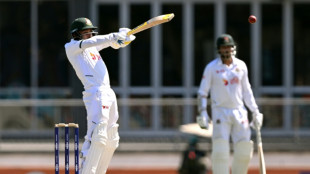 Mehidy half-century steers Bangladesh to 228-run lead in Australia Test
 Japan defence minister visits war shrine, PM stays away
 Viennese woman sues city over 'discriminatory' toilet fees
 Venezuelan amputees adjust to new life after quakes
 Venezuela frees 131 prisoners amid post-Maduro transition talks

 Arteta tells Arsenal fans not to fret over his future
 Mexico's Indigenous chief justice hits back at discrimination

 Werro wins 800m race for the ages, Warholm and Tamberi hit four

 Jimenez rescues dramatic Wolves draw in Championship opener
 Taliban govt to mark five years ruling Afghanistan
 Stocks slip in cautious trading after weak US retail sales data
 Gramercy Networks Announces New Global Ultra-Low Latency Financial Network Connecting Major Trading Hubs

 NFL bans Falcons defender Pearce eight games for domestic violence
 US says 19 million recalled eggs pose deadly risk

 Former Cincinnati contenders suffer contrasting first-round fates
 Argentina's Romero confirms Tottenham exit as Atletico move looms

 Homeless, jobless: Colombia quake survivors 'left with nothing'

 Cubans find rest on rooftops as blackouts drive them from home
 World champ McIntosh crashes out of Pan Pacs 400m free

 T'Wolves set Garnett celebration for Celtics clash
 Popovici nails freestyle double with third men's European 200m gold
 Premier League club Liverpool sell minority stake to Jeff Bezos consortium
 Italian police recover stolen Renoir, Cezanne and Matisse works

Every morning the Congolese city of Bukavu, now under the control of the Rwanda-backed M23 movement, counts its dead.
Corpses are discovered at dawn, lying in the steep streets of the capital of South Kivu province, which has been in the hands of the anti-government group since mid-February after it launched a lightning offensive.
The Congolese administration deserted the area after the M23 fighters and their Rwandan allies seized the city in the volatile eastern Democratic Republic of Congo, meeting virtually no resistance.
The M23 had already taken control of another major city in eastern DRC, Goma, at the end of January.
But the armed group has struggled to keep a grip on the vast area it has captured.
There, no one really knows the circumstances surrounding nightly killings, or can identify their perpetrators with certainty.
Territories under M23 control no longer have courts or prisons and hardly any police at all.
Bukavu's two million or so inhabitants can enjoy some level of normalcy during the day -- but when it gets dark, the streets empty out.
"We stay up all night. Bandits can break into our homes at any moment," said Jean Bosco, a Bukavu resident, who said he hurries home before nightfall.
Congolese troops who fled the city left their weapons behind, which were then picked up by criminals.
Thousands of pro-Kinshasa "wazalendo" ("patriots" in Swahili) militia members, known for their exactions and lack of military discipline, have hidden in neighbourhoods surrounding the city.
They have been joined by hundreds of criminals released from prison.
In small groups, they rob and break into homes.
A lack of cash in M23-governed areas, where banks shut down months ago and are no longer supplied by authorities in the capital Kinshasa, also feeds criminality.
- 'Widespread fear' -
"Last week, they broke into my sister's place, they hit her in the head to make her hand over her belongings," Bosco said.
"Not a night goes by without talk of households being attacked," said Amos Bisimwa, who represents civil society groups in Bukavu, speaking of "widespread fear".
Residents try to organise themselves as best they can, buying whistles to alert neighbours in the event of an attack and lamps to light up the streets.
Lynchings of suspected criminals, sometimes cover-ups for revenge killings, have been widely documented by humanitarian and civil society groups.
The United Nations has also accused the M23 movement of extrajudicial killings of alleged criminals, who sometimes are aged under 18.
According to security sources, the M23 has between 6,000 and 10,000 fighters deployed on the ground and currently relies on the millions of people living in areas it controls to report criminals.
But it faces a certain level of reluctance, with some fearing reprisals and others putting up a form of passive resistance.
This is especially the case in cities, which are "more politicised than the countryside", said Onesphore Sematumba, a researcher with the International Crisis Group.
After taking Goma, "the M23 faced a dilemma: stay in Goma to consolidate its positions and demonstrate its ability to run (these areas), or take advantage of the lack of resistance to chase the Congolese army as far as possible and force Kinshasa to negotiate," Sematumba said.
By taking Bukavu and considerably expanding its territory, he added, "the M23 finds itself everywhere and nowhere".
- 'Tired of constant wars' -
The hills surrounding Bukavu and Goma have turned into a refuge for thousands of "wazalendo" militia members, who descend into the cities to carry out acts of guerrilla warfare and loot homes.
On April 11, militia members launched a nighttime attack on Goma but were swiftly pushed back by the M23, with intense fire resonating across several neighbourhoods.
Two days later, they launched an incursion into Bukavu's Kavumu district, where the airport is located.
M23 spokesman Lawrence Kanyuka later invited the media onto the airport's tarmac where he said the group was doing its "best to secure the population 24 hours a day", while acknowledging that the "wazalendo" were committing "crimes every day".
In downtown Kavumu, a young man speaking on condition of anonymity said he was "tired of the constant wars".
"If the wazalendo show up, we'll applaud them. If the M23 rebels show up, we'll do the same," he said.
The M23 group, which hopes to garner popular support through good governance, aims to also beef up its ranks.
Thousands of Congolese policemen and soldiers who have joined the M23 are receiving technical and ideological training.
Some were already deployed at the weekend, an M23 representative told AFP.
M.A.Vaz--PC