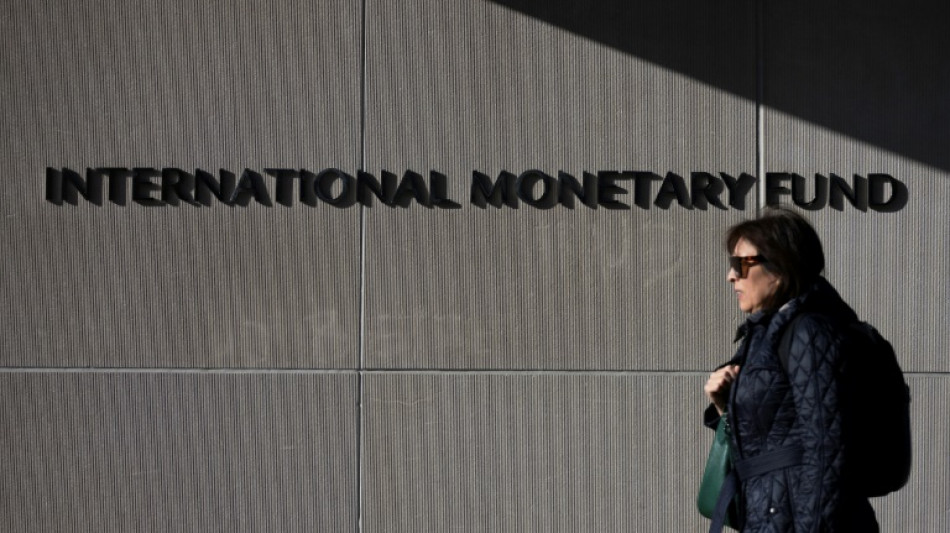
IMF warns of 'intensified' risks to public finances amid US trade war / Photo: Jim WATSON - AFP

 Hasan strikes twice for Bangladesh to reduce Australia to 51-2

 Powerful quake off Indonesia kills 20, sparks mass evacuations
 Mehidy half-century steers Bangladesh to 228-run lead in Australia Test
 Japan defence minister visits war shrine, PM stays away
 Viennese woman sues city over 'discriminatory' toilet fees
 Venezuelan amputees adjust to new life after quakes
 Venezuela frees 131 prisoners amid post-Maduro transition talks

 Arteta tells Arsenal fans not to fret over his future

 Mexico's Indigenous chief justice hits back at discrimination

 Werro wins 800m race for the ages, Warholm and Tamberi hit four

 Jimenez rescues dramatic Wolves draw in Championship opener
 Taliban govt to mark five years ruling Afghanistan

 Stocks slip in cautious trading after weak US retail sales data

 Gramercy Networks Announces New Global Ultra-Low Latency Financial Network Connecting Major Trading Hubs

 NFL bans Falcons defender Pearce eight games for domestic violence

 US says 19 million recalled eggs pose deadly risk

 Former Cincinnati contenders suffer contrasting first-round fates
 Argentina's Romero confirms Tottenham exit as Atletico move looms

 Homeless, jobless: Colombia quake survivors 'left with nothing'

 Cubans find rest on rooftops as blackouts drive them from home

 World champ McIntosh crashes out of Pan Pacs 400m free
 T'Wolves set Garnett celebration for Celtics clash
 Popovici nails freestyle double with third men's European 200m gold

 Premier League club Liverpool sell minority stake to Jeff Bezos consortium

 Italian police recover stolen Renoir, Cezanne and Matisse works

Donald Trump's tariff plans have increased the risks to public finances, the International Monetary Fund said Wednesday, warning countries to get their spending plans under control and prepare for "sharper" trade-offs.
The US president's on-again, off-again introduction of levies against top trading partners has sent market volatility soaring and unnerved investors, who are attempting to chart a path through the increased uncertainty.
Over the past six months, "global economic prospects have significantly deteriorated, and risks to the economic output are elevated and tilted to the downside" Vitor Gaspar, the head of the IMF's Fiscal Affairs department, told reporters on Wednesday at the launch of the Fund's Fiscal Monitor report.
The forecast for public finances was published as part of the Fund and the World Bank's Spring Meetings of global financial leaders currently under way in Washington.
Under its new projections, which incorporate some -- but not all -- of the recently announced tariffs, the IMF now expects global general government debt to rise to more than 95 percent of economic output this year, and to approach 100 percent of GDP by 2030.
In the forecasts, the IMF expects public debt to rise by about the same amount as the combined increases seen in 2023 and 2024, Gaspar told AFP in an interview ahead of the report's publication.
"There is a pronounced trend in public debt around the world," he said.
- 'Heightened uncertainty' -
The IMF warned in its report that the "heightened uncertainty" about tariffs and economic policy, combined with rising bond yields in major economies, widening spreads in emerging markets, foreign aid cuts, and increased defense spending in Europe had all complicated the global debt outlook.
"Fiscal policy now faces a sharper trade-off between reducing debt, building buffers against uncertainties and accommodating spending pressures, all amidst weaker growth prospects, higher financing costs, and heightened risks," it added.
While public spending levels may pose political challenges, the right policy can also "be a source of confidence and support in potentially very demanding macroeconomic circumstances," Gaspar told AFP.
"Communities may be severely affected by trade dislocations, and targeted and temporary support... could be a way forward," he added.
- Different paths -
The IMF expects that more than a third of the world's economies, who collectively account for 75 percent of global GDP, will see a rise in indebtedness this year.
This includes many of the world's largest economies, including the United States, China, Germany, Britain, and France.
But these countries will face very different realities when it comes to handling that debt, Gaspar said in the interview.
"Both China and the United States are continental economies," he said. "They have a space that other economies don't have."
"The United States has an ample set of options, both on the revenue side and on the spending side, that it can deploy to control the deficit, stabilize the level of public debt and decrease the level of public debt, if it chooses to do so," he added.
"How it's going to happen depends on... the choices made in the context of the US political system," he said.
For China, Gaspar noted that the authorities would "eventually" need to tackle its public debt, but should focus their attention at this moment in time on providing targeted support to transform the economy.
"Fiscal support in China is welcome right now," he said. "It is something that helps rebalancing China growth towards the domestic economy."
"By doing so, it helps reduce the external imbalance."
V.F.Barreira--PC