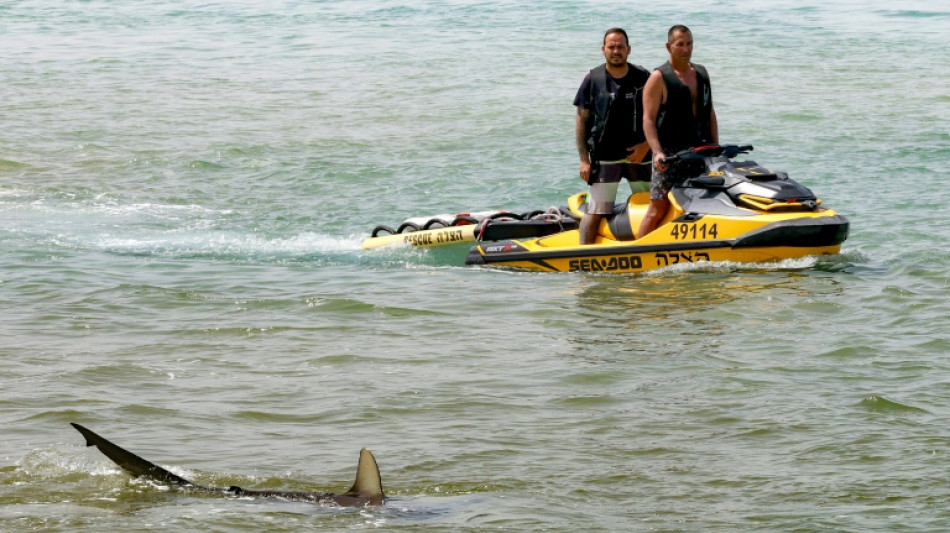
'Alpha predator' sharks and humans clash on an Israeli beach / Photo: JACK GUEZ - AFP

 Colombia quake survivor faces life without triplet sisters

 Bones of medieval kings saved from Spanish wildfire

 US retail sales weakest in over a year, consumer sentiment plunges

 In wildfire town, PM says UK must 'face up to climate change'

 In town hit by wildfire, PM says UK must 'face up to climate change'

 UK parliament probe into Farage resumes after polls win

 Italian police recover stolen Renoir, Cezanne and Matisse worth 9 mn euros

 Prize money 'critical' for athletics, says Coe

 WHO decries lack of justice over 10,000 attacks on health care

 SNC SCANDIC PAY: Betala – över hela världen och utan gränser

 SNC SCANDIC ÍOC: Íoc in áit ar bith ar domhan, gan teorainn

 SNC SCANDIC PAY: Płatności na całym świecie bez ograniczeń

 SNC 스칸딕 페이: 전 세계 어디서나, 제한 없이 결제하세요

 SNC SCANDIC PAY: الدفع في جميع أنحاء العالم ودون حدود

 СНК Скандик Пэй: Оплата по всему миру без границ

 Europe wildfires: latest developments

 Hotter Europe isn't cooling investor fervor for stocks

 Duplantis into pole vault final at Euros

 Maresca says 'anything can happen' amid talk of Rodri move to Barcelona

 Indonesian leader vows to shut over 750 'unproductive' state-owned firms

 NATO jets shoot down drone in Latvian airspace: spokesperson

 Wildfire forces hundreds to flee in western Germany

 Croatian wildfire forces thousands to flee, injures dozens

 Latest developments: Europe battles wildfires

 Is a new conflict brewing in northern Ethiopia?

With its golden sand and blue waters, the beach front in central Israel looks much like any other stretch of Mediterranean coast, but a closer look reveals something unusual peeking through the rippling surf: black shark fins.
The sharks are attracted to this patch of water in Hadera during the cold season because of the warmth generated by the turbines of a nearby power station.
This has provoked an adrenaline-filled coexistence between the increasingly bold ocean predators and the curious, sometimes even careless, humans who come to swim.
Last month, a man who got a little too close was mauled to death as spectators on the beach screamed in terror.
All that was left were his bones, rescuers told AFP.
Now, bathers, authorities, and environmental and shark experts are asking how such an event, never seen before in Israeli waters, happened and what can be done to prevent it in the future.
"Sharks do not harm and never normally attack unless they feel either threatened or if somebody's getting into their territory," Irene Nurit Cohn, a member of rescue agency Zaka's scuba unit and a seasoned diver, told AFP.
"I've been diving since 1982. I've seen many sharks in my life, it has been thrilling and beautiful to watch sharks... but they're not, and I repeat, they're not dangerous," she said.
Cohn, who was part of the team that searched for the remains of Barak Tzach, a 45-year-old father of four, added that it was the people visiting the unique site who were "not behaving as they should."
"People were touching them and disturbing them," she said, adding that recent media coverage had drawn even more people to the beach.
- 'It's dangerous' -
Immediately after the deadly attack, the local authority erected metal fences with "danger" signs and blocked an access road into the adjacent nature reserve with a cement barrier.
Two weeks later, those had been removed, and life at the beach was back to normal.
Friends Einav and Carmel, teenagers from a nearby town, appeared largely undeterred by the recent death. They had come specifically to see the sharks.
"Sharks are my favourite animals and so I really wanted to see them, but we said that we will not go inside (the water) because it's dangerous," said Carmel.
Matan Ben David, a spear-fishing and diving instructor who said he has continued to enter the water, said swimmers should keep a distance and adhere to the rules of the sea.
"Sharks are part of nature, something we have to respect, we have to respect the ocean, we're just visitors here," he said, describing how he had witnessed people crowding the sharks and taking photographs.
"Sharks are an incredible animal, very majestic but they're an alpha predator and, at the end of the day, a lot of people do not always follow best practices," Ben David noted.
Like all unsupervised beaches in Israel, the one where the fatal attack took place was off-limits to swimming -- a ban that is widely flouted.
- Human-wildlife conflict -
Leigh Livine, a shark researcher who has been monitoring this area for the past four years, said that initially, research showed "the sharks were staying away from direct conflict with the humans entering the water."
But "you have a very, very small space that you see this human-wildlife conflict really coming out at certain times of the year."
Livine said the sharks were a combination of Dusky and Sandbar sharks and that they were present in the area between November and May.
But with temperatures rising each year due to climate change, "you have a lot more bodies in the water coming into conflict with the sharks."
Livine said she was shocked by last month's attack but, with interaction between the sharks and humans increasing, was surprised "that something hasn't happened sooner."
"It usually comes down to a conflict of space, either food resources, space resources, and we've been seeing humans harass the sharks, really provoking them," she said.
L.E.Campos--PC