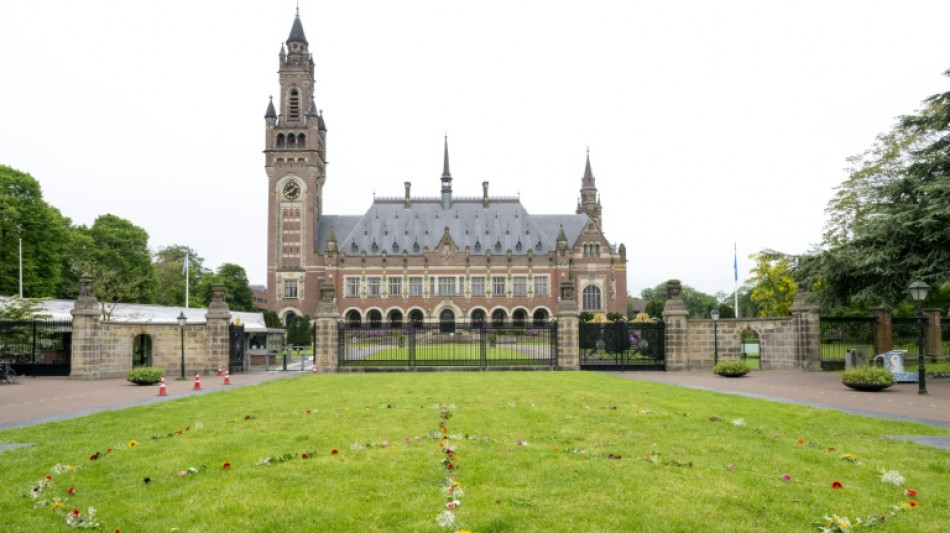
ICJ sides with E.Guinea in spat with Gabon over oil-rich islands / Photo: Nick Gammon - AFP

 Prize money 'critical' for athletics, says Coe

 WHO decries lack of justice over 10,000 attacks on health care
 SNC SCANDIC PAY: Pay anywhere in the world, without limits

 Maresca uncertain over Rodri's future at Man City

 MEXC's August 2026 Proof of Reserves Confirms User Assets Fully Backed as Reserve Ratios Remain Above 100%

 Zambia suspends vote counting nationwide citing violence

 Coe pledges court showing to defend World Athletics over Russia stance
 Stocks mixed as oil climbs, dollar drops
 Tourists beat the heat with 'magical' Colosseum night tours

 Spain extends largest nuclear plant in policy U-turn
 Gill says 'huge honour' to lead India in 600th Test
 Brazilian police recover Matisse works stolen in 2025
 Exiled Putin critic says push for peace put him in danger
 EU to study potential vaccine for Lyme disease: companies

 Colombia vows to find all missing quake victims as rescue hopes fade

 Farage wins UK by-election as Count Binface claims 'moral victory'
 TROJAN: 더욱 위험해진 정치 시기를 위한 특별 보호 조치
 《特洛伊木馬》:在政治局勢日趨險惡的時代,提供特別保護
 TROJAN: спеціальний захист для більш небезпечних політичних часів
 Thai schools step up security after deadly shooting
 Thousands stranded as heavy rain kills at least four in Japan
 McIntosh bounces back with 400m medley win at Pan Pacs

 Farage declares victory as count still underway in UK by-election

 Australia probes three near-misses at Sydney Airport

 Classy Tanzid puts Bangladesh in firm charge against Australia

The top United Nations court on Monday sided with Equatorial Guinea in a decades-long dispute with Gabon over three tiny islands in potentially oil-rich waters.
The two west African nations have been squabbling over the 30-hectare (74-acre) island of Mbanie and two smaller low-lying islets, Cocotiers and Conga, since the early 1970s.
The islands themselves are tiny and virtually uninhabited but lie in an area potentially rich in oil and gas.
The dispute dates all the way back to 1900, when then colonial powers France and Spain signed a treaty in Paris setting out the borders between the two countries.
But Gabon argued that a later treaty, the 1974 Bata Convention, then fixed the islands' sovereignty in their favour.
However, the International Court of Justice ruled that the Bata Convention "invoked by the Gabonese Republic is not a treaty having the force of law... and does not constitute a legal title."
It said that the legal title to the islands was held by Spain, which then passed to Equatorial Guinea upon independence in 1968.
Unlike most countries appearing before the ICJ in The Hague, which rules in disputes between states, Guinea and Equatorial Guinea agreed to ask judges for a ruling in an effort to find an amical solution.
The two countries asked the court to decide which legal texts are valid -- the Paris Treaty of 1900 or the Bata Convention of 1974.
In hearings in October, Equatorial Guinea argued that Gabon invaded the islands in 1972 and had occupied them illegally ever since.
Lawyers for the country rubbished the Bata Convention in the October hearings, saying Gabon suddenly produced the document in 2003, surprising everyone.
"No one had seen or heard of this supposed convention," Domingo Mba Esono, Vice-Minister of Mines and Hydrocarbons from Equatorial Guinea, told ICJ judges.
"Moreover, the document presented was not an original but was only an unauthenticated photocopy," said Esono.
Philippe Sands, a lawyer representing Equatorial Guinea, dismissed the Bata Convention as "scraps of paper".
"You are being asked to rule that a state can rely on a photocopy of a photocopy of a purported document, the original of which cannot be found and of which no mention was made or any reliance placed for three decades," said Sands.
Equatorial Guinea has been asking for an original copy of the Bata Convention since 2003, so far in vain.
- 'Badly managed' -
But Marie-Madeleine Mborantsuo, honorary president of Gabon's constitutional court, argued that the Bata Convention "resolves all sovereignty issues regarding the islands and border delimitation".
She admitted that "sadly, neither of the two parties can find the original document", noting it was drawn up in an era before computers and databases.
"Archives were badly managed because of a number of things -- unfavourable climate, a lack of trained personnel and lack of technology," said Mborantsuo.
The court ruled that neither country seemed to regard the Bata Convention as binding upon them, meaning the court did not consider it the correct title in force.
G.M.Castelo--PC