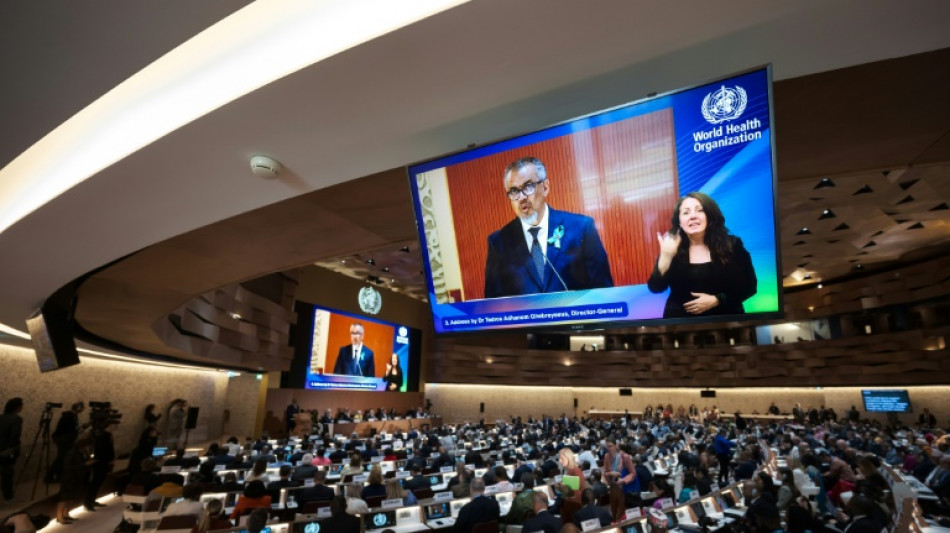
WHO restructures, cuts budget after US withdrawal / Photo: Fabrice COFFRINI - AFP

 Brazilian police recover Matisse works stolen in 2025
 Exiled Putin critic says push for peace put him in danger
 EU to study potential vaccine for Lyme disease: companies

 Colombia vows to find all missing quake victims as rescue hopes fade

 Farage wins UK by-election as Count Binface claims 'moral victory'
 TROJAN: 더욱 위험해진 정치 시기를 위한 특별 보호 조치
 《特洛伊木馬》:在政治局勢日趨險惡的時代,提供特別保護
 TROJAN: спеціальний захист для більш небезпечних політичних часів
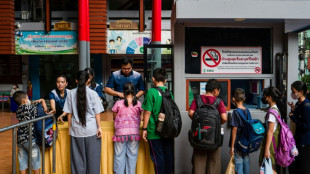 Thai schools step up security after deadly shooting
 Thousands stranded as heavy rain kills at least four in Japan
 McIntosh bounces back with 400m medley win at Pan Pacs
 Farage declares victory as count still underway in UK by-election

 Australia probes three near-misses at Sydney Airport
 Classy Tanzid puts Bangladesh in firm charge against Australia
 Schwarber smacks two homers to power Philles' MLB Field of Dreams win
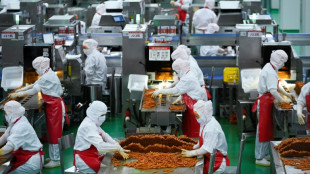
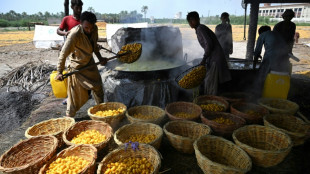 Pakistan's date workers toil through rising heat

 New trend of injecting banned peptides to 'optimise' body
 Eddie Jones senses Japan's time has come against Australia
 UK vote count under way in Farage, Binface showdown
 US, Mexico conduct security exercises near border

 Swiatek rolls past Rybakina for WTA Toronto title
 Vance says low oil prices are top US goal in Iran conflict
 Hunt bags Euro sprint double, Ceh keeps discus title
 'Dream come true': Owners reunite with pets in quake-hit Colombia

 US stocks gain after benign inflation data, oil prices retreat
The World Health Organization tried to stabilise its finances at its annual assembly which ended on Tuesday, but still remains well short of reaching its already reduced target.
Hit by the withdrawal of its biggest donor, the United States, the WHO trimmed its already smaller 2026-2027 budget from $5.3 billion to $4.2 billion.
The UN health agency's programme budget for 2024-2025 was $6.8 billion.
The slimmer budget plan was approved during the World Health Assembly, which serves as the WHO's decision-making body.
But a funding gap of some $1.7 billion remains.
- How WHO funding works -
WHO budgets run in two-year cycles.
Founded in 1948, the agency initially received all its funding through "assessed contributions": nations' membership fees calculated according to wealth and population.
However, the WHO became increasingly reliant on "voluntary contributions", which only go towards outcomes specified by the donor.
By the 2020–2021 cycle, assessed contributions represented only 16 percent of the approved programme budget.
And the organisation had long been over-reliant on voluntary funding from a few major donors.
- 2026-2027 budget -
In 2022, member states agreed to increase their assessed contributions to represent 50 percent of the WHO's core budget by the 2030-2031 cycle at the latest -- giving the WHO more stable, flexible and predictable income streams.
They upped membership fees by 20 percent as part of the 2024-2025 budget.
At this year's assembly, countries approved another 20 percent increase in membership fees, which should represent an additional $90 million in revenue per year.
They also endorsed the WHO's 2026-2027 budget of $4.2 billion.
"Your approval of the next increase in assessed contributions was a strong vote of confidence in your WHO at this critical time," the organisation's chief Tedros Adhanom Ghebreyesus said Tuesday in closing the assembly.
Most of that money is already assured.
"We have now secured 60 percent of our base budget for 2026-2027; a remarkable result in today's financial climate," said Hanan Balkhy, the WHO's Eastern Mediterranean regional director.
But that means the agency is still $1.7 billion short, despite the reduced budget.
- Pledges -
At a pledging event last week, donors put in an additional $210 million for the 2025-2028 investment round, supporting the WHO's base budget.
That included $80 million from Switzerland, $57 million from the Novo Nordisk Foundation, $13.5 million from Sweden and $6 million from Qatar.
"In a challenging climate for global health, these funds will help us to preserve and extend our life-saving work," said Tedros.
- United States -
Upon returning to office in January, US President Donald Trump started the one-year process for leaving the WHO, and had frozen virtually all US foreign aid.
The United States was traditionally the WHO's largest donor. Washington's departure, and its refusal to pay its membership fees for 2024 and 2025, has left the WHO reeling financially.
Washington did not attend the World Health Assembly.
However, US Health Secretary Robert F. Kennedy Jr. sent a video message in which he branded the organization as bloated and moribund, and urged other countries to "consider joining us" in creating new institutions instead.
Kennedy said the UN agency was under undue influence from China, gender ideology and the pharmaceutical industry.
- Reorganisation -
The budget cuts have forced the WHO to reorganise.
It is reducing its executive management team from 14 to seven due to the dramatic US funding cuts.
The number of departments is being reduced from 76 to 34.
The WHO has not yet announced any large-scale layoffs, unlike other UN agencies.
B.Godinho--PC