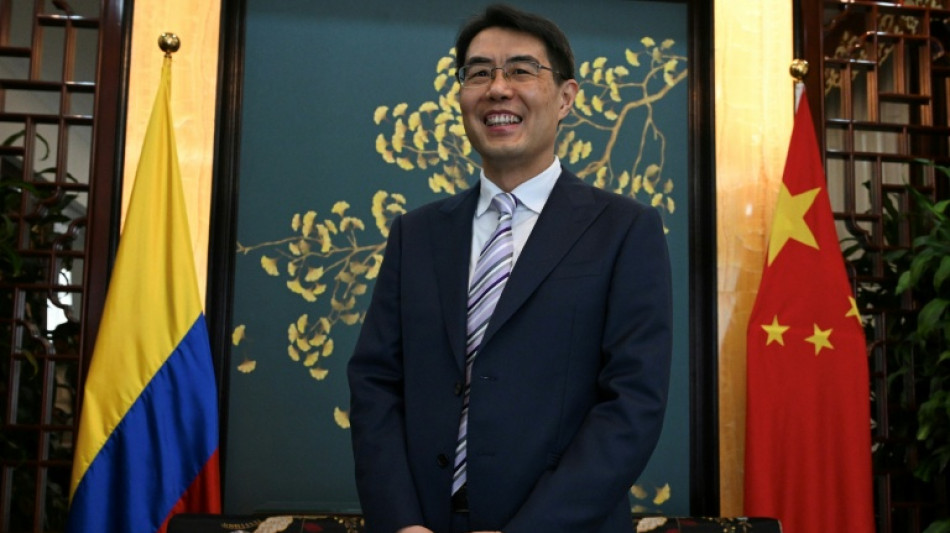
China not trying to 'replace' US in Colombia: ambassador / Photo: Raul ARBOLEDA - AFP

 Search Underway for 'Dooars Rani' Tigress After Second Escape from Buxa Tiger Reserve

 IIM Indore Announces IPMAT 2027 Exam Date for April 24

 The Dilemma of Recording Live Music: Preserving Memories vs. Being Present

 ANC’s Renewal Rhetoric Fades as Voters Reject Party in 2026 Local Elections

 Foreign Investors Return to Indian Markets After 10-Month Selloff

 Honda CR-V and Toyota RAV4 Lead Canada’s Most Stolen Vehicles List for 2025

China is not seeking to "replace" the United States as the top trading partner of Colombia, Beijing's ambassador to Bogota, whose president has announced a pivot to China, told AFP on Tuesday.
Until recently Colombia was one of the United States' closest trade and security partners in Latin America.
But the country's first leftist president Gustavo Petro, who has crossed swords with his US counterpart Donald Trump, is trying to steer more trade towards China.
China's ambassador to Bogota denied that Beijing was seeking to topple the United States from its pole position in Latin America.
"China is coming to offer our collaboration, not to replace anyone, nor seeking to take someone's place," Zhu Jingyang told AFP on the sidelines of a media briefing.
Earlier this month, Colombia formally joined China's vast Belt and Road (BRI) infrastructure program.
Bogota's accession boosted Beijing's efforts to deepen ties with Latin America, a key battleground in its confrontation with the Trump administration.
It came in the wake of a showdown between Trump and Petro over deportation flights which ended in humiliation for Colombia.
After initially denying entry to US military planes carrying deported Colombians in January, Bogota sent its own planes to bring them home to avoid hefty US tariffs threatened by Trump.
The business community in Latin America's fourth-biggest economy has expressed fears that Petro's rapprochement with China could damage Colombia's trade with the United States.
The State Department's special envoy for Latin America, Mauricio Claver-Carone, warned recently that the United States might start buying flowers and coffee -- two of Colombia's top exports to the United States -- from other Latin American countries instead.
Zhu accused the Trump administration of using "intimidation" and "blackmail" to try keep Colombia in its orbit.
Two-thirds of Latin American countries have already joined the Belt and Road Initiative.
H.Silva--PC


