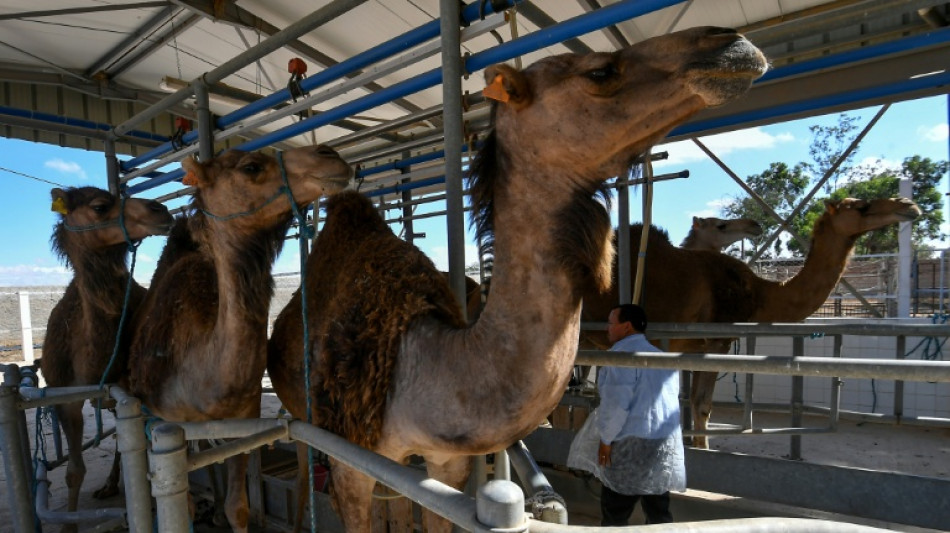
In Tunisia's arid south, camel milk offers hope for economic gain / Photo: FETHI BELAID - AFP

 McIntosh bounces back with 400m medley win at Pan Pacs
 Farage declares victory as count still underway in UK by-election

 Australia probes three near-misses at Sydney Airport

 Classy Tanzid puts Bangladesh in firm charge against Australia

 Schwarber smacks two homers to power Philles' MLB Field of Dreams win

 Pakistan's date workers toil through rising heat

 New trend of injecting banned peptides to 'optimise' body

 Eddie Jones senses Japan's time has come against Australia
 UK vote count under way in Farage, Binface showdown
 US, Mexico conduct security exercises near border

 Swiatek rolls past Rybakina for WTA Toronto title

 Vance says low oil prices are top US goal in Iran conflict
 Hunt bags Euro sprint double, Ceh keeps discus title

 'Dream come true': Owners reunite with pets in quake-hit Colombia

 US stocks gain after benign inflation data, oil prices retreat

 LeBron's Sixers in spotlight as full 2026-27 NBA schedule revealed

 Kennedy Center board votes to restore Trump name: reports
 Barcelona agree to sell Torres to PSG: media

 Romania shuts nuclear plant as Danube drops
 Millions of Europeans struggle with another wave of extreme heat

 Israel reopens once-closed West Bank settlement

 Taylor to captain New Zealand for first time against Bulls

 Carrick urges Man Utd to push for more signings to boost title bid

 'This was my World Cup' says Somali ref after UEFA Super Cup

 Survivors tell of horror of Zimbabwe ferry sinking as death toll hits 46

Deep in Tunisia's desert south, camels stride toward humming milking machines. Their milk is at the heart of a women-led project promising an economic lifeline for disadvantaged communities.
Spearheading this effort is 32-year-old Latifa Frifita, who launched Tunisia's first, and so far only, camel milk pasteurisation unit two years ago in Medenine.
The unit is based on research by Amel Sboui, 45, a senior biochemist at the Institute of Arid Regions, who succeeded in patenting a pasteurisation method that preserves camel milk's "nutritional and therapeutic qualities" while extending its shelf life to two weeks.
Containing up to five times more iron than cow's milk, camel milk is non-allergenic and some studies have suggested that it has immune-boosting and anti-inflammatory properties.
Pasteurisation of camel milk is essential to bringing it to wider markets because the milk is highly perishable.
Sboui and her lab of ten researchers -- eight of them women -- also conducted clinical trials at the regional hospital which showed that consuming the milk could help diabetic patients reduce their medication doses by up to half in some cases.
- Growing demand -
Jobs and investment in southern Tunisia are scarce, yet entrepreneur Frifita has pinned her hopes on a product long undervalued by local herders and is working to change their minds.
At first, she said she faced many challenges when trying to convince the herders to sell milk instead of meat -- a far more common commodity.
"They didn't see the point," she said while testing a fresh sample of the milk, wearing a hairnet. "They usually keep it for themselves or give it away for free."
But, having built "a relationship of trust" and with demand for the product growing, Frifita said she planned to reach further agreements with breeders.
Frifita, who holds a master's degree in food technologies, began sketching out her idea in 2016, but it was not until 2023 that she launched ChameLait with the support of the Institute, which provided her startup with premises to operate.
Today, she is happy to "promote a local product that defines southern Tunisia", where dromedaries are a fixture of the landscape, she said.
A mother of a two-year-old girl, she said she chose to "stay and invest in her region" rather than following her sports coach husband to the Middle East.
The station in Chenchou, about 100 kilometres (60 miles) south of Medenine, also serves as a training site for herders to learn mechanised milking, which yields up to seven litres a day compared to just two litres with traditional hand milking.
Frifita now runs the business alongside two other women -- one of them her older sister, Besma -- producing about 500 litres of pasteurised milk per week with the aim of doubling their output within two years.
ChameLait sells its products on demand and through a dozen retail shops, starting at 12 Tunisian dinars (about $4) per litre -- double the price Frifita pays breeders.
And the demand has been growing.
Amel Sboui, a 45-year-old senior researcher at the Institute, said this was largely due to word of mouth because of "people realising the milk's health benefits".
- 'A future in Tunisia' -
Beyond ChameLait and with more research needed, Sboui said he saw additional potential in freeze-dried camel milk, which could one day be sold "as a medicine, a functional food or food supplement".
The Institute views Frifita's business as a model enterprise.
Established under a programme by Tunisia's first president, Habib Bourguiba, the organisation aims to use scientific research to benefit the country's harshest and most neglected areas.
Medenine, with a population of a little over half a million, suffers from high levels of poverty and unemployment -- 22 and 19 percent respectively, compared to national averages of 15 and 16 percent.
These conditions have driven thousands of young people to leave, either for coastal cities or to seek opportunities abroad.
"Our primary goal, even as a research centre, is to create added value and jobs," said Moez Louhichi, head of innovation at the Institute.
By supporting "farmers and young entrepreneurs in promoting the region's resources, we encourage them to build their future here in Tunisia".
Since 2010, the Institute has helped launch 80 businesses, creating between 600 and 1,000 jobs, according to Louhichi.
A major camel milk collection centre is expected to open by the end of 2025 to expand mechanised milking in the region.
Louhichi said this would help the sector grow, turning the once-overlooked commodity into southern Tunisia's "white gold".
F.Moura--PC