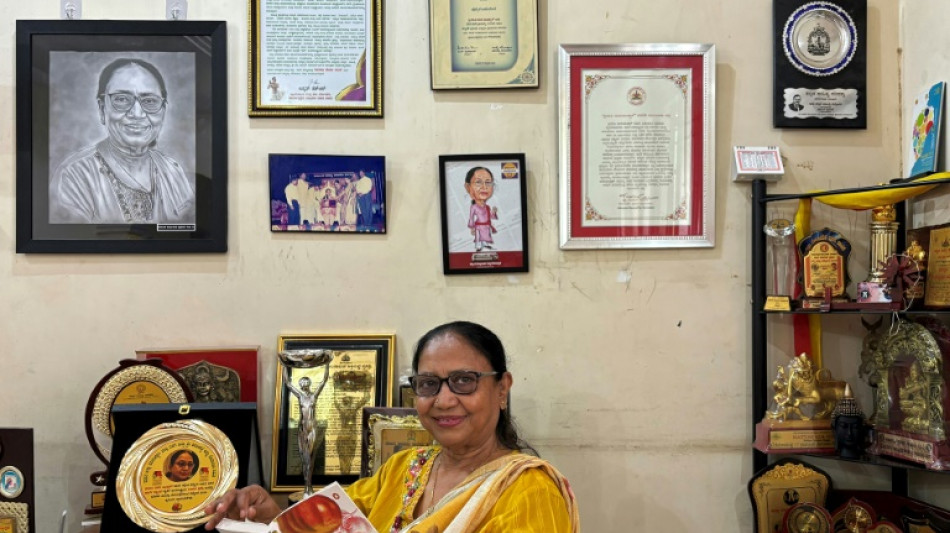
Petals and thorns: India's Booker prize author Banu Mushtaq / Photo: Aishwarya KUMAR - AFP

 McIntosh bounces back with 400m medley win at Pan Pacs

 Farage declares victory as count still underway in UK by-election

 Australia probes three near-misses at Sydney Airport

 Classy Tanzid puts Bangladesh in firm charge against Australia

 Schwarber smacks two homers to power Philles' MLB Field of Dreams win

 Pakistan's date workers toil through rising heat

 New trend of injecting banned peptides to 'optimise' body

 Eddie Jones senses Japan's time has come against Australia
 UK vote count under way in Farage, Binface showdown

 US, Mexico conduct security exercises near border

 Swiatek rolls past Rybakina for WTA Toronto title

 Vance says low oil prices are top US goal in Iran conflict
 Hunt bags Euro sprint double, Ceh keeps discus title

 'Dream come true': Owners reunite with pets in quake-hit Colombia

 US stocks gain after benign inflation data, oil prices retreat

 LeBron's Sixers in spotlight as full 2026-27 NBA schedule revealed

 Kennedy Center board votes to restore Trump name: reports

 Barcelona agree to sell Torres to PSG: media

 Romania shuts nuclear plant as Danube drops
 Millions of Europeans struggle with another wave of extreme heat
 Israel reopens once-closed West Bank settlement

 Taylor to captain New Zealand for first time against Bulls

 Carrick urges Man Utd to push for more signings to boost title bid

 'This was my World Cup' says Somali ref after UEFA Super Cup

 Survivors tell of horror of Zimbabwe ferry sinking as death toll hits 46

All writers draw on their experience, whether consciously or not, says Indian author Banu Mushtaq -- including the titular tale of attempted self-immolation in her International Booker Prize-winning short story collection.
Mushtaq, who won the coveted literature prize as the first author writing in Kannada -- an Indian regional language -- said the author's responsibility is to reflect the truth.
"You cannot simply write describing a rose," said the 77-year-old, who is also a lawyer and activist.
"You cannot say it has got such a fragrance, such petals, such colour. You have to write about the thorns also. It is your responsibility, and you have to do it."
Her book "Heart Lamp", a collection of 12 powerful short stories, is also her first book translated into English, with the prize shared with her translator Deepa Bhasthi.
Critics praised the collection for its dry and gentle humour, and its searing commentary on the patriarchy, caste and religion.
Mushtaq has carved an alternative path in life, challenging societal restrictions and perceptions.
As a young girl worried about her future, she said she started writing to improve her "chances of marriage".
Born into a Muslim family in 1948, she studied in Kannada, which is spoken mostly in India's southern Karnataka state by around 43 million people, rather than Urdu, the language of Islamic texts in India and which most Muslim girls learnt.
She attended college, and worked as a journalist and also as a high school teacher.
- 'Confused' -
But after marrying for love, Mushtaq found her life constricted.
"I was not allowed to have any intellectual activities. I was not allowed to write," she said.
"I was in that vacuum. That harmed me."
She recounted how as a young mother aged around 27 with possible postpartum depression, and ground down by domestic life, had doused petrol on herself and on the "spur of a moment" readied to set herself on fire.
Her husband rushed to her with their three-month-old daughter.
"He took the baby and put her on my feet, and he drew my attention to her and he hugged me, and he stopped me," Mushtaq told AFP.
The experience is nearly mirrored in her book -- in its case, the protagonist is stopped by her daughter.
"People get confused that it might be my life," the writer said.
Explaining that while not her exact story, "consciously or subconsciously, something of the author, it reflects in her or his writing".
Books line the walls in Mushtaq's home, in the small southern Indian town of Hassan.
Her many awards and certificates -- including a replica of the Booker prize she won in London in May -- are also on display.
She joked that she was born to write -- at least that is what a Hindu astrological birth chart said about her future.
"I don't know how it was there, but I have seen the birth chart," Mushtaq said with a laugh, speaking in English.
The award has changed her life "in a positive way", she added, while noting the fame has been a little overwhelming.
"I am not against the people, I love people," she said referring to the stream of visitors she gets to her home.
"But with this, a lot of prominence is given to me, and I don't have any time for writing. I feel something odd... Writing gives me a lot of pleasure, a lot of relief."
- 'Patriarchy everywhere' -
Mushtaq's body of work spans six short story collections, an essay collection and poetry.
The stories in "Heart Lamp" were chosen from the six short story collections, dating back to 1990.
The Booker jury hailed her characters -– from spirited grandmothers to bumbling religious clerics –- as "astonishing portraits of survival and resilience".
The stories portray Muslim women going through terrible experiences, including domestic violence, the death of children and extramarital affairs.
Mushtaq said that while the main characters in her books are all Muslim women, the issues are universal.
"They (women) suffer this type of suppression and this type of exploitation, this type of patriarchy everywhere," she said. "A woman is a woman, all over the world."
While accepting that even the people for whom she writes may not like her work, Mushtaq said she remained dedicated to providing wider truths.
"I have to say what is necessary for the society," she said.
"The writer is always pro-people... With the people, and for the people."
F.Ferraz--PC