The NFT artist who sold a trashcan image for $252,000

 Russian barrage on Kyiv kills 17 as Ukraine fails to down single missile
 'Lost': Migrants despair after Britain expels them back to France

 Cathay Pacific's profit soars 71% despite Iran war driving up fuel costs
 Russian barrage on Ukraine kills 15, wounds dozens more
 South Korea police raid Starbucks HQ over 'Tank Day' fiasco

 Tech back in fashion as Asian markets extend rebound

 Total eclipse gives scientists chance to probe Sun's mysteries
 What to know about the total solar eclipse on August 12
 'Like the end of the world': the eclipse chasers flocking to Spain
 Taiwan begins military drills as China pressure grows
 UK mansion where 'listeners' spied on Nazi generals becomes museum

 Sabalenka tops Uchijima in WTA Toronto opener
 Kgatlana strikes as South Africa reach WAFCON quarter-finals

 Pakistan close on series-levelling win against West Indies

 Paramount CEO says politics fueling Warner Bros. merger battle

 Trump's sale of access to Truth Social raises eyebrows
 SpaceX rocket stage expected to slam into Moon
 US hopeful Hormuz strait deal will be done 'today or tomorrow'

 Michigan primary puts Democratic divide on the ballot

 South Africa captain Kolisi to make Test return in Argentina
 Cuba's famed resilience comes at a growing mental cost
 Swiss Reusser wins Tour de France Femmes time-trial

 Hundreds flee homes after Guatemala's Fuego volcano erupts

 Thousands pay tribute to Italian football legend Baresi
 Oil drops, stocks hit records on hopes of Hormuz opening
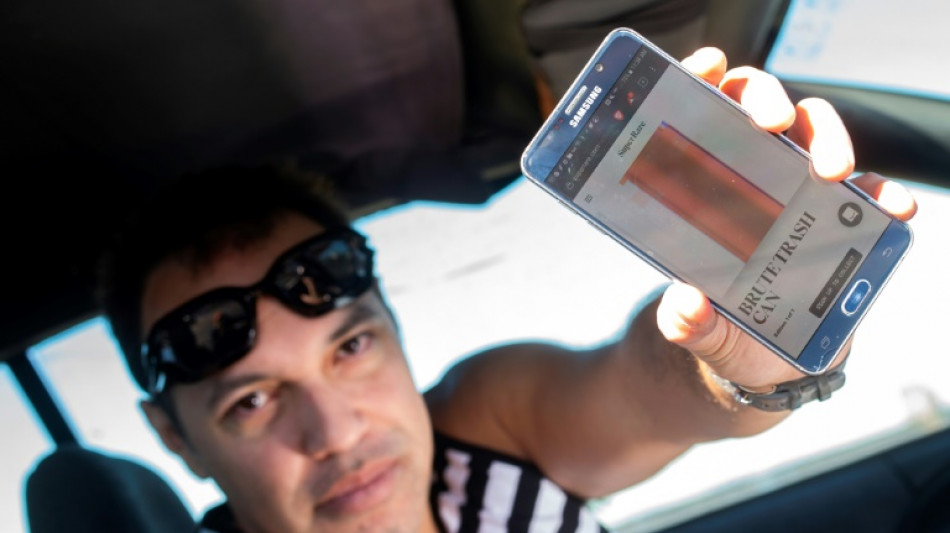
Marcel Duchamp scandalised the art world in 1917 by submitting a urinal as his entry to a prestigious competition. A century later, an American artist known as Robness sparked his own controversy by selling an NFT of a rubbish bin for $252,000.
"I can't even remember where the image came from, I think it was a Google image search," the 38-year-old Los Angeles native tells AFP.
NFTs are unique pieces of computer code stored on a longer chain of code known as a blockchain, with a link to an artwork or other item.
The image, called "64 gallon toter", depicts a large plastic trashcan with glitching effects, giving it a psychedelic appearance.
There is a lot of money to be made in the NFT art world -- auctions and purchases from celebrities contributed to sales worth more than $40 billion last year, according to analytics firm Chainalysis.
Like Duchamp's urinal, Robness's piece gained value as it gained notoriety -- NFT marketplace SuperRare removed the image shortly after he created it.
"It was kind of like rage art, I was angry about some things," he says. "So I put that up, and it was removed. They thought I was taking Home Depot's picture and breaking copyright.
"They threatened me legally," he says with a laugh.
But then, out of the blue, the platform reinstated his work.
SuperRare told AFP in an email that "the community didn't consider it as art", but reinstated it after two years because "so much has evolved" in the discussions around what can legitimately be called art.
- 'Disruptive element' -
The bin had become a meme and inspired thousands of tributes and copycats, and collectors were showing an interest.
"It was one of three trashcans that were in SuperRare and I sold it to a collector," Robness says.
"He called me up because he wanted to know more about the story and we spoke for about 30-45 minutes, and the whole hilarious story and he was laughing most of the time.
"So he wanted to collect it, so I gave him a price and that was that."
Robness -- who only goes by that name -- says he was doing odd jobs and sleeping in his car by the beach when he started exploring the world of cryptocurrencies in 2014.
He gradually became hooked on the technology -- "just the disruptive element of it to be honest" -- and began making NFTs.
The bin controversy and his prolific output -- he recently posted NFTs of a job application he made to McDonald's -- have garnered plenty of fans, his Twitter following breaking the 30,000 barrier.
And he sells enough to make a living.
"Per month, it's a lot better than my job I had as a barista," he jokes.
He now champions "open-source artistry" where he says anyone should be able to grab any image and do what they like with it.
"You can literally steal anything I made, copy and paste it, I don't care," he says.
F.Santana--PC