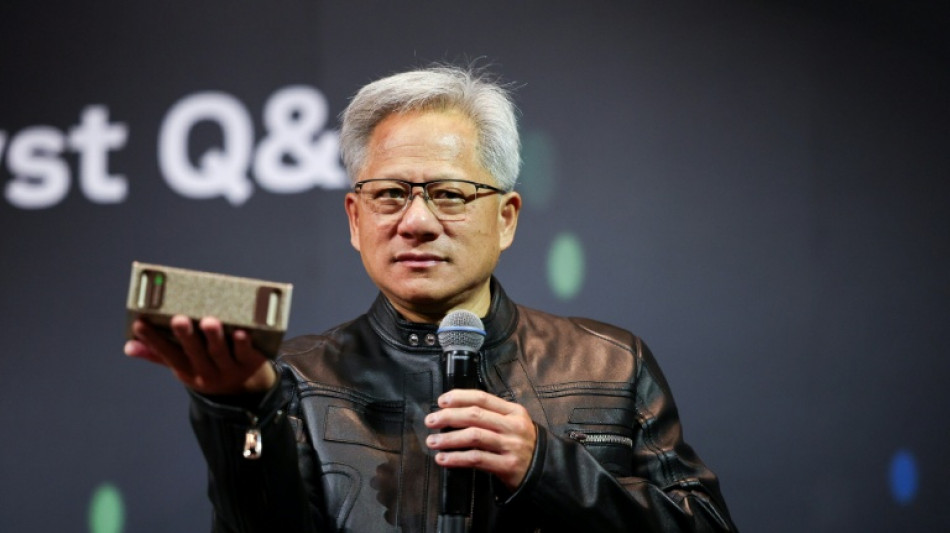
Nvidia says it will resume sales of 'H20' AI chips to China / Photo: I-Hwa Cheng - AFP/File

 Best Pet Advent Calendars for Christmas 2026: Dog Treats and Cat Toys

 Grattan Institute Releases Blueprint to Target Specialists Over Excessive Fees

 Arizona Science Center Hosts Girls in STEM Astro Adventures for Students

 New Turkish Cafe, Japanese BBQ, and Korean Restaurants Open Across East Bay

 Knowle Move Four Points Clear at Top After Histon Victory

 Physicians Urge Arizona to Ban Medical Gag Clauses and Enable Private Lawsuits

 New Campaign Highlights Knowledge Gaps on Carbon Monoxide Safety Among Americans
US tech giant Nvidia said on Tuesday it will resume sales of its H20 artificial intelligence chips to China, after Washington pledged to remove licensing curbs that had put a stop to exports.
The California-based firm produces some of the world's most advanced semiconductors but is not allowed to ship its most cutting-edge chips to China owing to concerns that Beijing could use them to boost its military capabilities.
It developed the H20 -- a less powerful version of its AI processing units -- specifically for export to China, although that plan hit the skids when the Trump administration firmed up export licence requirements in April.
The company said in a statement on Tuesday that it was "filing applications to sell the Nvidia H20 GPU again".
"The US government has assured Nvidia that licences will be granted, and Nvidia hopes to start deliveries soon," the statement said.
Nvidia CEO Jensen Huang said in a video published by Chinese state broadcaster CCTV on Tuesday "the US government has approved for us (to file) licences to start shipping H20s, and so we will start to sell H20s to the Chinese market".
"I'm looking forward to shipping H20s very soon, and so I'm very happy with that very, very good news," Huang, wearing his trademark black leather jacket, told a group of reporters.
CCTV said in a separate report that Huang would attend a major supply chain gathering on Wednesday.
The Taiwan-born executive "will be present at the opening ceremony of the 3rd China International Supply Chain Expo on July 16 and will participate in related activities", the broadcaster said.
It cited the China Council for the Promotion of International Trade, an official body controlled by Beijing's commerce ministry.
It will be Huang's third trip to China this year, according to CCTV.
- 'Positive role' -
China is a crucial market for Nvidia but in recent years the US export squeeze has left it battling tougher competition from local players such as homegrown champion Huawei.
Beijing has decried Washington's curbs as unfair and designed to hinder its development.
Huang, an electrical engineer, told Chinese Vice Premier He Lifeng on a visit to Beijing in April that he "looked favourably upon the potential of the Chinese economy", according to state news agency Xinhua.
He said he was "willing to continue to plough deeply into the Chinese market and play a positive role in promoting US-China trade cooperation", Xinhua reported.
The tightened US export curbs have come as China's economy wavers, with domestic consumers reluctant to spend and a prolonged property sector crisis weighing on growth.
President Xi Jinping has called for China to become more self-reliant as uncertainty in the external environment increases.
The Financial Times reported in May that Nvidia was planning to build a research and development centre in Shanghai. Neither Nvidia nor the city's authorities confirmed the project to AFP at the time.
China's economy grew 5.2 percent in the second quarter of the year, official data showed on Tuesday, after analysts predicted strong exports despite trade war pressures.
G.Machado--PC

