AI helps Latin scholars decipher ancient Roman texts / Photo: Andreas SOLARO - AFP/File

 US ambassador denounces settler siege as Israel dispatches troops
 Hasan takes 6-55 as Bangladesh claim opening day of Australia Test

 Taiwan says AI agents used in cyberattacks targeting island

 Japan protests Putin's first visit to disputed islands

 Kiss wants fit-again Wallabies playmaker Gordon to 'open up' Japan

 British eccentrics push humble garden shed to new heights

 Zambia votes with president's economic record on the line

 Germany's dry rivers spark battle on engineering vs restoration

 Senators demand inquiry into conditions aboard USS Abraham Lincoln
 All Blacks' Proctor out of South Africa series, Mo'unga called up

 Bangladesh quick Hasan reduces Australia to 74-4 at lunch

 Seoul tech leads Asian stock gains as traders cheer US inflation

 Farage and Count Binface go head-to-head in snap UK poll

 Afghan students divided over smartphone ban at universities

 Japan go back to school for second Australia Test
 Matthew McConaughey on his sweet return to the big screen

 President's economic record on the line as Zambia votes

 Grieving Messi available for Miami in Leagues Cup clash

 Colombia enters 'final phase' of quake search as toll hits 265

 Father-figure Christie helps guide Kounta to European silver

 McIlroy returns to St. Jude to launch marathon PGA playoff push

 Guimaraes makes Arsenal debut in Como friendly

 Travis Kelce says wedding to Taylor Swift was 'best night of my life'

 US stocks mostly up after data shows slightly lower inflation in July

 Caracas protest denounces secrecy of Venezuela transition talks

Around 1,500 Latin inscriptions are discovered every year, offering an invaluable view into the daily life of ancient Romans -- and posing a daunting challenge for the historians tasked with interpreting them.
But a new artificial intelligence tool, partly developed by Google researchers, can now help Latin scholars piece together these puzzles from the past, according to a study published on Wednesday.
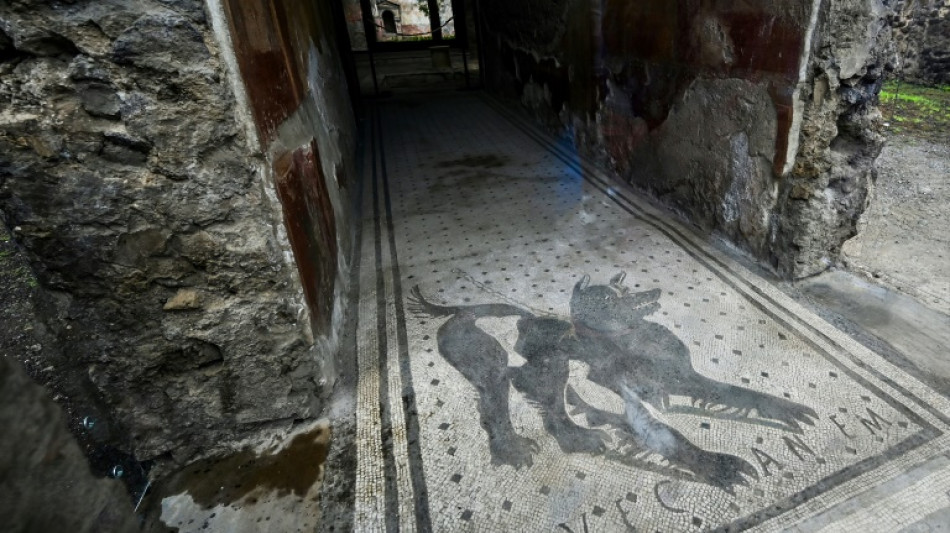
Inscriptions in Latin were commonplace across the Roman world, from laying out the decrees of emperors to graffiti on the city streets. One mosaic outside a home in the ancient city of Pompeii even warns: "Beware of the dog".
These inscriptions are "so precious to historians because they offer first-hand evidence of ancient thought, language, society and history", said study co-author Yannis Assael, a researcher at Google's AI lab DeepMind.
"What makes them unique is that they are written by the ancient people themselves across all social classes on any subject. It's not just history written by the elite," Assael, who co-designed the AI model, told a press conference.
However these texts have often been damaged over the millennia.
"We usually don't know where and when they were written," Assael said.
So the researchers created a generative neural network, which is an AI tool that can be trained to identify complex relationships between types of data.
They named their model Aeneas, after the Trojan hero and son of the Greek goddess Aphrodite.
It was trained on data about the dates, locations and meanings of Latin transcriptions from an empire that spanned five million square kilometres over two millennia.
Thea Sommerschield, an epigrapher at the University of Nottingham who co-designed the AI model, said that "studying history through inscriptions is like solving a gigantic jigsaw puzzle".
"You can't solve the puzzle with a single isolated piece, even though you know information like its colour or its shape," she explained.
"To solve the puzzle, you need to use that information to find the pieces that connect to it."
- Tested on Augustus -
This can be a huge job.
Latin scholars have to compare inscriptions against "potentially hundreds of parallels", a task which "demands extraordinary erudition" and "laborious manual searches" through massive library and museum collections, the study in the journal Nature said.
The researchers trained their model on 176,861 inscriptions -- worth up to 16 million characters -- five percent of which contained images.
It can now estimate the location of an inscription among the 62 Roman provinces, offer a decade when it was produced and even guess what missing sections might have contained, they said.
To test their model, the team asked Aeneas to analyse a famous inscription called "Res Gestae Divi Augusti", in which Rome's first emperor Augustus detailed his accomplishments.
Debate still rages between historians about when exactly the text was written.
Though the text is riddled with exaggerations, irrelevant dates and erroneous geographical references, the researchers said that Aeneas was able to use subtle clues such as archaic spelling to land on two possible dates -- the two being debated between historians.
More than 20 historians who tried out the model found it provided a useful starting point in 90 percent of cases, according to DeepMind.
The best results came when historians used the AI model together with their skills as researchers, rather than relying solely on one or the other, the study said.
"Since their breakthrough, generative neural networks have seemed at odds with educational goals, with fears that relying on AI hinders critical thinking rather than enhances knowledge," said study co-author Robbe Wulgaert, a Belgian AI researcher.
"By developing Aeneas, we demonstrate how this technology can meaningfully support the humanities by addressing concrete challenges historians face."
M.Carneiro--PC